
By Al Miraq News Desk
Published: August 21, 2026
Pakistan’s political, security and economic landscape remains active, with several important developments emerging across the country. From Field Marshal Syed Asim Munir’s meeting with prominent personalities and political leadership from Balochistan to the latest developments concerning Pakistan Tehreek-e-Insaf founder Imran Khan, the day has brought a number of significant stories.
According to the information provided, Field Marshal Syed Asim Munir held an important interaction with prominent personalities and political leadership from Balochistan, where discussions focused on peace, stability, economic development and the province’s future. He emphasized that Balochistan and Pakistan share a common present and future and stressed the importance of empowering young people and creating opportunities for sustainable development.
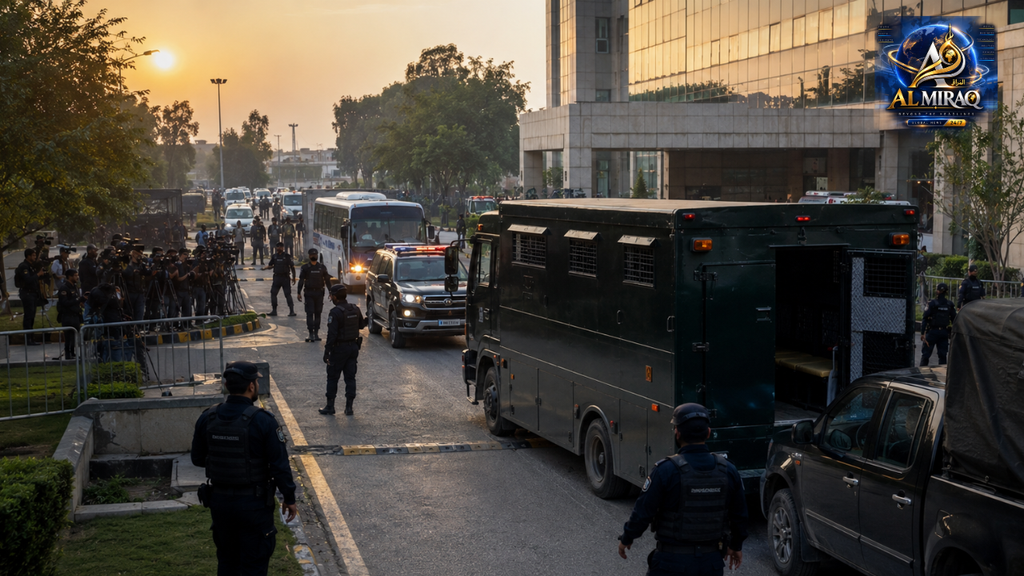
Meanwhile, PTI founder Imran Khan was reportedly transferred back to Adiala Jail after being taken to Shifa Hospital under tight security. The development has renewed attention on his health and the conditions surrounding his detention.
Pakistan’s political environment also witnessed movement as Prime Minister Shehbaz Sharif again invited the opposition to negotiations. PTI welcomed the offer but called for practical steps beyond a verbal invitation. At the same time, opposition leaders Maulana Fazlur Rehman and Mahmood Khan Achakzai discussed the possibility of establishing a united opposition platform.
Other major developments include the introduction of a biometric and facial verification system for pensioners, parliamentary approval of amendments related to defence legislation, an increase in petroleum prices and continuing Jamaat-e-Islami protests against fuel prices and petroleum levies.
Asim Munir Highlights Peace and Development in Balochistan
One of the major developments in today’s Pakistan news is the meeting between Field Marshal Syed Asim Munir and prominent personalities and political representatives from Balochistan.
During the interaction, the Field Marshal emphasized the importance of Balochistan for Pakistan’s present and future. He described the province as being rich in capable, patriotic and dignified people and highlighted the need to create an environment where its people can contribute to long-term national development.
According to the supplied report, Asim Munir stressed that sustainable peace and stability in Balochistan are fundamental to economic progress.
The message places peace and economic development closely together. A stable environment is considered essential for attracting investment, improving economic opportunities and supporting the prosperity of ordinary citizens.
Focus on Balochistan’s Youth
The role of young people was another important part of the discussion.
Field Marshal Asim Munir said that Balochistan’s youth possess considerable capabilities and that there is no shortage of potential among young people in the province. However, providing them with opportunities and empowering them is necessary for sustainable development.
Youth empowerment is particularly important in a province where economic opportunities, education, employment and development remain central public concerns.
The emphasis on creating opportunities suggests that long-term stability cannot depend only on security measures. Economic participation and opportunities for young people are also important elements of development.
Security Concerns and Allegations of Foreign Proxies
Security was another major subject discussed during the meeting.
According to the source material, Field Marshal Asim Munir stated that militant and hostile elements, along with foreign proxies, were attempting to destabilize Balochistan and prevent the province from progressing.
He said that the state would respond strongly to attempts aimed at undermining stability and development.
The remarks also emphasized the need to counter what was described as negative propaganda against Pakistan and Balochistan.
The broader message was that Balochistan’s actual development and potential should be highlighted while attempts to create instability should be confronted.
At the same time, the Field Marshal praised the role of important personalities, political representatives and social leaders in the province.
Call for a Positive Narrative About Balochistan
Another significant point was the importance of presenting Balochistan’s development and potential to the wider public.
According to the supplied material, Asim Munir emphasized that Balochistan’s true potential and development should be highlighted.
The province has substantial human and natural resources, and improving its economic prospects remains an important national issue.
The discussion also included the commitment of representatives from Balochistan to work for peace, development and prosperity while standing alongside the state and armed forces against external security threats.
The message presented during the meeting was that the future of Balochistan ultimately depends on its people and their ability to participate in development.
Asim Munir Meets Syrian Foreign Minister
Another important diplomatic and security-related development was the meeting between Field Marshal Syed Asim Munir and Syrian Foreign Minister Asaad Hassan Al-Shibani.
The meeting reportedly covered the regional security situation and matters of mutual interest.
During the discussion, Asim Munir described Pakistan’s relationship with Syria as longstanding and fraternal. He emphasized the importance of cooperation and joint efforts for regional and global peace and stability.
The discussion also focused on cooperation to address common security challenges.
The Syrian Foreign Minister, according to the supplied report, appreciated the professional role of the Pakistan Army in promoting regional stability and expressed interest in strengthening bilateral relations between Pakistan and Syria.
Both sides agreed on the importance of expanding cooperation in defence and security-related areas.
Imran Khan Transferred Back to Adiala Jail
In another major Pakistan news development, PTI founder and former Prime Minister Imran Khan was reportedly transferred from Shifa Hospital back to Adiala Jail.
According to the supplied information, Imran Khan had been taken to the hospital under tight security late at night and was subsequently moved back to Adiala Jail in the early morning.
He was reportedly shifted back to his cell at the prison.
The development comes amid continuing discussion about his health and medical condition.
Concerns Over Imran Khan’s Health
The source material also includes claims from people close to Imran Khan’s political circle regarding concerns over his health.
Maryam Watoo, speaking about the situation, questioned whether those describing his health condition as not particularly serious had experienced prolonged solitary confinement themselves.
She argued that nine months of solitary confinement could create significant psychological and physical pressure.
The report also contains claims that several vital organs have been affected and that Imran Khan had developed a clot in his eye.
These claims are presented in the supplied source as statements by people discussing his condition. They should therefore be distinguished from independently verified medical findings unless an official medical report confirms them.
The issue remains politically sensitive because Imran Khan continues to be one of Pakistan’s most prominent political figures.
Shehbaz Sharif Again Offers Talks to Opposition
Pakistan’s political situation also saw another development as Prime Minister Shehbaz Sharif reportedly invited the opposition to negotiations.
Speaking during a federal cabinet meeting, the Prime Minister said the government was ready to sit down with the opposition and discuss political issues.
The offer reflects continuing calls for political dialogue at a time when tensions between the government and opposition remain significant.
Shehbaz Sharif emphasized that negotiations require participation from both sides, suggesting that the government was prepared to begin discussions if the opposition came to the negotiating table.
PTI Welcomes Dialogue Offer
The Pakistan Tehreek-e-Insaf leadership welcomed the Prime Minister’s offer but called for concrete action.
PTI Chairman Barrister Gohar reportedly said the Prime Minister should move beyond a verbal offer and take practical steps toward negotiations.
He argued that political problems should have political solutions and that dialogue could help resolve outstanding political disputes.
The PTI position suggests that while the party is receptive to negotiations, it wants the government to demonstrate seriousness through practical measures.
Opposition Parties Discuss United Platform
Another significant political development was a meeting between opposition leader Mahmood Khan Achakzai and Maulana Fazlur Rehman.
According to the supplied report, the two leaders discussed moving toward a united opposition platform.
Maulana Fazlur Rehman said there had been agreement on moving toward a joint opposition and playing a coordinated parliamentary role.
He also indicated that further consultations and meetings would take place.
The proposed united opposition could become an important development in Pakistan’s parliamentary politics if different opposition parties succeed in coordinating their positions.
However, the final structure and participation of different political parties will depend on future consultations.
New Digital System for Pensioners
Pakistan’s government has also announced a technological initiative aimed at making pension payments easier for senior citizens and persons with disabilities.
Prime Minister Shehbaz Sharif reportedly launched a proof-of-life certification system for pensioners using biometric and facial verification technology.
The objective is to reduce the need for pensioners to repeatedly visit banks.
The Prime Minister described the use of biometric and facial verification as a service that could make life easier for elderly citizens and people with disabilities.
Technology Aimed at Reducing Bank Visits
Under the new approach, pensioners could potentially complete verification through facial recognition rather than repeatedly travelling to banks.
The initiative is being presented as part of Pakistan’s broader digital transformation.
Finance Minister Muhammad Aurangzeb reportedly emphasized that technology could improve transparency in the pension system.
For millions of pensioners, reducing unnecessary travel and paperwork could represent a major improvement in accessing pension services.
The initiative also reflects the government’s stated focus on using technology to make public services more convenient.
Senate Approves Defence-Related Legislation
Pakistan’s Parliament also witnessed developments related to defence legislation.
According to the supplied report, after approval by the National Assembly, the Senate also passed bills concerning amendments to the Defence Forces Act 2026 and the National Command Authority Act 2010.
The bills were introduced in the National Assembly by Defence Minister Khawaja Asif.
The parliamentary developments come amid broader discussions concerning Pakistan’s defence and national security framework.
Petrol Prices Increased Again
Economic pressure on ordinary citizens remains another major part of Pakistan news.
The federal government reportedly increased petroleum prices again, with a notification issued regarding the new rates.
According to the supplied material, petrol increased by Rs27 per litre, bringing its price to Rs337.78 per litre.
The price of high-speed diesel also increased by Rs1.64 per litre, reaching Rs364.70 per litre.
The latest increase is likely to have wider economic implications because fuel prices directly affect transportation and indirectly influence the cost of goods and services.
Higher petroleum prices can increase transportation expenses, which may then contribute to higher prices for food, household items and other essential products.
Jamaat-e-Islami Continues Protest Over Fuel Prices
Jamaat-e-Islami has continued its protests against rising petroleum prices and the petroleum levy.
The party’s protest in Lahore reportedly entered its sixth day, with demonstrators demanding relief for ordinary citizens.
Jamaat-e-Islami leader Hafiz Naeem ur Rehman addressed protesters in Lahore and called for a reduction in petrol prices and an end to what he described as excessive petroleum levies.
He said the party was prepared for a prolonged struggle and would continue its campaign until its demands were addressed.
Protest Also Continues in Karachi
Jamaat-e-Islami’s protest against fuel prices also continued in Karachi.
According to the supplied report, party workers were gathered near Governor House, where the demonstration had also entered its sixth day.
Roads around the Governor House were reportedly blocked with containers, while additional police personnel were deployed in the surrounding area.
Authorities were also monitoring traffic conditions to minimize disruption to the movement of vehicles.
The continuing protests demonstrate the political sensitivity surrounding rising fuel prices and the financial pressure faced by households.
Why These Developments Matter
The latest developments show that Pakistan is simultaneously dealing with several interconnected challenges.
Security and development remain major issues in Balochistan, while political tensions continue between the government and opposition parties.
At the same time, the health and legal situation surrounding Imran Khan remains a major subject of public and political discussion.
Economic pressures are also visible through rising petroleum prices and protests against fuel costs.
Meanwhile, the government is attempting to use technology to modernize public services, particularly through digital verification for pensioners.
Together, these developments highlight the complex political, economic and security environment facing Pakistan.
What to Watch Next
Several developments could remain important in the coming days.
The proposed united opposition platform involving different political leaders could also influence parliamentary politics.
Fuel prices will also remain a major concern for households and businesses, particularly if further changes occur.
Al Miraq — Beyond the Headlines.