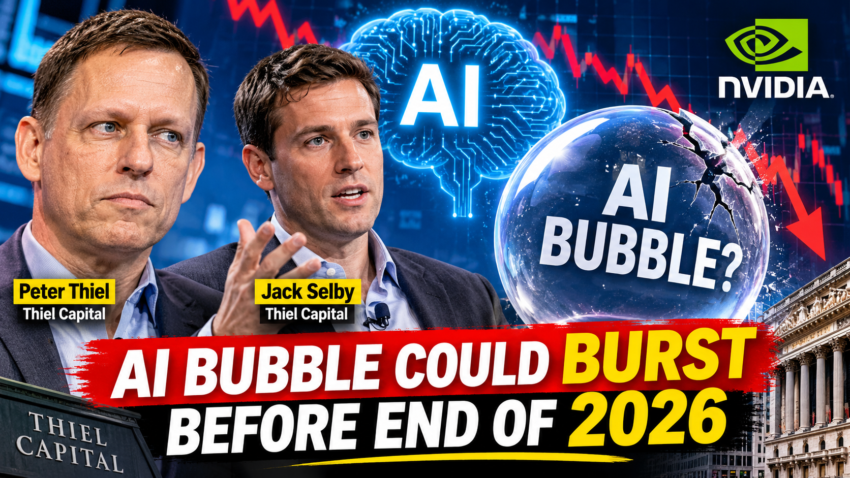
The artificial intelligence boom has become one of the biggest investment stories of the decade, attracting billions of dollars from technology companies, venture capital firms, and institutional investors. However, growing concerns about high valuations, expensive infrastructure, and increasing debt are raising questions about whether the AI industry is heading toward a financial correction.
Jack Selby, a senior executive at Peter Thiel’s investment firm Thiel Capital, has delivered a serious warning about the future of the artificial intelligence market. Speaking at the SALT London conference on November 5, 2026, Selby suggested that the current AI investment boom could be a speculative bubble that bursts before the end of the year.
His comments have attracted attention across financial markets because they come from someone closely connected to one of Silicon Valley’s most influential investors. Selby’s warning also arrives as several AI infrastructure companies face falling share prices and rising borrowing costs.
The central question for investors is whether artificial intelligence companies can generate enough revenue to justify the enormous amount of money being invested in the technology.
Who Is Jack Selby and Why Is His AI Warning Important?
Jack Selby is a managing director at Thiel Capital and managing partner of Copper Sky Capital. He has long been associated with billionaire investor Peter Thiel and has experience in the technology and investment industries.
Peter Thiel is widely recognized for his early involvement in major technology businesses and his investments in innovative companies. His investment network has played an important role in shaping discussions around technology, financial markets, and emerging industries.
Selby’s comments are particularly important because he is not simply questioning whether artificial intelligence is useful. Instead, he is raising concerns about the financial structure supporting the current AI expansion.
At the SALT London conference, Selby argued that the AI industry requires extraordinary amounts of capital to develop and operate. Modern AI systems depend on expensive semiconductor chips, advanced computing equipment, large data centers, electricity, cooling infrastructure, and highly specialized technical teams.
He also questioned the stories and expectations being used by some companies to attract additional investment. According to his assessment, the enthusiasm surrounding AI may have encouraged investors to overlook the financial risks associated with building the infrastructure required to support the technology.
His warning suggests that the current investment momentum could eventually slow down if investors begin demanding stronger evidence of profitability.
Why Selby Believes the AI Market Could Be a Bubble
The AI industry has experienced extraordinary growth as businesses increasingly adopt artificial intelligence tools for automation, software development, customer service, research, and data analysis.
Companies developing advanced AI models have attracted enormous investment because investors believe these technologies could transform almost every major industry.
However, rapid growth does not necessarily mean that every company involved in the sector will become profitable.
One of the biggest concerns is the difference between the amount of money being invested in AI and the revenue companies are currently generating from their products and services.
Building advanced AI systems requires substantial financial resources. Technology companies must purchase powerful processors, establish data centers, secure electricity supplies, and continuously upgrade their computing infrastructure.
These expenses can become difficult to manage when revenue growth fails to match expectations.
Selby believes the industry may be relying too heavily on investor enthusiasm and debt financing. If lenders become less willing to finance expensive AI projects, companies could face significant financial pressure.
He also warned that the market’s euphoric momentum might not last much longer, suggesting that the investment cycle could end before January 2027.
Importantly, his prediction is a warning rather than a confirmed forecast. There is no guarantee that the AI market will collapse within that timeframe.
Rising Costs of AI Infrastructure Create Financial Pressure
One of the strongest arguments behind concerns about an AI bubble is the enormous cost of building the infrastructure needed to support artificial intelligence.
AI models require advanced computing systems capable of processing massive amounts of information. These systems depend on specialized chips, powerful servers, high-speed networking equipment, and sophisticated cooling technologies.
Data centers have consequently become essential to the AI economy.
Major technology companies and specialized infrastructure providers are spending billions of dollars to expand their computing capacity. Although these investments may create long-term opportunities, they also introduce significant financial risks.
For example, companies that borrow heavily to construct data centers must generate enough income to cover interest payments, operating expenses, and future infrastructure investments.
If demand for AI computing services grows more slowly than expected, these companies could struggle to maintain their financial commitments.
Another challenge is electricity consumption. Large data centers require substantial amounts of power, making access to affordable and reliable electricity increasingly important.
Companies may also encounter construction delays, regulatory restrictions, equipment shortages, and rising operating costs.
These challenges could reduce expected profits and force investors to reconsider the valuations of AI infrastructure businesses.
AI Infrastructure Stocks Face a Major Market Test
Selby’s warning came during a difficult period for several companies involved in AI infrastructure development.
According to the original Crypto Briefing report, shares of CoreWeave, Nebius, and IREN had each declined by more than 30% during the preceding month.
These companies operate in areas connected to the growing demand for AI computing capacity, making them particularly sensitive to changes in investor expectations.
CoreWeave has attracted considerable attention because of its role in providing cloud computing infrastructure for artificial intelligence workloads. Its business depends on demand for computing resources and the ability to finance large infrastructure investments.
Nebius is another company seeking to benefit from the expansion of AI-focused cloud infrastructure. Its growth prospects are closely connected to demand for advanced computing services.
IREN has also attracted investor interest through its infrastructure and computing operations as the market increasingly focuses on the resources required to support AI development.
Falling share prices do not automatically mean that these companies are experiencing business failures. Stock markets often react to changing expectations about future growth, interest rates, competition, and profitability.
Nevertheless, a sharp decline in infrastructure stocks can indicate that investors are becoming more cautious about the financial assumptions supporting the AI boom.
For companies that depend on external financing, declining investor confidence can make future expansion more expensive.
Rising Bond Yields Raise Questions About AI Debt
Another important development highlighted in the report involves the debt market.
Some debt associated with CoreWeave was reportedly trading at yields of approximately 15% to 16%. Such elevated yields indicate that investors are demanding substantial compensation for the risks associated with holding those bonds.
Bond yields can increase when investors become concerned about a company’s ability to repay its debt or when they believe the financial risks have increased.
For businesses investing heavily in data centers and computing equipment, higher borrowing costs can create additional pressure.
A company that previously expected to finance infrastructure expansion at relatively affordable rates may need to reconsider its investment plans when lenders demand significantly higher returns.
This creates a potentially difficult situation for AI infrastructure providers.
They need additional capital to expand their operations, but obtaining that capital becomes more expensive when financial markets lose confidence.
If borrowing costs continue increasing, some businesses may delay construction projects, reduce spending, or search for alternative sources of funding.
The broader concern is that the AI industry could experience a financial slowdown even while demand for artificial intelligence technology remains strong.
Peter Thiel’s Investment Decisions Add to the Debate
Investors are also examining Peter Thiel’s historical exposure to major AI-related companies.
The original report highlighted disclosures showing that a Thiel-linked investment fund exited its Nvidia position, previously valued at approximately $100 million, during the third quarter of 2025.
Nvidia is one of the most important companies in the artificial intelligence industry because its advanced processors are widely used to train and operate sophisticated AI models.
Its growth has become closely associated with the expansion of AI infrastructure worldwide.
The reported investment decision has attracted attention because it raises questions about how some experienced investors view the long-term valuation of leading AI companies.
However, an investment decision should not automatically be interpreted as proof that a company or industry is about to collapse.
Funds regularly change their portfolios for different reasons, including risk management, valuation concerns, diversification, and changing investment strategies.
Still, the combination of Selby’s public warning and previously reported portfolio changes has encouraged investors to examine whether the AI market has become too dependent on optimistic growth expectations.
Anthropic’s Financial Position Raises More Questions
Another major company mentioned during the discussion was Anthropic , the developer of the Claude AI assistant.
Selby questioned why Anthropic was seeking public-market financing despite holding substantial financial resources.
According to figures discussed in connection with the company’s revised financial disclosures, Anthropic generated approximately $2.4 billion in interest income during the first nine months of 2026, while reporting an operating loss of approximately $1.3 billion over the same period. The company reportedly held around $96 billion in cash and cash equivalents at the end of September.
These figures attracted attention because they highlight an important distinction between financial resources and operating profitability.
A technology company can hold significant cash reserves while still spending more money on its core operations than it generates through revenue.
Selby’s criticism raises questions about the financial sustainability of companies seeking enormous valuations while continuing to invest heavily in research, computing infrastructure, and product development.
However, interest income can provide meaningful financial support, and operating losses are not unusual for rapidly expanding technology companies.
The bigger issue for investors is whether companies such as Anthropic can eventually build sustainable business models that generate sufficient operating revenue.
Is Artificial Intelligence Really Facing Another Dot-Com Bubble?
Comparisons between the current AI boom and the dot-com bubble of the late 1990s have become increasingly common.
During the dot-com era, investors poured money into internet-related businesses because they believed online technology would transform the global economy.
Many companies attracted extraordinary valuations despite having limited revenue, weak business models, or no clear path toward profitability.
When investor confidence collapsed, numerous internet companies failed, and technology stocks experienced substantial declines.
The current AI market shares some similarities with that period.
Both investment cycles involve revolutionary technologies, ambitious growth expectations, intense competition, and substantial investor enthusiasm.
However, there are also important differences.
Today’s AI industry includes some of the world’s largest and most financially powerful technology companies. Businesses such as Microsoft, Alphabet, Amazon, and Nvidia have established operations, significant customer bases, and substantial financial resources.
These companies are not entirely dependent on speculative investment to survive.
Nevertheless, smaller AI startups and infrastructure providers may face much greater financial pressure if funding becomes unavailable.
Another major difference is the scale of physical infrastructure involved. AI development requires expensive data centers, semiconductor manufacturing capacity, electricity, and advanced networking systems.
This means a potential correction could affect not only technology stocks but also companies involved in construction, energy, semiconductor production, and equipment manufacturing.
The Financial Times has also highlighted concerns about elevated valuations, uncertain revenue prospects, debt exposure, and complex financing arrangements across the AI industry. Financial Times+1
Why Other Financial Experts Are Also Concerned
Selby is not the only prominent financial figure expressing concerns about the sustainability of AI investment.
Executives and market participants from major financial institutions have increasingly questioned whether the enormous spending on artificial intelligence will produce adequate returns.
The growing concern centers on three important issues.
First, AI infrastructure requires substantial upfront investment. Companies must spend billions before they can fully benefit from new computing facilities.
Second, investors want stronger evidence that customers are willing to pay enough for AI services to support these costs.
Third, increasing reliance on borrowing could make the sector vulnerable to higher interest rates and changing credit conditions.
The November 2026 discussion at SALT London also included concerns about AI-related debt, employment changes, and the broader economic consequences of artificial intelligence.
Some investors remain optimistic about the long-term opportunities, particularly in data centers, electricity infrastructure, and cybersecurity. Others believe current valuations have moved too far ahead of realistic business performance. Business Insider+1
This disagreement demonstrates that the AI market is entering a period in which investors may become more selective about the companies they support.
Could an AI Bubble Burst Before January 2027?
Selby’s prediction that the AI bubble could burst before the end of 2026 has created an important discussion about the market’s immediate future.
With November already underway, investors have relatively little time to determine whether his warning will prove accurate.
Several developments could influence the direction of the market during the remaining weeks of the year.
One major factor will be the financial performance of AI infrastructure companies. If these businesses demonstrate stronger revenue growth and improving profitability, investors may regain confidence.
However, disappointing financial results could increase concerns about excessive spending and unrealistic valuations.
Another important factor will be the availability of financing. Companies relying on debt to expand data centers could face serious challenges if lenders become more cautious.
Interest rates and broader economic conditions will also play an important role.
If borrowing costs remain elevated, expensive infrastructure projects may become less attractive.
Political developments could create additional uncertainty. Recent opposition to data-center construction and concerns about electricity consumption have demonstrated that AI expansion also depends on public support and regulatory decisions.
Recent market reporting has highlighted how political opposition, infrastructure limitations, and concerns about valuations are influencing investor expectations. Le Monde.fr+1
What an AI Market Crash Could Mean for Technology Companies
A significant correction in AI-related stocks could affect companies across the technology industry.
Semiconductor manufacturers could experience declining demand if cloud providers and data-center developers reduce their spending.
Companies supplying servers, networking equipment, cooling systems, and power infrastructure could also face slower growth.
Startups that depend on venture capital may encounter even greater difficulties.
During periods of strong investor confidence, emerging companies can often secure funding based on ambitious future projections. However, when market sentiment changes, investors generally become more interested in immediate revenue, cash flow, and profitability.
This shift could make it harder for smaller AI companies to compete with established technology giants.
At the same time, a market correction could create opportunities for financially strong businesses to acquire valuable technology, hire experienced employees, and purchase infrastructure at more attractive prices.
Therefore, a potential AI bubble burst would not necessarily destroy the artificial intelligence industry.
Instead, it could change which companies receive funding and determine which business models remain financially sustainable.
Why the Long-Term Future of AI Could Still Be Strong
Despite growing concerns about market valuations, artificial intelligence continues to offer significant technological and economic opportunities.
AI tools are already being used in healthcare research, financial services, education, manufacturing, software development, customer support, and scientific discovery.
Businesses are increasingly exploring ways to use AI to improve productivity, automate repetitive tasks, and reduce operating costs.
These applications could create substantial long-term demand for artificial intelligence products and services.
However, the success of the technology does not guarantee that every AI company will become profitable.
This distinction is essential for understanding Selby’s warning.
The internet transformed communication, shopping, entertainment, and business operations, but many internet companies from the dot-com era disappeared because they could not establish sustainable business models.
Artificial intelligence could follow a similar pattern.
The technology may continue improving even if some of the companies receiving the largest investments today fail to meet expectations.
For long-term investors, identifying businesses with strong competitive advantages, reliable customers, sustainable revenue, and responsible financial management may become increasingly important.
What Investors Should Watch Before the End of 2026
Investors following the AI market should pay attention to several important developments over the coming weeks.
AI infrastructure spending: Major technology companies’ spending plans will provide important clues about future demand for computing capacity and data centers.
Debt market conditions: Rising bond yields could make expansion more expensive for infrastructure companies and increase financial pressure.
Revenue growth: Investors should examine whether AI companies are converting technological popularity into recurring customer revenue.
Semiconductor demand: Chip manufacturers’ financial results could indicate whether demand for AI processors remains strong.
Data-center construction: Electricity availability, regulatory approvals, and community opposition could influence infrastructure development.
Company valuations: Businesses with extremely high valuations may become vulnerable if their growth expectations are revised downward.
These indicators will help investors determine whether the current weakness represents a temporary market correction or the beginning of a more significant restructuring of the AI industry.
Final Thoughts: Is the AI Boom Approaching Its Breaking Point?
Jack Selby’s warning has added another important voice to the growing debate about whether the artificial intelligence investment boom has become unsustainable.
His concerns focus on expensive infrastructure, increasing debt, speculative valuations, and the possibility that AI companies may struggle to generate enough revenue to justify their investment requirements.
The recent weakness in AI infrastructure stocks and rising yields on certain related bonds have made these concerns particularly relevant.
However, investors should remember that a potential market bubble and the long-term value of artificial intelligence are two different issues.
AI technology could continue transforming businesses and industries even if some companies experience major financial difficulties.
The coming weeks will be important for determining whether investor enthusiasm can be supported by actual business performance