
By Al Miraq News Desk
Published: August 22, 2026
Google has formally opened its first local office in Pakistan, marking a significant new stage in the technology company’s relationship with the country and giving fresh momentum to Islamabad’s efforts to expand its digital economy.
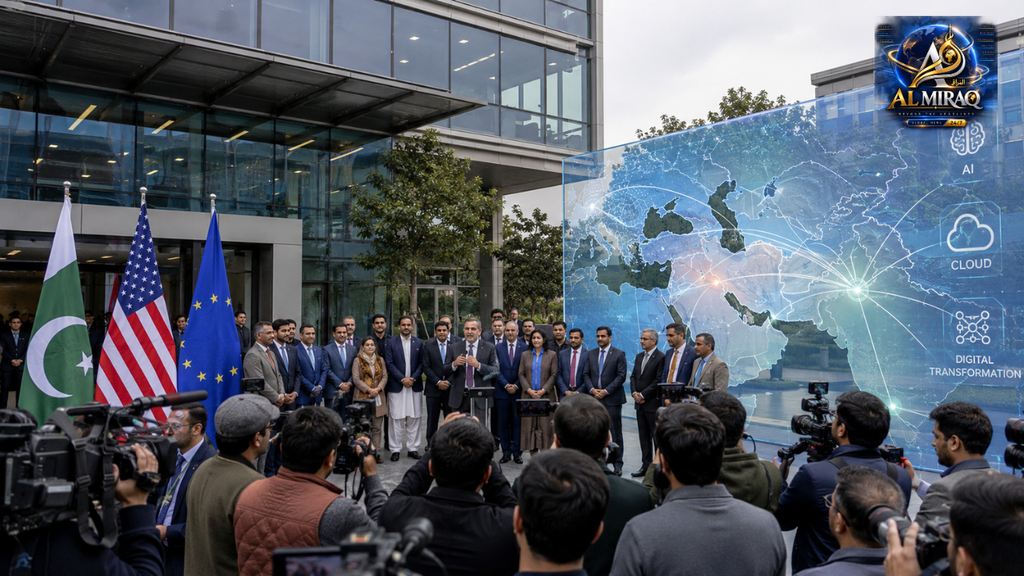
Prime Minister Shehbaz Sharif inaugurated Google’s Pakistan office in Islamabad on August 18, 2026, during a meeting with a nine-member Google delegation led by Wilson L. White, the company’s vice president for Government Affairs and Public Policy. US Chargé d’Affaires Natalie Baker also attended the event.
The opening comes as Pakistan seeks to strengthen its information technology infrastructure, increase IT exports and equip its large young population with skills in artificial intelligence and other emerging technologies.
Google has described the local presence as a milestone in its long-term commitment to Pakistan. The company says its focus will include digital skills, local businesses, hardware manufacturing and opportunities for Pakistani talent.
Google Pakistan Office Marks New Phase in Technology Partnership
The opening of the Google Pakistan office represents a formalization of a relationship that has developed over more than a decade.
Google Vice President Wilson White said the company has been investing in and remaining committed to Pakistan for more than ten years. He linked Google’s plans with Prime Minister Shehbaz Sharif’s ambition to turn Pakistan into a $30 billion IT export hub.
The inauguration was therefore presented not simply as the opening of a corporate facility, but as part of a broader partnership around Pakistan’s digital transformation.
The Prime Minister’s Office said the local office would strengthen cooperation between Pakistan and Google and create opportunities for young people, developers and businesses. The government has also emphasized the importance of upgrading IT infrastructure and expanding training in information technology and artificial intelligence.
For Pakistan’s technology sector, the significance of the move will depend largely on what follows the inauguration. A local corporate presence can make it easier to coordinate with government institutions, educational organizations, businesses and technology entrepreneurs, although the opening itself does not automatically mean that Google is establishing a large-scale software engineering or research center in the country.
What Google Plans to Do in Pakistan
Google says its engagement with Pakistan will concentrate on three broad areas: investment in people, manufacturing and infrastructure connected to hardware exports, and support for local businesses.
The company’s plans build on digital-skilling initiatives that were already underway before the local office opened.
Pakistan’s Ministry of Information Technology and Telecommunication said Google-linked programs had already awarded more than 350,000 Career Certificate scholarships. The ministry also reported that Google Developer Groups had reached around 300,000 developers, including 50,000 trained in generative AI and cloud technologies.
Other initiatives highlighted by the ministry include support for more than 120 local gaming and app studios, the AI Seekho 2026 program and digital-literacy training involving more than 300,000 students and 5,000 educators.
Google has separately said its career certificate programs and collaboration with schools and teachers have helped upskill more than one million Pakistanis.
These figures indicate that Google’s Pakistan strategy extends beyond the physical office. Much of the company’s stated activity is centered on education, skills development, entrepreneurship and the digital economy.
AI and Digital Skills at the Center of the Partnership
Artificial intelligence has become one of the most important components of Pakistan’s technology strategy, and Google’s local expansion is closely connected to that priority.
The government has been promoting AI training as part of its broader digital transformation agenda, while Google has expanded its programs around generative AI, cloud technologies and digital skills.
Google also announced that students in Pakistan would receive free access to Google Gemini for one year, although details of the formal rollout were still to be announced following the inauguration.
The development could be particularly important for university students and young professionals seeking practical exposure to AI tools. However, access to technology alone will not determine the success of the initiative. Training quality, internet availability, education standards and opportunities to convert digital skills into employment or business activity will remain critical.
Google and Pakistan’s IT Export Ambitions
Pakistan has increasingly positioned its technology sector as an important source of future economic growth.
Prime Minister Shehbaz Sharif has set an ambition of transforming Pakistan into a $30 billion IT export hub. Google has said this objective aligns with its own plans for the country.
The government is attempting to increase the country’s ability to compete in international technology markets by expanding digital skills, improving infrastructure and encouraging foreign technology companies to establish deeper relationships with the Pakistani market.
The Ministry of IT said ICT export remittances reached $417 million in July of fiscal year 2026-27, an 18 percent increase, while the ICT industry recorded a trade surplus of $344 million during the month.
These figures provide context for why the government considers Google’s presence strategically important. Pakistan wants its technology sector to generate greater foreign exchange, create higher-value employment and connect domestic companies with international customers.
Google’s involvement could support those goals, particularly if local developers, startups and small businesses can use its platforms and programs to reach global markets.
Support for Local Businesses and Startups
Another important part of Google’s stated strategy is supporting Pakistani businesses.
Google has said its local office will help create long-term opportunities for Pakistani youth and enable local businesses to go global.
For startups and app developers, access to global technology platforms can reduce some barriers to entering international markets. Developers can build applications for users outside Pakistan, while businesses can use digital advertising, cloud services, productivity tools and AI technologies to expand their operations.
Google has also highlighted its support for Pakistan’s gaming and app-development ecosystem. Government figures indicate that more than 120 local gaming and app studios have received support through relevant initiatives.
If these programs expand following the opening of the local office, they could contribute to a larger technology ecosystem involving developers, entrepreneurs, educators and investors.
Chromebook Manufacturing Adds a Hardware Dimension
Google’s Pakistan strategy is not limited to software and digital skills.
The company has also highlighted a Chromebook assembly line established with local partners. The government says the facility has a capacity of up to 500,000 devices, while Google has indicated that there is potential for locally assembled Chromebooks to be exported to other countries in the region.
This introduces a manufacturing dimension to Pakistan’s relationship with Google.
If local production develops successfully, Pakistan could potentially become part of a wider regional hardware supply chain. That could create opportunities not only in assembly but also in logistics, component supply, technical services and export-related businesses.
However, the long-term impact will depend on production costs, infrastructure, supply-chain reliability, workforce capabilities and international demand.
Why the Google Pakistan Office Matters
The arrival of a major global technology company is significant because international investment can influence confidence in a country’s technology market.
Technology sector expert Parvez Iftikhar, as referenced in the supplied reporting, emphasized that Google’s physical presence could increase confidence among international investors. At the same time, he stressed that better internet infrastructure would be essential for Pakistan to receive the full benefit of such developments.
That point highlights a central challenge.
A strong digital economy requires more than technology companies and training programs. Reliable and affordable broadband, stable electricity, modern data infrastructure, digital payment systems and effective cybersecurity are also essential.
For Pakistani developers and startups, improvements in connectivity could be as important as access to new technology programs.
Internet Infrastructure Remains a Key Challenge
Pakistan’s ambitions for a technology-driven economy face several infrastructure challenges.
A growing number of people are using smartphones and digital services, but the country’s technology ecosystem still depends heavily on the quality, affordability and reliability of internet access.
For companies building cloud-based applications, AI services and digital businesses, consistent connectivity is fundamental.
This means Google’s local presence should be viewed as one component of a much larger transformation rather than a standalone solution.
The government will need to continue investing in digital infrastructure while the private sector expands services and creates new employment opportunities.
What the Development Could Mean for Pakistani Youth
Pakistan has a large and relatively young population, making human capital one of the country’s most important potential advantages in the digital economy.
Google’s existing skills programs and its planned expansion of AI, cloud, gaming and technology education could provide young Pakistanis with additional pathways into the global digital workforce.
Career certificates can help people develop specific technical skills, while AI tools can potentially increase productivity for students, freelancers, developers and small businesses.
The bigger question is whether those skills translate into sustainable jobs, export revenues and new companies.
The answer will depend on the broader business environment, access to finance, reliable internet services, international demand and the ability of Pakistani companies to compete globally.
Government Sees Google as Part of a Wider Digital Transformation
Prime Minister Shehbaz Sharif has described Pakistan as undergoing a major digital transformation, particularly in government and the wider economy.
The government’s “Digital Nation Pakistan” vision includes efforts to modernize public services and strengthen the country’s digital ecosystem.
The Google partnership is therefore being positioned within a broader national strategy.
The government has also indicated that it wants more international technology companies to establish operations and partnerships in Pakistan. Federal Minister for IT and Telecommunication Shaza Fatima Khawaja described Google’s arrival as the result of years of work and said it could encourage additional international companies to consider Pakistan.
Whether that happens will depend on investor perceptions of Pakistan’s infrastructure, regulatory environment, economic conditions and technology-market potential.
A New Google-Pakistan Agreement Expands the Partnership
The relationship moved beyond the office inauguration later in the week.
The agreement includes an ambition to help advance Pakistan’s IT exports and digital economy toward $30 billion by 2030.
Under the MoU, Google is set to provide 150,000 Career Certificates to Pakistani youth during 2026.
Another proposed area is the use of AI within government, including support for the Federal Board of Revenue’s transformation efforts.
What Remains Unclear
Despite the scale of the announcements, several questions remain open.
Pakistan will need sustained investment in internet infrastructure, education, electricity, cybersecurity, digital regulation and workforce development.
What Google’s Pakistan Office Could Mean for the Future
The opening of the Google Pakistan office is an important development for the country’s technology sector, but its greatest significance may lie in what comes next.
Google already had a substantial relationship with Pakistan through training, education, developer programs and business initiatives. The local office gives that relationship a more formal and visible foundation.
The company’s plans around AI, digital skills, hardware manufacturing, gaming, applications and local businesses align closely with Pakistan’s ambitions to expand its technology economy.
Conclusion
The development is significant, but its long-term importance will depend on implementation.
The latest partnership, including the subsequent memorandum of understanding, indicates that both sides are seeking a much deeper relationship.
For Pakistan’s digital economy, the Google Pakistan office is therefore best understood as a starting point rather than an endpoint.
Al Miraq — Beyond the Headlines.