By Al Miraq News Desk
Published: August 26, 2026
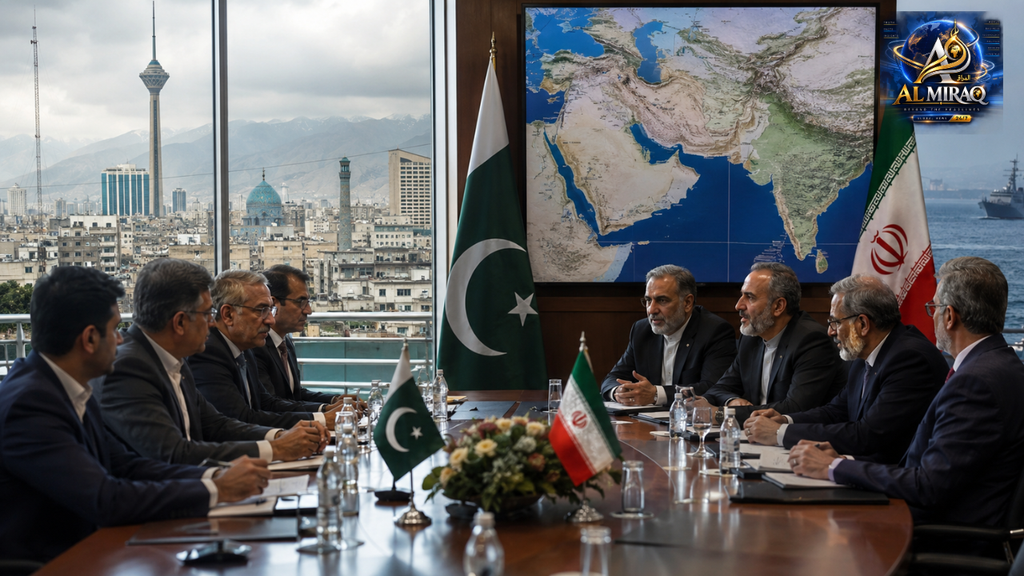
Pakistan and Iran have held high-level discussions in Tehran focusing on bilateral relations, border security and efforts to promote peace and stability across the region. Field Marshal Asim Munir and Pakistan’s Interior Minister Mohsin Naqvi met senior Iranian officials during a visit that comes as tensions continue to shape the wider Middle Eastern security environment.
The talks underline Islamabad’s stated interest in maintaining close relations with Tehran while supporting diplomatic efforts aimed at reducing regional tensions. The discussions also place particular importance on security along the Pakistan-Iran border and broader cooperation between the two neighboring countries.
According to the Inter-Services Public Relations (ISPR), Pakistan remains committed to supporting a peaceful, stable and comprehensive approach to resolving conflicts in the region.
The visit comes at a time when Iran is facing continued international economic pressure and the wider Middle East remains affected by multiple security crises. Against that backdrop, Pakistan’s engagement with Iran carries significance beyond bilateral relations.
Pakistan Iran Talks in Tehran
Field Marshal Asim Munir and Mohsin Naqvi held meetings with Iranian Interior Minister Eskandar Momeni during their visit to Tehran.
The discussions reportedly covered bilateral relations and security matters, particularly issues connected with the shared border between Pakistan and Iran.
The two countries share a long land border and have historically maintained extensive political, economic and people-to-people connections. Border security has remained an important part of bilateral discussions because instability in border regions can affect trade, travel and security on both sides.
Pakistan has repeatedly emphasized the importance of regional stability and diplomatic engagement with neighboring countries.
The latest meetings therefore represent part of a broader effort by Islamabad to maintain communication with Tehran while navigating a complicated regional environment.
Why Border Security Matters
The Pakistan-Iran border extends across a difficult and largely remote geographic area. Security concerns in border regions have periodically affected relations between the two countries.
Cooperation between the two governments is important not only for preventing security incidents but also for facilitating legitimate movement and trade.
For Pakistan, stability along its western border is particularly significant because the country faces security challenges on multiple fronts. For Iran, maintaining a secure eastern border is similarly important.
Regular engagement between senior security and political officials can provide channels for addressing disputes before they escalate.
Pakistan Seeks Diplomatic Solutions to Regional Tensions
Pakistan has positioned itself as a supporter of diplomatic solutions to conflicts in the Middle East.
The country has repeatedly called for dialogue and peaceful mechanisms to address regional disputes. The Tehran visit fits into that broader diplomatic approach.
The timing is especially important because tensions involving Iran, the United States and other regional actors continue to influence international security calculations.
Islamabad’s engagement with Tehran allows Pakistan to communicate directly with an important neighboring country while maintaining its wider diplomatic relationships.
The challenge for Pakistani policymakers is to balance these relationships without becoming directly involved in regional confrontations.
Iran Faces Continued Economic Pressure
The Tehran discussions also took place against the backdrop of renewed economic pressure on Iran.
Iranian officials have rejected what they describe as unlawful American sanctions and have indicated that Tehran will resist external economic pressure.
Iranian Foreign Ministry spokesman Esmaeil Baghaei has reportedly criticized American economic measures and rejected the idea of accepting economic pressure as a tool for influencing Iranian policy.
The United States, meanwhile, has announced a major economic campaign aimed at putting additional pressure on Iran.
U.S. Treasury Secretary Scott Bessent has described the strategy as an effort to cut economic lifelines supporting the Iranian government and isolate Tehran economically.
Washington’s approach represents a significant element of the broader confrontation between the United States and Iran.
Tehran Rejects Economic Pressure
Iranian officials have argued that sanctions are not a new phenomenon and that the country has developed experience in dealing with economic restrictions.
The Iranian position is that external economic pressure will not force Tehran to abandon its strategic objectives.
The confrontation therefore extends well beyond military considerations. Financial restrictions, energy markets, trade routes and international banking access have all become important elements of the broader dispute.
For countries such as Pakistan, developments in the Iran-U.S. relationship can have indirect consequences because of their geographical proximity to Iran and their economic interests in the region.
Pakistan-Iran Relations Enter a Sensitive Phase
Relations between Pakistan and Iran have generally involved a mixture of cooperation, economic interests and security concerns.
Both countries have an interest in keeping their common border stable. They also have incentives to expand legitimate trade and connectivity.
At the same time, regional conflicts can complicate bilateral diplomacy.
Pakistan’s geographic position makes it particularly sensitive to instability in Iran, Afghanistan and the wider Gulf region. Islamabad therefore has strong reasons to maintain diplomatic communication with Tehran.
The latest Pakistan Iran talks in Tehran can be viewed within this wider framework.
Rather than representing an isolated diplomatic event, the visit reflects the importance Pakistan attaches to maintaining direct communication with its neighbors during periods of regional uncertainty.
Oman Also Expected to Play a Diplomatic Role
The news comes as Oman is also expected to continue diplomatic engagement in Tehran.
The Omani foreign minister is expected to visit Tehran as part of efforts to encourage regional peace and stability.
Oman has historically maintained diplomatic channels with countries that have difficult relationships with each other. Its role as a facilitator of dialogue has made the country an important diplomatic actor in the Gulf.
Any effort involving Oman, Pakistan and Iran could potentially contribute to broader communication at a time when regional tensions remain high.
However, the outcome of such diplomatic activity will depend on whether the major parties involved are willing to make practical compromises.
Wider Middle East Security Concerns
The Pakistan-Iran discussions cannot be separated completely from the wider security situation across the Middle East.
Tensions involving Iran, Israel, the United States and other regional actors continue to affect international diplomacy.
The Gaza conflict has added another layer of complexity. Palestinian officials have reported casualties from Israeli airstrikes in Gaza, while European governments have continued to criticize Israeli settlement policies.
The European Union has opposed the E1 settlement plan and called for the withdrawal of the relevant tender, while Britain has also criticized new settlement plans.
These developments demonstrate how interconnected regional security issues have become.
For Pakistan, instability in the Middle East can affect energy prices, overseas employment, trade, shipping routes and the safety of Pakistani citizens living or working in the region.
Implications for Europe and NATO
Although Pakistan and Iran are not NATO members, developments between the two countries can have implications for European and broader international security.
Europe has significant economic and strategic interests in the Middle East. Energy supplies, maritime routes and migration patterns can all be influenced by regional instability.
Any major escalation involving Iran could potentially affect shipping through strategically important waterways and place additional pressure on international energy markets.
For NATO members, particularly European states, instability in the Middle East can also create secondary security challenges.
These may include increased pressure on maritime security, terrorism prevention, intelligence cooperation and protection of critical infrastructure.
Pakistan’s diplomatic engagement with Iran could therefore be relevant to international efforts aimed at preventing further escalation.
Gaza Adds to Regional Diplomatic Pressure
The situation in Gaza remains another major concern for governments across the region.
The supplied reports describe Israeli airstrikes in central Gaza that reportedly killed Palestinians and injured others, including a child.
Separately, European governments have continued to express opposition to Israeli settlement expansion.
The developments highlight the increasingly interconnected nature of regional diplomacy. Political disputes involving Israel, Iran and other Middle Eastern actors can influence the positions of governments well beyond the immediate conflict zone.
Pakistan has traditionally supported the Palestinian cause and called for peaceful resolution of the broader conflict.
Its diplomatic engagement with Iran takes place within this broader regional context.
Syria and the Risk of Further Escalation
Another area of concern is Syria, where the possibility of renewed conflict continues to generate diplomatic activity.
The supplied reports indicate that American mediation efforts have involved meetings with Syrian officials and intelligence representatives.
The broader concern is that additional military confrontation could expand beyond existing areas of conflict and draw neighboring countries deeper into regional instability.
Turkey’s position is also important because of its geographic proximity to Syria and its direct security interests there.
Any major escalation could therefore have consequences extending across several countries.
What Remains Unclear
Despite the importance of the Tehran meetings, several issues remain unclear.
There is no indication from the supplied information that the talks produced a major new bilateral agreement or a comprehensive settlement on regional conflicts.
The meetings appear to have focused primarily on bilateral relations, security issues and broader diplomatic efforts.
The precise outcome of discussions concerning border security and regional tensions will depend on follow-up actions by both governments.
Similarly, the wider confrontation between Iran and the United States remains unresolved.
Economic pressure can influence diplomatic calculations, but its eventual impact on Tehran’s policies remains uncertain.
Diplomatic Engagement Does Not Guarantee De-escalation
High-level meetings can create channels for communication, but they do not automatically eliminate underlying disagreements.
Pakistan must continue balancing its relationship with Iran against its relationships with the United States, Gulf states, China and other international partners.
That balancing act could become more difficult if tensions in the Middle East intensify.
For Iran, maintaining productive relations with neighboring countries can help reduce diplomatic isolation and support economic and regional connectivity.
For Pakistan, stable relations with Iran can contribute to greater security along its western frontier.
Pakistan’s Broader Diplomatic Strategy
The Tehran visit is also consistent with Pakistan’s broader effort to use diplomatic engagement to address regional security challenges.
Islamabad has an interest in preventing conflicts from spreading and in keeping communication channels open with all major regional actors.
Pakistan’s position is particularly important because of its location between South Asia, Central Asia, the Middle East and the Arabian Sea.
Developments in any one of these regions can have consequences for Pakistan’s security and economy.
Maintaining constructive relations with Iran therefore has strategic value even when broader geopolitical disagreements remain unresolved.
Conclusion
The latest Pakistan Iran talks in Tehran highlight Islamabad’s continuing efforts to strengthen bilateral relations, improve border security and support diplomatic approaches to regional instability.
The meetings between Field Marshal Asim Munir, Mohsin Naqvi and Iranian officials come at a sensitive moment, with Iran facing significant economic pressure from the United States and the wider Middle East confronting multiple security challenges.
For Pakistan, maintaining stable relations with Iran is particularly important because of the two countries’ shared border and interconnected security and economic interests.
The talks do not, by themselves, resolve the larger disputes involving Iran, the United States, Israel and other regional powers. However, continued diplomatic engagement provides an important channel for communication and could help reduce the risk of misunderstandings along Pakistan’s western frontier.
The wider consequences will depend on what follows. If regional tensions continue to rise, Pakistan may face increasing pressure to balance competing international relationships. If diplomatic efforts gain momentum, Islamabad could potentially play a constructive role in encouraging dialogue and regional stability.
For now, the Tehran meetings underline one clear priority: Pakistan wants to keep communication with Iran open while pursuing a more stable security environment across its neighborhood.
Al Miraq — Beyond the Headlines.