By Al Miraq News Desk
Published: August 15, 2026
Category: Pakistan / World
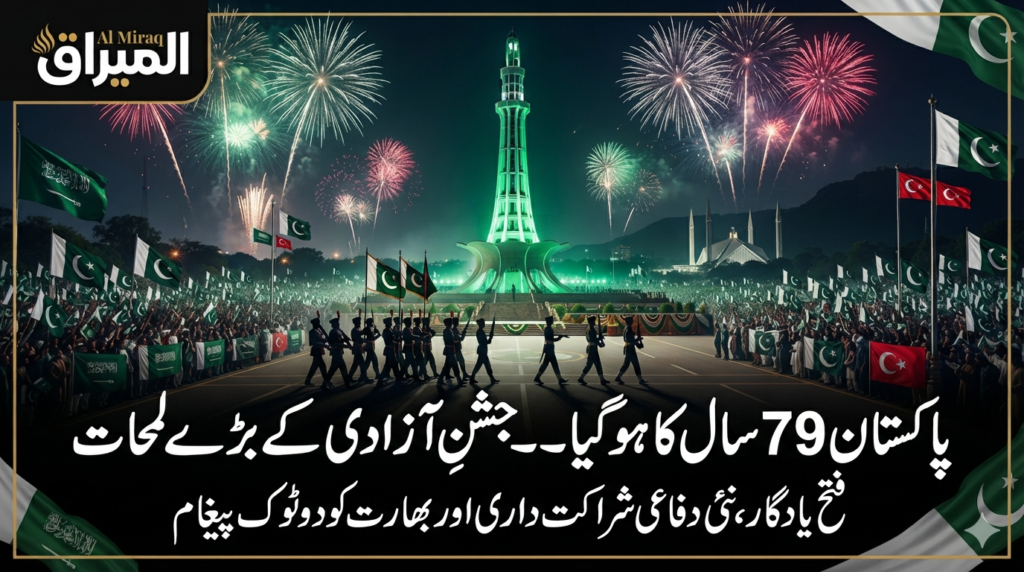
Pakistan marked its 79th Independence Day on August 14, 2026, with nationwide celebrations, flag-hoisting ceremonies, prayers, patriotic programmes and events honouring the country’s founders and those who sacrificed their lives for its independence.
From Islamabad and Karachi to cities across the country, streets and public spaces were decorated in green and white as citizens celebrated Pakistan’s independence. Fireworks illuminated the sky over Islamabad at midnight, while families and young people gathered with national flags to mark the occasion.
But this year’s Independence Day carried significance beyond traditional celebrations.
Pakistan’s leadership used the occasion to highlight national sovereignty, regional security and the country’s position following the 2025 conflict with India. A newly inaugurated Yadgar-e-Fatah, or Victory Memorial, in Islamabad became one of the central symbols of this year’s official celebrations.
Prime Minister Shehbaz Sharif also delivered a strong message on Pakistan’s water resources, warning that the country would respond if its water interests were threatened.
Meanwhile, Pakistan’s growing defence cooperation with Saudi Arabia and Türkiye has added another major dimension to the country’s evolving regional strategy.
Pakistan Celebrates 79 Years of Independence
Independence Day ceremonies began early across Pakistan.
National and provincial governments organised flag-hoisting ceremonies, while prayers were offered for the country’s progress, security and prosperity.
In Karachi, senior officials visited the mausoleum of Quaid-e-Azam Muhammad Ali Jinnah, where prayers were offered and floral tributes were laid in honour of Pakistan’s founder.
A ceremonial guard change was also held at the mausoleum, with cadets from the Pakistan Naval Academy performing guard duties.
Across the country, government buildings, public spaces and private homes were decorated with Pakistani flags.
The celebrations were not limited to official events. Families gathered in parks and public areas, children dressed in green and white, and communities organised patriotic programmes.
For millions of Pakistanis, August 14 remains an important opportunity to remember the country’s history and reflect on the sacrifices that accompanied independence.
Islamabad Marks Independence Day With Victory Memorial
One of the most prominent features of this year’s official celebrations was the inauguration of the Yadgar-e-Fatah, or Victory Memorial, in Islamabad.
The monument was inaugurated by President Asif Ali Zardari and Prime Minister Shehbaz Sharif ahead of Independence Day. It was presented as a tribute to Pakistan’s armed forces and a commemoration of what Pakistani officials describe as the country’s victory during the 2025 India-Pakistan conflict.
The conflict in May 2025 lasted several days before a ceasefire was reached. Pakistan has referred to the confrontation as Marka-e-Haq, while India uses different terminology and has its own account of the conflict.
The inauguration therefore carried both military and political significance.
Speaking at the ceremony, Prime Minister Shehbaz Sharif emphasised Pakistan’s desire for peace but warned that the country would respond strongly to threats against its sovereignty.
Shehbaz Sharif Warns India Over Pakistan’s Water
Water security became one of the strongest themes in the prime minister’s Independence Day message.
Shehbaz Sharif warned that Pakistan’s water resources were a “red line” and said Islamabad would respond directly if India failed to change course on the issue.
The remarks come amid continuing tensions surrounding the Indus Waters Treaty, the agreement governing the distribution of river waters between India and Pakistan.
Pakistan has strongly objected to India’s suspension of the treaty following the 2025 Pahalgam attack and subsequent military escalation.
The prime minister said Pakistan wanted peace and stability but that its desire for peace should not be interpreted as weakness.
His comments underline the importance Islamabad attaches to water security at a time when climate change, population growth and regional tensions are already placing greater pressure on water resources.
For Pakistan, the Indus river system is essential to agriculture, drinking water, hydropower and the broader economy.
Pakistan Says It Wants Peace But Will Defend Its Sovereignty
The government’s Independence Day message attempted to combine two themes: a preference for peace and a commitment to national defence.
Shehbaz Sharif said Pakistan wanted the world to remain protected from new conflicts and tensions, while also warning that any future threat to the country’s sovereignty would receive a strong response.
This message comes after one of the most serious periods of India-Pakistan military tension in recent years.
The 2025 confrontation involved missile and drone strikes before a ceasefire brought the immediate fighting to an end. Pakistan and India continue to present significantly different narratives about the conflict and its outcome.
The government in Islamabad has since increasingly presented the episode as a demonstration of Pakistan’s military capabilities and national resilience.
Asim Munir Honoured During Victory Celebrations
Pakistan’s military leadership also featured prominently in the Independence Day events.
Field Marshal Syed Asim Munir, who was promoted to the rank of field marshal in 2025 following the India-Pakistan conflict, has been repeatedly praised by Pakistani political and military leadership for his role during the confrontation.
At the Victory Memorial ceremony, President Asif Ali Zardari and Prime Minister Shehbaz Sharif praised the armed forces and their leadership.
The government’s presentation of the 2025 conflict as a national victory has become an increasingly visible part of official commemorations.
However, because India has its own account of the confrontation, international readers should understand that descriptions such as “victory” and “defeat” reflect the respective narratives of the two countries rather than an uncontested historical assessment.
Pakistan, Saudi Arabia and Türkiye Strengthen Defence Cooperation
Another major development highlighted around Independence Day was Pakistan’s expanding defence cooperation with Saudi Arabia and Türkiye.
On August 7, Pakistan, Saudi Arabia and Türkiye signed the Mecca Joint Defence Agreement, creating a framework for deeper strategic and military cooperation. The agreement includes a collective-defence principle under which an armed attack against one member is treated as an attack against all.
The agreement is being described by officials as defensive rather than directed against a specific country.
Türkiye has outlined plans for broader cooperation involving land, sea and air exercises, defence industries, technology, unmanned systems, electronic warfare and other areas.
The agreement represents a significant development in regional security cooperation.
For Pakistan, the partnership strengthens ties with two strategically important Muslim-majority countries.
For Saudi Arabia, Pakistan brings extensive military experience and a long-standing defence relationship.
Türkiye contributes substantial military and defence-industrial capabilities, including advanced drone and aerospace technologies.
Why the New Defence Pact Matters
The agreement comes at a time of major geopolitical uncertainty across the Middle East and South Asia.
The United States, Iran, Israel, Gulf countries and other regional powers remain involved in a complicated network of security relationships and conflicts.
The Pakistan-Saudi-Türkiye arrangement could therefore become an important part of a broader regional effort to strengthen collective security.
However, analysts have also noted that the practical meaning of the agreement will depend on how its commitments are implemented.
The pact creates a framework for cooperation, but the precise military mechanisms and operational commitments will determine its long-term significance.
Pakistan and Türkiye have also stressed that the arrangement should be understood as defensive.
Iran Sends Independence Day Message to Pakistan
Pakistan’s relationship with Iran also remained an important part of the country’s regional diplomatic landscape.
Iranian President Masoud Pezeshkian conveyed Independence Day greetings to the Pakistani people, while Iranian officials continued to emphasise the historical relationship between the two neighbouring countries.
Pakistan and Iran share a long border and have interests in trade, energy, border security and regional stability.
Despite occasional disagreements and security concerns along the border, both countries have repeatedly expressed interest in strengthening bilateral relations.
The broader geopolitical environment makes this relationship particularly important.
Pakistan’s geographical position means that it must balance relationships with major regional powers while protecting its own economic and security interests.
US-Pakistan Relations Remain Important
The United States also conveyed Independence Day greetings to Pakistan.
US Secretary of State Marco Rubio highlighted areas of cooperation between Washington and Islamabad, including counterterrorism and other sectors.
The relationship between the United States and Pakistan has gone through several phases over the decades, ranging from close strategic cooperation to periods of significant tension.
Today, both countries continue to have shared interests in counterterrorism, regional stability, trade and economic cooperation.
The challenge for Islamabad is to maintain constructive relationships with Washington while simultaneously strengthening partnerships with countries such as China, Saudi Arabia, Türkiye and Iran.
Pakistan’s Military Displays Continued Confidence
Pakistan’s armed forces used Independence Day to reaffirm their commitment to national defence.
The military’s message emphasised sovereignty, territorial integrity and the defence of the country against potential threats.
Such statements have become particularly significant following the 2025 confrontation with India.
Pakistan’s military remains one of the country’s most influential institutions, and national security continues to occupy a central place in the country’s political discourse.
At the same time, Independence Day messages also focused on economic development, national unity and prosperity.
Independence Day Celebrations Reach Young Pakistanis
Away from political and military ceremonies, young Pakistanis played a major role in the celebrations.
Schools, universities and community organisations arranged patriotic programmes involving music, speeches, performances and cultural activities.
Students performed national songs using instruments including piano, violin and guitar, while social-media users shared photographs and videos showing how they were celebrating Independence Day.
Such activities demonstrate how the meaning of Independence Day continues to evolve.
For younger generations, August 14 is not only a historical commemoration but also a cultural event that takes place across television, social media and digital platforms.
A Day of Remembrance
Independence Day is also a day of remembrance.
Pakistan’s creation in 1947 followed years of political struggle and the partition of British India.
Millions of people were affected by the migration and violence surrounding partition.
For Pakistanis, the day therefore carries memories of the country’s founders, including Muhammad Ali Jinnah, as well as the families who experienced the upheaval of 1947.
Official ceremonies across the country included prayers and tributes for those who contributed to the creation and defence of Pakistan.
The Role of Social Media in This Year’s Celebrations
Social media has become one of the most visible platforms for Independence Day celebrations.
From Facebook and Instagram to TikTok, YouTube and X, Pakistanis shared:
- Independence Day greetings
- National songs
- Historical photographs
- Patriotic videos
- Family celebrations
- Flag displays
- Fireworks
- Cultural performances
News organisations also encouraged citizens to share short videos showing how they were celebrating.
This created a nationwide digital celebration alongside traditional ceremonies.
Pakistan’s Independence Day Message to the World
The overall message from Pakistan’s leadership this year combined patriotism, national security, diplomacy and a call for peace.
The government presented Pakistan as a country determined to protect its sovereignty while seeking stability in the region.
The emphasis on water security was particularly notable.
The new defence agreement with Saudi Arabia and Türkiye also demonstrated Islamabad’s interest in developing stronger regional partnerships.
Meanwhile, the continuing relationship with Iran, China and the United States shows how Pakistan is attempting to maintain multiple strategic relationships at the same time.
What Comes Next for Pakistan?
The celebrations may have ended, but several major issues will continue to shape Pakistan’s future.
Among them are:
Water security:
The dispute surrounding the Indus Waters Treaty could remain a major source of tension with India.
Regional security:
Pakistan will need to navigate a rapidly changing security environment involving South Asia and the Middle East.
Economic growth:
Sustainable economic development remains essential for improving living standards and creating opportunities for Pakistan’s large young population.
Diplomacy:
Islamabad will need to maintain relationships with multiple competing global and regional powers.
National unity:
Political polarization remains a major challenge, making social cohesion an important part of the country’s future.
A New Chapter at 79
Pakistan’s 79th Independence Day was therefore more than a celebration of the country’s birth.
It was also a reflection of where Pakistan stands today.
The country celebrated its history while highlighting military achievements, national sovereignty and the sacrifices of its armed forces.
At the same time, Pakistan’s leadership spoke about peace, regional stability and the need to protect national interests through diplomacy and strategic partnerships.
The inauguration of the Yadgar-e-Fatah, the warnings over water security and the new Pakistan-Saudi-Türkiye defence agreement all point to a country navigating a complicated geopolitical environment.
For ordinary Pakistanis, however, Independence Day remains deeply personal.
The flags, national songs, family gatherings, prayers and celebrations represent a connection to the country’s history and a hope for its future.
As Pakistan enters its 80th year since independence, the challenge will be turning that national pride into lasting stability, economic opportunity, unity and prosperity.
Pakistan’s 79th Independence Day was a celebration of the past — but its real significance lies in what the country does next.
Al Miraq — Beyond the Headlines.