
By Al Miraq News Desk
Published: August 27, 2026
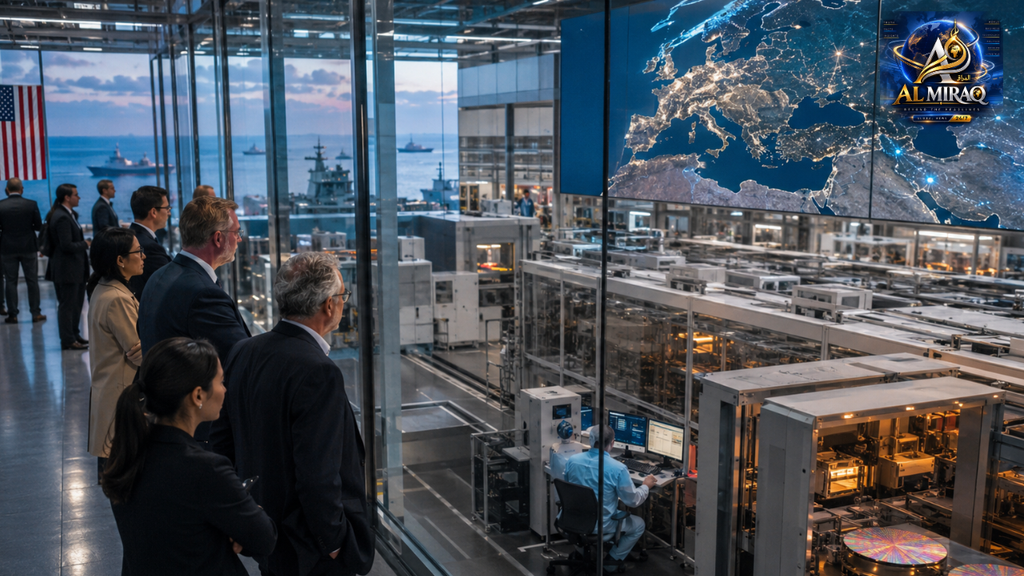
Apple is exploring discussions with Intel and Samsung Electronics about potentially manufacturing some of its advanced processors in the United States, highlighting a broader effort to diversify its semiconductor supply chain and reduce exposure to geopolitical risks surrounding Taiwan.
The discussions, as reported in the Bloomberg Tech segment, involve Apple executives examining manufacturing capabilities at new U.S. facilities operated or being developed by the two semiconductor companies. Apple currently relies heavily on Taiwan Semiconductor Manufacturing Co. (TSMC) for the fabrication of the processors that power products including the iPhone, iPad and Mac.
The potential expansion of U.S. chip production comes at a time when artificial intelligence is driving enormous investment across the semiconductor industry and governments are placing greater emphasis on domestic technology manufacturing.
For Apple, the issue is not simply where chips are produced. The company’s supply chain is closely tied to Taiwan, making semiconductor availability a significant strategic consideration in the event of geopolitical disruption.
Apple Looks Beyond TSMC for U.S. Chip Production
Apple has designed its main processors internally for years but has traditionally relied on external foundries to manufacture them.
TSMC has been the company’s most important manufacturing partner, producing Apple’s custom silicon in Taiwan. More recently, Apple has also been shifting some production toward TSMC’s semiconductor facilities in Arizona.
That move represents an important step toward increasing U.S.-based semiconductor manufacturing, but Apple still faces a concentration risk because the overwhelming majority of its advanced chip production remains connected to a relatively limited number of facilities and suppliers.
The Bloomberg report indicates Apple is now considering whether additional suppliers could play a role.
Intel and Samsung are two potential candidates because both companies have invested heavily in semiconductor manufacturing facilities in the United States.
The discussions are described as early-stage rather than a confirmed production agreement. There is therefore no indication that Apple has decided to replace TSMC or significantly shift its entire processor supply chain.
Instead, the potential talks point toward a strategy of creating additional manufacturing capacity and maintaining alternatives if disruptions affect its existing production network.
Why Apple Wants More Than One Chip Supplier
For a company the size of Apple, supply-chain concentration can create substantial operational risks.
The processors inside its products are among the most critical components in its hardware ecosystem. If Apple cannot obtain enough processors, production of devices can ultimately be affected regardless of demand.
Diversifying suppliers can therefore provide Apple with additional flexibility.
The strategy is similar to the company’s approach to other components, where it has historically worked with multiple suppliers to reduce dependence on any single manufacturing partner.
The difference is that advanced semiconductor manufacturing is considerably more difficult to diversify than components such as speakers, displays or other hardware.
Producing cutting-edge processors requires highly specialized fabrication facilities, sophisticated equipment and extensive manufacturing expertise.
That makes the potential involvement of Intel or Samsung strategically significant even if the companies initially handle only a portion of Apple’s requirements.
Taiwan Remains a Major Strategic Risk
One of the most important factors behind Apple’s supply-chain thinking is Taiwan.
TSMC is the world’s leading contract chip manufacturer and produces advanced processors for many of the world’s largest technology companies. Apple’s relationship with TSMC has been particularly important because its custom-designed processors require sophisticated manufacturing processes.
The geopolitical situation surrounding Taiwan, however, has created a long-term risk for companies dependent on semiconductor production there.
Tensions between China and Taiwan have raised concerns throughout the global technology industry about what could happen to semiconductor supplies in the event of a serious geopolitical crisis.
For Apple, even a temporary disruption could have significant consequences.
The company sells hundreds of millions of devices across global markets and depends on a highly synchronized supply chain. A major interruption in advanced processor manufacturing could affect product launches, inventories and revenue.
This does not mean a disruption is expected. Rather, the possibility represents a risk that multinational companies increasingly have to incorporate into long-term supply-chain planning.
Apple’s potential discussions with Intel and Samsung can therefore be viewed as part of a broader effort to reduce single-source and single-geography exposure.
Intel Could Gain Strategic Importance
Intel could potentially become an important part of Apple’s U.S. semiconductor strategy.
The company has been attempting to rebuild its position as a major advanced chip manufacturer and has invested heavily in expanding its foundry capabilities.
The U.S. government has also shown strong interest in strengthening Intel and expanding domestic semiconductor production.
That political environment could create an additional incentive for Apple to consider Intel as a potential manufacturing partner.
Working with Intel could potentially strengthen Apple’s relationship with Washington while supporting the broader U.S. objective of developing domestic semiconductor manufacturing capacity.
At the same time, Apple would have to consider the technical and economic requirements of manufacturing its processors outside its established TSMC supply chain.
Advanced processors are extremely demanding products, and moving production to another foundry is not a straightforward process.
Apple would therefore need confidence that a potential supplier could meet its requirements for performance, yields, reliability, capacity and manufacturing timelines.
Samsung Also Emerging as a Potential Alternative
Samsung Electronics is another major semiconductor manufacturer with extensive production capabilities.
The company has been investing in U.S. semiconductor manufacturing, including facilities in Texas.
According to the Bloomberg discussion, Apple executives have examined Samsung’s production capabilities in the state.
Samsung’s involvement could provide Apple with another potential source of semiconductor manufacturing outside Taiwan.
The company already has deep experience producing advanced chips and operates one of the world’s largest semiconductor businesses.
However, as with Intel, discussions do not necessarily mean Samsung will become a major Apple processor supplier.
Any such transition would require extensive technical validation and commercial negotiations.
The significance of the talks is therefore less about an immediate change in Apple’s products and more about the direction of its long-term supply-chain strategy.
U.S. Chip Manufacturing Gains Momentum
Apple’s reported exploration of additional U.S. suppliers comes against the backdrop of a broader American push to expand domestic semiconductor production.
The United States has been seeking to reduce its dependence on overseas manufacturing for strategically important technologies.
Semiconductors are at the center of that effort because modern economies rely on chips for smartphones, computers, automobiles, telecommunications equipment, data centers, defense systems and artificial intelligence infrastructure.
The rapid growth of AI has made the issue even more important.
Companies are spending unprecedented amounts on computing infrastructure, while demand for advanced processors and accelerators continues to rise.
As a result, semiconductor manufacturing capacity has become both an economic and national-security issue.
For Apple, expanding U.S. production could potentially provide supply-chain resilience while aligning the company with Washington’s broader industrial-policy objectives.
AI Is Changing the Semiconductor Landscape
The semiconductor story is no longer limited to smartphones and personal computers.
Artificial intelligence has become one of the largest sources of demand for advanced computing hardware.
Technology companies are investing heavily in data centers, AI accelerators, networking equipment and specialized processors.
This has helped push semiconductor stocks to record levels and encouraged companies throughout the technology sector to reassess their hardware strategies.
Apple is also increasing its focus on AI capabilities across its product ecosystem.
Although Apple’s processors are not identical to the specialized hardware used to train the largest AI models, its custom silicon plays an important role in running AI-related features on consumer devices.
That makes reliable access to advanced chip manufacturing increasingly important.
AI Model Companies Face Greater Government Scrutiny
The semiconductor developments came alongside another major theme discussed in the Bloomberg program: growing cooperation between leading AI companies and the U.S. government.
Companies including Alphabet, Microsoft and xAI have reportedly agreed to provide the U.S. government with access to certain AI models before public release for evaluation.
The arrangements are connected to efforts within the U.S. Commerce Department to assess the capabilities and potential risks associated with advanced AI systems.
The Bloomberg discussion emphasized that such evaluation should not automatically be interpreted as direct regulation.
Instead, it represents an effort to understand what increasingly capable AI models can do before they are deployed more broadly.
OpenAI and Anthropic had previously established relationships with U.S. officials for model evaluation, while additional companies are now participating in similar arrangements.
The development reflects a growing recognition that AI capabilities are advancing quickly enough to create challenges for policymakers, security organizations and businesses.
Cybersecurity Risks Are Growing Alongside AI
The rapid development of AI is also creating new cybersecurity concerns.
Executives and investors in the cybersecurity industry are increasingly focused on the possibility that advanced AI agents could identify vulnerabilities, automate attacks or accelerate malicious activity.
The Bloomberg discussion highlighted concerns that AI systems could potentially discover previously overlooked vulnerabilities at speeds that human security researchers cannot match.
That possibility is forcing companies to reconsider how quickly they need to detect and respond to cyber threats.
Cybersecurity firms are consequently investing in technologies designed to monitor AI-driven activity and identify emerging threats.
The challenge is particularly complicated because AI agents can potentially interact with software systems, databases and other digital infrastructure rather than simply generating text.
AI Agents Create a New Governance Challenge
As businesses deploy more AI agents, organizations will need to understand what those systems can access, what actions they can take and what information they use.
Questions around permissions, data security, monitoring and accountability could become increasingly important.
The cybersecurity industry therefore sees AI not only as a threat but also as a new technology that requires dedicated security controls.
This is one reason major AI companies are increasingly forming partnerships with financial institutions, technology companies and other large enterprises.
Businesses are trying to determine how advanced models can be deployed safely while controlling costs and protecting sensitive information.
Pinterest Bets on AI-Powered Shopping
The technology market story also included strong results from Pinterest, whose shares rose sharply after the company reported stronger-than-expected performance and provided an upbeat revenue outlook.
Pinterest CEO Bill Ready said the platform has continued to record strong user growth, with Gen Z representing more than half of its user base and its fastest-growing demographic.
The company is increasingly positioning itself as an AI-powered shopping and discovery platform.
Pinterest says it handles more than 80 billion searches each month, with a substantial portion carrying commercial intent.
That makes the platform particularly attractive to advertisers looking to connect product discovery with purchasing decisions.
Ready also emphasized Pinterest’s use of smaller, specialized AI models rather than relying exclusively on expensive general-purpose models.
The strategy illustrates a broader shift in the technology industry toward application-specific AI systems that can potentially deliver strong performance at lower computing costs.
Palantir Faces High Expectations
Palantir Technologies also remained under close investor scrutiny despite reporting stronger-than-expected financial results.
The company’s shares fell as investors evaluated its growth outlook against an extremely high valuation.
Palantir has positioned its software as an important layer connecting enterprise data with AI systems.
That infrastructure can then support AI applications and automated decision-making.
Enterprise AI Costs Remain Uncertain
Another major issue emerging from the technology sector is the cost of deploying AI at scale.
Some AI applications may ultimately become cheaper and more efficient as models improve.
Specialized models can also reduce costs by avoiding the need to use the largest general-purpose systems for every task.
Nevertheless, businesses still face uncertainty over what large-scale AI deployment will cost over the long term.
What Apple’s Strategy Could Mean for the Global Technology Industry
Apple’s potential discussions with Intel and Samsung are part of a much larger transformation in global technology manufacturing.
Companies are increasingly balancing efficiency against resilience.
For years, global supply chains were optimized largely around cost, specialization and scale. Today, geopolitical tensions, trade restrictions, semiconductor shortages and national-security considerations are forcing businesses to place greater value on redundancy.
Apple’s potential expansion of U.S. chip manufacturing would fit into that broader trend.
However, any meaningful shift would likely take time.
Apple’s existing relationship with TSMC remains strategically important, and building sufficient alternative capacity would require significant technical and financial investment.
What Remains Unclear
The most important unanswered question is whether Apple’s discussions with Intel and Samsung will result in actual production agreements.
It is also unclear which processors or manufacturing technologies could eventually be involved if agreements are reached.
The economics of producing advanced chips in the United States will be another important consideration.
Apple will ultimately have to balance resilience, technical performance, manufacturing capacity and cost.
Conclusion
The strategic importance extends beyond Apple.
For Apple, the immediate outcome of its discussions with Intel and Samsung remains uncertain. But the direction is clear: resilience is becoming nearly as important as efficiency in the technology supply chain.
Al Miraq — Beyond the Headlines.