
Pakistan 79th Independence Day: Celebrations, Yadgar-e-Fatah and Key Developments
Pakistan 79th Independence Day: Celebrations, Yadgar-e-Fatah and Key Developments
By Al Miraq News Desk
Published: August 15, 2026
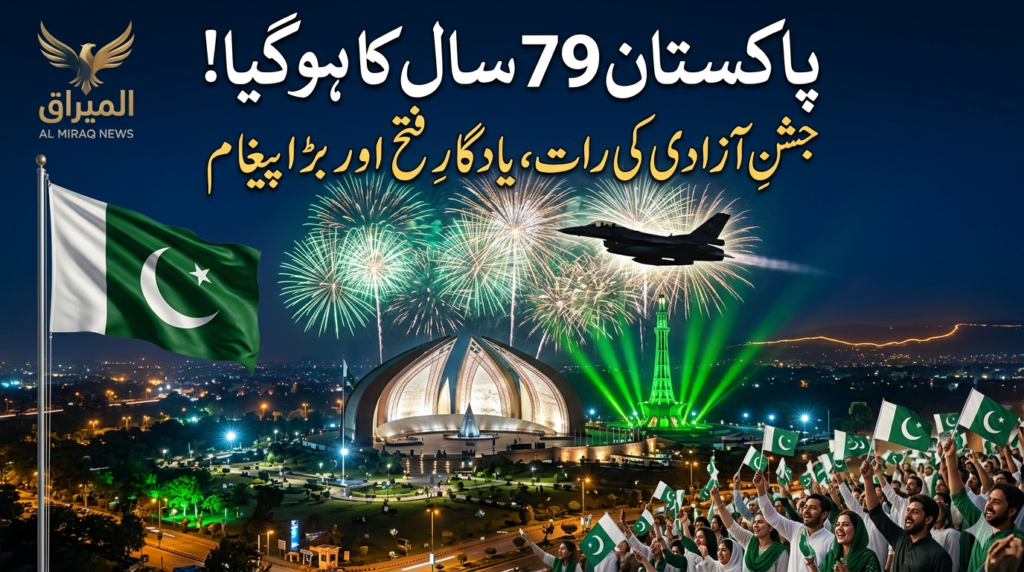
Pakistan marked its 79th Independence Day with celebrations across the country, as cities were illuminated in green and white, national flags filled major roads and public spaces, and official ceremonies were held from Karachi to Islamabad and from Lahore to Quetta.
The celebrations combined traditional Independence Day ceremonies with a major official event in Islamabad: the inauguration of Yadgar-e-Fatah, a memorial presented by Pakistani authorities as a symbol of the country’s military achievements, national unity and sacrifices made by soldiers.
The day began with flag-hoisting ceremonies, gun salutes and special events at important national landmarks. At the mausoleum of Pakistan’s founder, Muhammad Ali Jinnah, a ceremonial guard change was held, while officials paid their respects and offered prayers.
Celebrations Begin Across Pakistan
As midnight approached on August 14, celebrations reached their peak in cities throughout Pakistan.
Major roads were decorated with national flags, while buildings and landmarks were illuminated with green-and-white lighting.
In Islamabad, prominent buildings and major avenues were transformed with decorative lights. Karachi also hosted fireworks and public celebrations, while Lahore’s Liberty Chowk was decorated for Independence Day festivities.
The celebrations extended across all four provinces and other parts of the country, reflecting the nationwide character of Pakistan’s Independence Day.
From families gathering in public spaces to large official ceremonies, the day featured patriotic songs, fireworks, cultural performances and flag displays.
Guard Change Ceremony Held at Quaid’s Mausoleum
One of the traditional highlights of Independence Day took place at the mausoleum of Quaid-e-Azam Muhammad Ali Jinnah in Karachi.
A contingent from the Pakistan Naval Academy assumed guard duties during a formal guard-changing ceremony.
Senior officials also visited the mausoleum, laid floral wreaths and offered prayers in honour of Pakistan’s founder.
The ceremony reflected the traditional connection between Independence Day celebrations and remembrance of the leaders who played a central role in the creation of Pakistan.
Pakistan Monument Hosts Flag-Hoisting Ceremony
In Islamabad, the Pakistan Monument hosted a major Independence Day flag-hoisting ceremony.
According to the supplied broadcast transcript, Chairman Senate Syed Yousuf Raza Gilani attended the event as the chief guest.
Gun salutes were also held in Islamabad and provincial capitals as part of the official Independence Day programme.
The ceremonies were accompanied by patriotic music and messages highlighting national unity, sovereignty and the country’s future.
Yadgar-e-Fatah Becomes Major Independence Day Highlight
The most prominent official event was the inauguration ceremony of Yadgar-e-Fatah in Islamabad.
The memorial was presented as a tribute to the sacrifices of soldiers and as a symbol of what Pakistani authorities describe as the country’s success during the 2025 India-Pakistan confrontation.
President Asif Ali Zardari, Prime Minister Shehbaz Sharif and Field Marshal Syed Asim Munir attended the ceremony.
At midnight, the national flag was raised as the memorial was illuminated with elaborate lighting and projection mapping.
The event also featured a flypast by Pakistan Air Force aircraft.
The ceremony brought together representatives of the armed forces, civil administration and different regions of Pakistan.
Memorial Highlights National Unity
Officials described Yadgar-e-Fatah as a symbol of national unity and the sacrifices of soldiers.
Military and civil armed forces contingents from Punjab, Sindh, Khyber Pakhtunkhwa, Balochistan, Azad Jammu and Kashmir and Gilgit-Baltistan participated in the ceremony.
Their participation was presented as a visual representation of Pakistan’s territorial diversity and national unity.
A documentary presentation also showed the construction and development of the memorial.
The ceremony combined military traditions with modern visual technology, including projection mapping, music and lighting.
Zardari Praises Military Leadership
President Asif Ali Zardari addressed the Yadgar-e-Fatah ceremony and praised Pakistan’s armed forces.
According to the transcript, he credited the military leadership under Field Marshal Syed Asim Munir with responding to India during the 2025 confrontation.
Prime Minister Shehbaz Sharif also praised the armed forces, describing the memorial as a representation of national determination and military capability.
The statements reflected Pakistan’s official narrative surrounding the 2025 conflict.
Because India has its own account of the confrontation, descriptions of the conflict and its outcome should be understood as statements reflecting Pakistan’s official position rather than as an uncontested international assessment.
Pakistan Warns Over Water Security
Water security also featured prominently in the Independence Day message.
Prime Minister Shehbaz Sharif warned that Pakistan’s water resources were a critical national interest and said Pakistan would respond if its concerns were not addressed.
He also emphasised that Pakistan wanted peace but that its desire for peace should not be interpreted as weakness.
The issue is particularly sensitive because Pakistan and India have a long-running dispute over the Indus Waters Treaty and the management of shared river resources.
For Pakistan, water is closely connected to agriculture, food security, energy production and the wider economy.
Wagah Border Celebrates Independence Day
The Wagah border also became a major centre of Independence Day activity.
The area echoed with patriotic slogans as Pakistan Rangers personnel participated in a special ceremony.
The border ceremony has traditionally attracted large crowds and remains one of the most recognisable symbols of the relationship between Pakistan and India.
This year’s celebrations came against the backdrop of continuing political and security tensions between the two countries.
Pakistan Highlights Regional Defence Cooperation
The transcript also referred to the recently announced defence cooperation involving Pakistan, Saudi Arabia and Türkiye.
Officials have described the arrangement as aimed at collective defence and regional stability rather than being directed against a specific country.
The three countries have longstanding military and diplomatic relationships, and greater cooperation could expand their coordination in defence, training and security.
The development comes at a time when the Middle East and South Asia are experiencing significant geopolitical changes.
Norway and Pakistan Discuss Security Cooperation
Pakistan also continued diplomatic engagement with European countries.
Norway’s foreign minister met Pakistan’s prime minister and military leadership during a visit that included discussions on bilateral relations and regional security.
According to the transcript, the two sides discussed cooperation in multiple areas, including security and defence.
Pakistan also encouraged Norwegian companies to explore investment opportunities in the country’s oil and gas sector.
The discussions indicate Islamabad’s continuing effort to expand economic and diplomatic relationships beyond its traditional partners.
Security Incidents Reported Across Pakistan
While Independence Day celebrations dominated the national atmosphere, several security incidents were also reported.
In Lahore, a police operation targeted suspects allegedly involved in the killing of police personnel in Badami Bagh.
The transcript reported that suspect Rehan Bhatt was killed during an encounter in Sheikhupura, while several alleged associates were arrested.
Separately, security forces conducted operations in parts of Khyber Pakhtunkhwa against suspected militants.
These incidents highlight the continuing security challenges facing Pakistan even as the country celebrated Independence Day.
Karachi Reports Multiple Firing Incidents
Karachi also witnessed several incidents involving aerial firing during the celebrations.
According to the broadcast transcript, multiple people were injured in different parts of the city, while one woman was reportedly killed.
Police also arrested several suspects allegedly involved in aerial firing and recovered weapons.
Aerial firing has repeatedly been criticised by authorities because bullets fired into the air can fall unpredictably and cause serious injuries or deaths.
The incidents served as a reminder that public celebrations can also create serious safety risks when firearms are misused.
Transporters and Petroleum Dealers Announce Strike
Another major domestic development was the dispute between the government and transport and petroleum-sector representatives.
According to the transcript, negotiations between the government and goods transporters did not produce an agreement.
The transporters demanded practical implementation of their demands and indicated that their strike would continue until their concerns were addressed.
Petroleum dealers also maintained their plan for a nationwide strike.
A prolonged transport disruption could affect the movement of food, livestock feed and other essential goods.
The possibility of petrol stations closing also raised concerns about transportation and supply chains.
Fuel Prices Increase
The transcript also reported an increase in petroleum prices.
According to the figures included in the broadcast, petrol prices increased by Rs45 per litre, while diesel prices also rose.
Such increases can have a direct effect on transportation costs, logistics and household expenses.
For a country where road transport plays a major role in moving goods and people, changes in fuel prices can quickly affect prices across other sectors of the economy.
Independence Day Celebrations Continue Into the Night
Despite political, economic and security challenges, Independence Day celebrations continued throughout the night.
Fireworks were held in several cities, while public spaces remained decorated with Pakistani flags.
Cultural performances and national songs added to the atmosphere.
In Lahore, musical programmes were held at cultural venues, while Karachi hosted fireworks and public celebrations.
Schools, colleges and community organisations also participated in patriotic programmes.
A Celebration That Combines History and Modern Pakistan
Pakistan’s 79th Independence Day brought together several different aspects of the country’s identity.
The ceremonies at Jinnah’s mausoleum connected the celebrations with Pakistan’s founding history.
The Pakistan Monument represented the national capital’s role in the country’s political identity.
Yadgar-e-Fatah represented the military narrative surrounding the 2025 conflict.
Meanwhile, public celebrations, music, fireworks and social-media activity reflected how Independence Day has evolved into a major cultural event for younger generations.
What Pakistan’s 79th Independence Day Means
For Pakistanis, August 14 remains more than a public holiday.
It is a day associated with the country’s creation, the sacrifices of the independence movement and the generations that followed.
This year’s celebrations also reflected the challenges Pakistan faces today: regional tensions, water security, terrorism, economic pressure and the need for stronger international partnerships.
The official messages repeatedly emphasised national sovereignty and unity.
At the same time, Pakistan’s leadership said it wanted peace and regional stability.
Looking Ahead
As Pakistan moves toward its 80th year since independence, the country’s next chapter will be shaped by how effectively it manages its internal and external challenges.
Economic stability, political cooperation, security, water resources and regional diplomacy will all remain important.
The country’s relationships with India, China, Saudi Arabia, Türkiye, Iran, the United States and European partners will continue to influence its strategic position.
For ordinary citizens, however, Independence Day remains primarily a celebration of national identity.
The green-and-white flags, patriotic songs, fireworks and family gatherings provide a reminder of the country’s history while expressing hopes for a more stable and prosperous future.
Conclusion
Pakistan’s 79th Independence Day was marked by celebrations across the country, major ceremonies at national landmarks and the inauguration of Yadgar-e-Fatah in Islamabad.
From the guard-changing ceremony at Quaid-e-Azam’s mausoleum to the spectacular midnight ceremony at the Victory Memorial, the celebrations combined history, patriotism and national security.
At the same time, the day unfolded against a backdrop of serious political, economic and security challenges.
For Pakistan, the celebrations were ultimately both a look back at the country’s journey since 1947 and a statement about the direction it hopes to take in the years ahead.
Al Miraq — Beyond the Headlines.