
By Al Miraq News Desk
Published: August 28, 2026
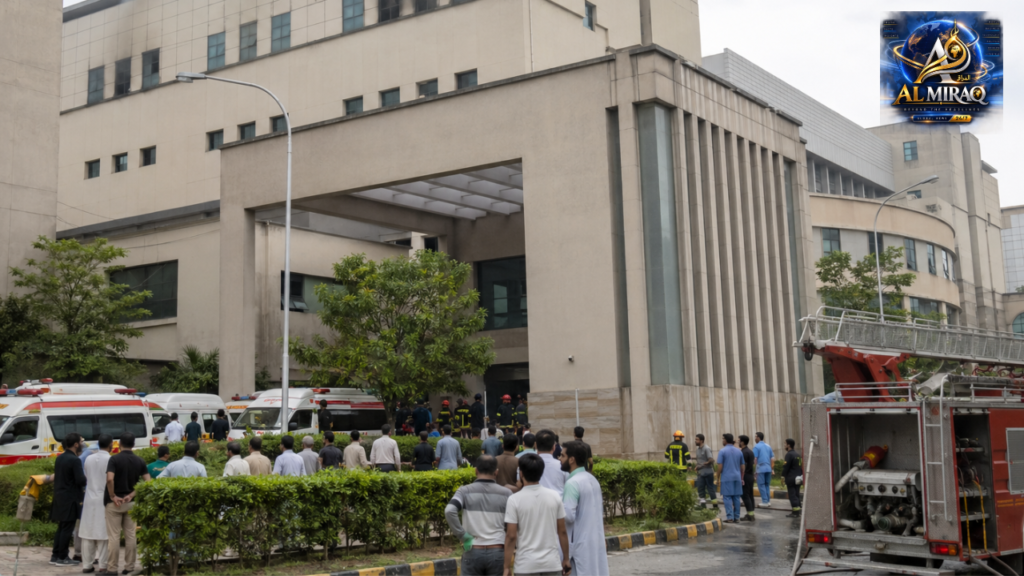
The devastating PIMS fire safety controversy has intensified after 14 newborn babies died in a fire at the Pakistan Institute of Medical Sciences (PIMS) in Islamabad, with reports raising serious questions about the hospital’s fire-prevention arrangements, emergency exits and regulatory oversight.
The fire broke out early Wednesday, August 26, in the nursery of the Mother and Child Health Centre at PIMS.
The tragedy has since moved beyond questions about the immediate cause of the fire.
The allegations remain subject to investigation.
What Happened at PIMS?
The fire erupted in the neonatal area of PIMS’s Mother and Child Health ward during the early hours of Wednesday.
According to PIMS officials, the nursery contained 15 newborns at the time. Initial reports attributed the fire to an electrical or air-conditioning-related fault, although the exact cause remains under investigation. Different official and media accounts have described the suspected trigger in somewhat different terms, including an air-conditioner compressor failure, an electrical short circuit and a spark that rapidly intensified in an oxygen-rich environment.
The presence of oxygen equipment in a neonatal intensive-care environment is an important factor in understanding why a relatively localized fire can become extremely dangerous.
The tragedy prompted an immediate government response.
Prime Minister Shehbaz Sharif ordered a high-level inquiry and suspended Federal Health Secretary Aslam Ghori.
PIMS Fire Safety NOC Becomes a Major Question
One of the most serious developments following the tragedy is the reported absence of a fire-safety NOC for PIMS.
Sources cited by Geo News and other Pakistani media outlets said PIMS did not have the required fire-safety NOC when the fire occurred. The revelation has raised questions over how a major public-sector hospital could continue operating while questions remained over its compliance with fire-safety requirements.
The issue is particularly significant because PIMS is one of the country’s major public hospitals and serves patients from Islamabad as well as other parts of Pakistan.
A fire-safety NOC is not simply an administrative document.
That importance becomes even greater in neonatal units.
Newborn babies in intensive care cannot evacuate themselves. Many depend on incubators, oxygen systems, monitoring equipment and continuous medical support. Any emergency evacuation therefore requires specialized planning, trained personnel, functioning alarms and clearly accessible escape routes.
The reported absence of a valid fire-safety NOC has consequently become one of the central questions surrounding the PIMS tragedy.
Questions Raised About Islamabad’s Healthcare Regulator
The controversy has also expanded to the Islamabad Healthcare Regulatory Authority, or IHRA.
The authority is responsible for regulating healthcare facilities in Islamabad, including licensing and regulatory oversight. Reports citing sources said the regulator itself had inadequate fire-safety arrangements and allegedly lacked a fire-safety completion certificate at its own premises.
If confirmed through official investigation, such circumstances would raise significant questions about the effectiveness of the regulatory framework.
Sources cited in reports have also alleged that hospitals can receive or renew licences without adequate verification of fire-safety arrangements and relevant NOCs.
CDA Had Reportedly Raised Fire Safety Concerns
Another important element of the developing story concerns the Capital Development Authority (CDA).
According to reports citing sources, the CDA had written to the Islamabad Healthcare Regulatory Authority twice, asking it not to issue certificates to hospitals that lacked adequate fire-safety arrangements. The reports say the authority did not respond to those letters.
These questions could determine whether the disaster was the result of an isolated technical failure or whether it exposed deeper institutional weaknesses.
Reports Point to Broader Fire Safety Problems
The PIMS tragedy has also prompted scrutiny of fire-safety arrangements at other major healthcare facilities in Islamabad.
Reports have raised concerns about fire-prevention mechanisms at the Federal Government Polyclinic Hospital, including allegations that smoke detectors and other fire-safety systems were inadequate and that the hospital had not obtained the relevant fire department NOC.
The reports also said the CDA had previously written to hospital authorities regarding fire-safety protocols.
Separately, concerns have been raised about fire-safety arrangements at the Capital Development Hospital, including questions about emergency evacuation routes and fire-control facilities.
These claims require independent verification and should not automatically be interpreted as evidence that the hospitals are currently unsafe. However, they demonstrate why the PIMS disaster has triggered calls for a wider review rather than an investigation limited to a single building.
A nationwide assessment of hospital fire safety could determine whether similar weaknesses exist in other public and private healthcare facilities.
Emergency Exits and Response Under Examination
Fire-safety compliance involves much more than extinguishers.
A hospital needs functioning alarms, smoke detection, emergency lighting, accessible escape routes, fire doors, trained staff, evacuation procedures and equipment that can be used immediately.
A report reviewed after the PIMS fire indicated that some emergency exits were locked or obstructed and raised concerns about the hospital’s fire-prevention arrangements. It also reported questions surrounding the initial response and whether hospital security hindered firefighters during the early stages of the operation.
These claims are particularly important because seconds can determine survival during a hospital fire.
PIMS administration, however, has disputed aspects of the criticism. The hospital said emergency exits were operational and that staff used the fire extinguishers installed at the facility while attempting to control the blaze.
The conflicting accounts underline why an independent investigation is necessary.
Rather than relying on individual statements, investigators can examine CCTV footage, emergency call records, fire brigade logs, building plans, inspection records, maintenance documents and staff testimony to reconstruct the incident.
Air Conditioning and Electrical Faults Under Investigation
The suspected role of the air-conditioning system has also attracted attention.
Initial reports indicated that an air-conditioning compressor may have exploded or malfunctioned, while other statements referred to an electrical short circuit or spark. PIMS management said the fire intensified rapidly after ignition and that oxygen connections associated with incubators contributed to the rapid spread.
Reports have also raised concerns about damaged electrical wiring and malfunctioning air-conditioning equipment at the hospital.
However, photographs or videos showing damaged equipment after a fire do not by themselves establish what caused the blaze.
Determining the cause will require technical examination of the equipment, electrical systems and relevant maintenance records.
Investigators will also need to determine whether the equipment had been inspected regularly, whether previous faults had been reported and whether maintenance work had been completed appropriately.
Why Fire Safety Is Especially Critical in Neonatal Units
The PIMS incident highlights a fundamental challenge in hospital emergency planning: not every patient can escape independently.
A healthy adult may be able to walk or run away from a fire alarm. A newborn in an incubator cannot.
Neonatal units therefore require specialized emergency procedures. Staff must be trained to move vulnerable infants rapidly while maintaining essential medical support.
Fire safety in such environments must also account for oxygen systems, electrical equipment, incubators, monitoring devices and other equipment that can complicate an emergency.
This makes prevention particularly important.
A functioning alarm can provide valuable warning. Smoke detectors can identify a fire before flames spread extensively. Properly maintained electrical equipment can reduce ignition risks. Clear emergency routes can make evacuation faster.
The absence or failure of any one of these systems can create additional danger.
Government Investigation Could Determine Responsibility
The federal government has established a high-level inquiry committee to investigate the PIMS fire.
The committee has been tasked with determining the immediate cause of the blaze, establishing a timeline, examining the response of hospital staff and emergency agencies, reviewing evacuation procedures and assessing compliance with fire-safety regulations.
It has also been given authority to identify possible negligence and recommend administrative reforms.
This investigation will be critical in separating confirmed failures from allegations.
The most important questions include:
- What exactly caused the fire?
- Were all required fire-safety certificates valid?
- Were emergency exits accessible?
- Were alarms and smoke detectors functioning?
- Were fire extinguishers and other equipment operational?
- Were staff adequately trained for neonatal evacuation?
- How quickly did emergency services receive the fire alert?
- Did hospital security or other factors delay firefighters?
- Were previous maintenance or safety warnings ignored?
- Who was legally responsible for ensuring compliance?
Answers to those questions could determine whether disciplinary or legal action follows.
The Tragedy Raises Wider Concerns for Pakistan’s Hospitals
The PIMS fire has significance beyond Islamabad because it has exposed the vulnerability of healthcare facilities where patients depend entirely on institutional safety systems.
Hospitals contain electrical equipment, oxygen systems, generators, air-conditioning units, chemicals and other infrastructure that can increase fire risks.
At the same time, many patients cannot evacuate without assistance.
That combination makes hospital fire prevention a public-safety issue rather than simply a building-management concern.
The tragedy could therefore become a turning point if authorities use it to conduct comprehensive inspections of hospitals across Pakistan.
Such an exercise would need to go beyond paperwork.
Hospitals should be assessed for the actual condition of their equipment, accessibility of evacuation routes, functionality of alarms, staff preparedness and the ability of emergency services to reach critical areas.
Regulatory Oversight Will Face Greater Scrutiny
The reported questions surrounding IHRA and CDA could also lead to a broader debate about how healthcare safety is regulated in Islamabad.
A licensing system is only effective if safety requirements are independently verified and violations result in corrective action.
If a hospital can continue operating despite unresolved fire-safety deficiencies, the regulatory process may fail at its most important purpose.
At the same time, authorities must establish facts before assigning blame.
The current allegations concern multiple institutions and should be tested against official records, inspection reports, correspondence and applicable regulations.
The PIMS inquiry could therefore have implications for the entire healthcare regulatory system in the capital.
What Remains Unclear
Despite the growing amount of information available, several critical questions remain unanswered.
The exact cause of the fire has not yet been conclusively established.
There are also differing accounts regarding the precise timing of the fire, the emergency call and the arrival of firefighters. Officials and hospital representatives have provided accounts that investigators will need to reconcile using independent records.
Questions about the fire-safety NOC, emergency exits, maintenance arrangements and regulatory licensing also require documentary confirmation.
The distinction between a reported deficiency and an officially established violation is important.
A credible investigation should therefore make its evidence publicly available wherever possible and clearly identify which failures were confirmed, which were procedural shortcomings and which allegations could not be substantiated.
A Test of Accountability and Hospital Safety
The deaths of 14 newborns at PIMS have created a profound national tragedy and placed hospital safety under intense scrutiny.
The immediate focus will remain on determining what caused the fire and whether it could have been prevented. But the wider question is whether Pakistan’s hospitals are sufficiently prepared to protect patients who cannot protect themselves.
The reported absence of a fire-safety NOC at PIMS, allegations concerning regulatory oversight and questions about emergency infrastructure all demand careful examination. None should be treated as conclusively proven until supported by the relevant investigation and official records.
What is already clear is that the tragedy has exposed the potentially devastating consequences of weak fire-prevention systems in a healthcare environment.
For PIMS, the investigation will determine responsibility for the August 26 fire. For Islamabad’s healthcare system, however, the consequences could be much broader.
If authorities respond with transparent investigations, stronger inspections, properly enforced certification requirements and regular emergency drills, the deaths of the 14 newborns could lead to meaningful reforms.
If warnings and regulatory shortcomings are once again overlooked, the central lesson of the PIMS fire may remain unlearned.
The future of PIMS fire safety and hospital safety across Islamabad will ultimately depend not only on identifying what went wrong, but on ensuring that the systems designed to protect patients actually work when lives depend on them.
Al Miraq — Beyond the Headlines.