
By Al Miraq News Desk
Published: August 28, 2026
The Sindh High Court has taken an unusually stern view of delays in a narcotics case, ordering police to bring the investigation officer to court in handcuffs after he repeatedly failed to appear and had not submitted the case challan despite the accused remaining in jail for months.
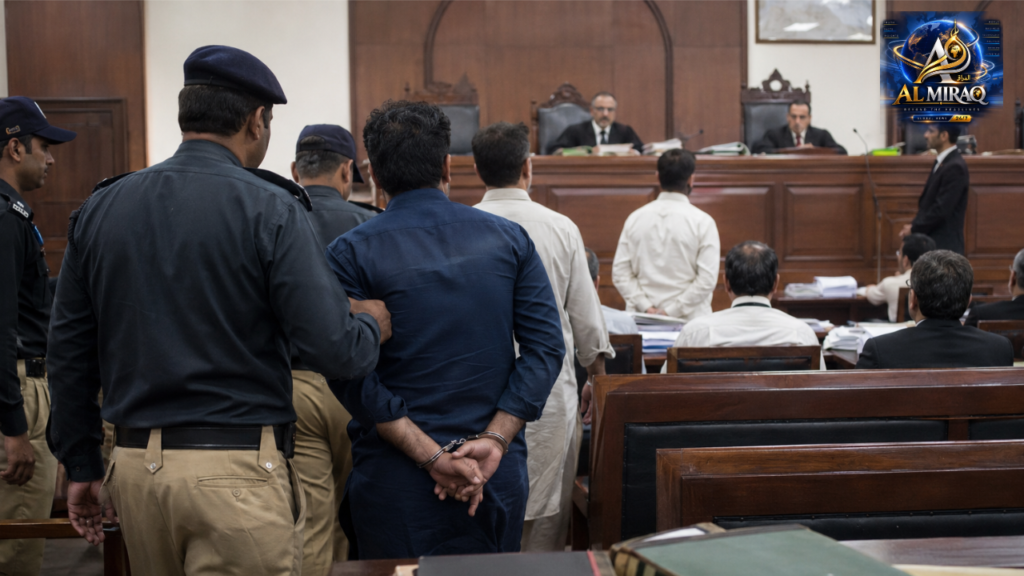
During the hearing, Justice Muhammad Iqbal Kalhoro expressed strong displeasure over the investigation officer’s absence and questioned why the required challan had not been submitted. The court subsequently ordered the officer to be brought before it, leading Boat Basin police to present him in handcuffs.
The proceedings have highlighted concerns about delays in criminal investigations and the consequences that procedural failures can have for people held in custody.
The Sindh High Court’s official case-law system records Justice Muhammad Iqbal Kalhoro as a judge of the Karachi court and shows his involvement in criminal bail matters.
Sindh High Court Takes Serious Notice of Investigation Delay
The defence told the court that the case had been registered on March 20 and that the accused had remained behind bars for approximately five months. Despite the passage of that period, the investigation officer had allegedly failed to submit the challan before the relevant court.
The court’s concern became more pronounced when the investigation officer did not appear despite being summoned.
Justice Muhammad Iqbal Kalhoro questioned the police about the officer’s absence and directed that he be brought before the court.
Court Orders Police to Produce Officer
At the beginning of the hearing, the judge expressed displeasure over the investigation officer’s failure to appear.
The officer was subsequently brought to the court in handcuffs.
The unusual step underlined the seriousness with which the court viewed the officer’s failure to comply with its directions.
Officer Cites Financial Problems for Delay
He explained that he lived in a rented house and was facing financial difficulties.
The explanation did not satisfy the court.
Two Accused Granted Bail
The bail order is significant because prolonged detention before trial can become a major legal concern when criminal proceedings are not progressing within the required framework.
Bail is a procedural relief and does not by itself amount to an acquittal.
The underlying criminal case can continue through the appropriate legal process.
Action Ordered Against Investigation Officer
In addition to granting bail to the accused, the court directed the Deputy Inspector General of Police, South Zone, to take action against the investigation officer.
This direction places the officer’s conduct under the scrutiny of senior police authorities.
The reported proceedings indicate that the court was particularly concerned by three issues: the officer’s failure to appear before the court, the failure to submit the challan, and the fact that accused persons had remained in jail while the investigation remained incomplete.
The court’s direction means that the matter could have consequences for the officer beyond the individual criminal case.
Any eventual departmental action, however, would depend on the competent police authority and the applicable service and disciplinary procedures.
Why the Challan Matters in a Criminal Case
The controversy also illustrates why timely completion of investigations is important in Pakistan’s criminal justice system.
Pakistan’s criminal procedure framework contains provisions governing the submission of police reports after investigation. Sindh High Court case-law has previously discussed the importance of investigation reports and the legal framework governing delays in investigation.
When an accused is already in custody, delays can become particularly consequential because the individual remains deprived of liberty while the prosecution and investigation move forward.
This is why courts regularly scrutinize unexplained delays and demand accountability from investigating authorities.
Boat Basin Police Station and Narcotics Cases
Boat Basin Police Station in Karachi’s South district has handled a range of criminal cases, including narcotics-related matters.
Sindh High Court records show that narcotics cases registered at Boat Basin have previously reached the court in bail proceedings. For example, a December 2025 order by Justice Muhammad Iqbal Kalhoro concerned a case registered at Boat Basin Police Station under provisions of the Control of Narcotic Substances Act.
The court’s case database also records other Boat Basin narcotics cases involving post-arrest bail applications.
This broader judicial record demonstrates that narcotics investigations frequently become the subject of bail proceedings and judicial scrutiny, particularly when questions arise concerning evidence, investigation procedures or custody.
The Larger Question of Police Investigation Quality
The proceedings have also raised broader questions about the effectiveness of police investigations in serious criminal cases.
An investigation officer plays a central role in converting an initial criminal complaint into a properly investigated case. The officer is responsible for gathering evidence and completing procedural requirements so that the court can determine the matter according to law.
Court Oversight and Police Accountability
The incident also demonstrates the role of superior courts in supervising the conduct of public officials when their actions affect judicial proceedings.
Courts generally depend on police investigators to provide accurate records and timely reports. When an investigating officer does not comply with court directions, the court has the authority to demand an explanation and, where appropriate, direct relevant authorities to take action.
The reported order to produce the officer in handcuffs was an especially forceful response.
However, the wider significance lies not simply in the unusual courtroom episode but in the question of institutional accountability.
A criminal justice system depends on coordination between investigators, prosecutors, defence lawyers and courts. Failure at any one stage can slow the entire process.
The Sindh High Court’s intervention therefore sends a clear message that delays affecting people in custody can attract serious judicial attention.
What Remains Unclear
While the hearing provides a clear account of the court’s dissatisfaction with the investigation officer, several aspects of the underlying case remain matters for the regular criminal process.
Likewise, the court’s criticism of the investigation officer does not by itself establish criminal misconduct. Any departmental or other action ordered against him would need to follow the applicable legal and administrative procedures.
It is also important to distinguish the judge’s comments during the hearing from a final judicial finding concerning the officer’s overall service record or professional competence.
The reported financial explanation given by the officer was his stated reason for the delay.
The court has nevertheless made clear that the circumstances were serious enough to warrant action and further scrutiny.
What the Case Means for Karachi’s Criminal Justice System
The proceedings could have significance beyond the two accused persons involved in this particular case.
Karachi’s criminal justice system handles a large volume of cases, placing substantial demands on police investigators, prosecutors and courts. Timely investigation is essential if cases are to move efficiently from registration to trial.
When investigation officers fail to submit required reports, courts may face difficulty in determining how cases should proceed.
For accused persons, especially those unable to secure timely bail, delays can have direct consequences for personal liberty.
For law-enforcement agencies, meanwhile, judicial criticism can serve as a reminder that investigative responsibilities are subject to court oversight.
The case therefore raises an important institutional issue: police efficiency is not simply an administrative matter. It can directly affect constitutional and legal rights, the functioning of courts and public confidence in the justice system.
A Strong Judicial Message on Delayed Investigations
The Sindh High Court’s handling of the matter represents a particularly strong judicial response to what the court viewed as unacceptable investigative delay.
The incident has drawn attention to the responsibilities of investigating officers and the importance of ensuring that criminal cases do not become stalled because of administrative or procedural failures.
The case also illustrates the distinction between allegations and judicial findings.
As the matter moves forward, attention is likely to remain focused on the action taken by senior police authorities against the investigation officer and on the progress of the underlying narcotics case. The Sindh High Court’s intervention has nevertheless already sent a strong message that investigative delays involving people in custody can attract direct and forceful judicial scrutiny.
Al Miraq — Beyond the Headlines.