
By Al Miraq News Desk
Published: August 17, 2026
Category: Business / Pakistan
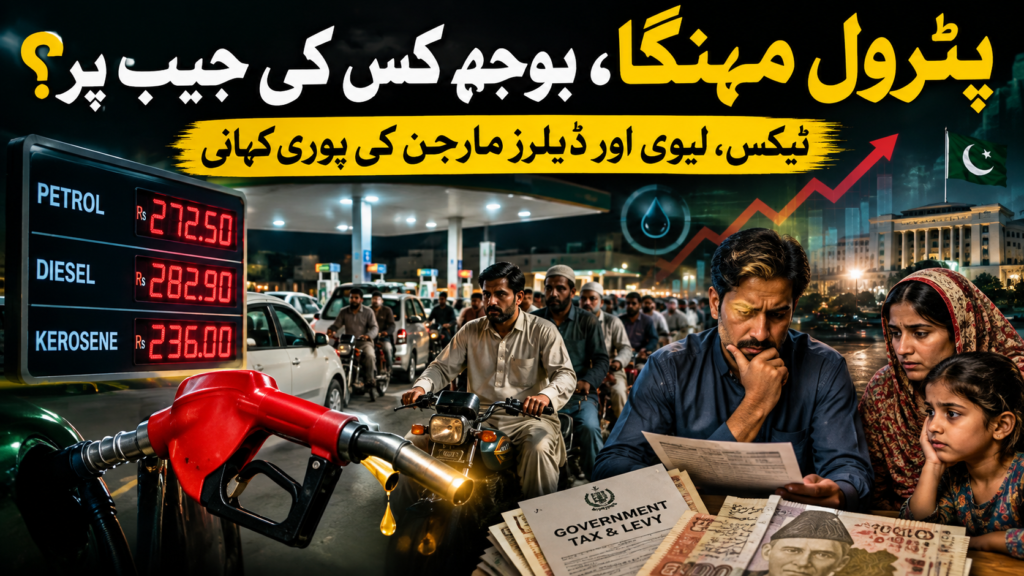
Petrol prices have once again become a major economic and political issue in Pakistan, with government decisions over fuel pricing, taxes, levies and dealer margins raising fresh questions about who ultimately bears the cost.
At one end of the debate, US President Donald Trump has spoken about higher fuel costs as a sacrifice that consumers may have to make for what he describes as a broader global objective.
In Pakistan, meanwhile, the government has increased the petroleum dealers’ margin on petrol and diesel by Rs1.34 per litre, taking the margin from Rs8.64 to Rs9.98 per litre, according to the information presented in the supplied news transcript.
The increase has been followed by a strike call from petroleum dealers, adding another layer of uncertainty to an already sensitive fuel market.
But behind the political statements and industry disputes lies a much simpler question:
Who ultimately pays the price when the cost of petroleum rises?
For millions of Pakistanis, the answer is the ordinary consumer.
Why Petrol Prices Matter So Much
Petrol is not simply another household expense.
It is directly connected to transportation, logistics, food distribution, agriculture, business activity and everyday commuting.
A change of even a few rupees per litre can eventually make its way through the economy.
A motorcyclist may pay more to travel to work.
A family may spend more on daily transportation.
A transport operator may face higher operating costs.
Businesses may have to spend more to move products from factories and warehouses to markets.
Those additional expenses can eventually affect the prices consumers pay for everyday goods.
This creates what economists often describe as a ripple effect.
The impact of fuel prices does not necessarily stop at the petrol station.
It can spread throughout the wider economy.
Dealer Margin Increased by Rs1.34 Per Litre
One of the central developments highlighted in the transcript is the increase in the petroleum dealers’ margin.
The margin has reportedly been increased from Rs8.64 per litre to Rs9.98 per litre.
That represents an increase of Rs1.34 per litre.
Petroleum dealers argue that their operating costs and business pressures have increased, while consumers are primarily concerned about the final price they have to pay at fuel stations.
This creates a difficult balancing act.
Dealers need sufficient margins to operate their businesses, maintain fuel stations and cover expenses.
At the same time, consumers are already dealing with high living costs.
The question is therefore not simply whether dealers should receive a higher margin.
The larger question is how the entire petroleum pricing structure affects the final consumer.
Petroleum Dealers Announce Strike
The increase in dealer margins has triggered a response from the petroleum dealers’ association.
According to the supplied transcript, the petroleum dealers have announced a strike.
A fuel-sector strike can have consequences far beyond petrol stations.
If fuel stations stop operating normally, transportation can be disrupted.
Public transport operators may face difficulties.
Private motorists may rush to fuel stations before a strike begins, potentially creating unusually long queues.
Supply chains can also be affected if fuel availability becomes uncertain.
This is why disputes involving petroleum dealers often receive immediate public attention.
The Real Question: Who Pays?
The most important issue raised by the transcript is the effect on ordinary Pakistanis.
When petroleum prices or associated costs increase, consumers can experience the impact through several channels.
Transportation
People who use motorcycles, cars, buses, taxis and other vehicles can face higher travel costs.
For workers who commute long distances every day, even a small increase can become significant over the course of a month.
Food Prices
Food does not simply appear in shops.
Agricultural products have to move from farms to markets.
Food products may then move from wholesale markets to retailers.
Each stage requires transportation.
Higher fuel costs can therefore increase the cost of moving food through the supply chain.
Business Costs
Businesses also depend on fuel.
Factories, distributors, retailers and service providers may all be indirectly affected by higher transportation costs.
When operating expenses rise, some businesses may pass part of those costs to consumers.
Household Budgets
For families already managing tight budgets, additional transportation and food expenses can reduce the amount of money available for other needs.
This is why fuel prices often become a politically sensitive issue.
Pakistan’s Petroleum Levy Revenue
The transcript also highlights the government’s petroleum levy revenue.
According to the figures provided, the government collected approximately Rs1,567 billion through the petroleum levy during the previous financial year.
The transcript says this was Rs9 billion above the target.
Petroleum levy collections are an important source of government revenue.
However, from the perspective of consumers, the question is how these revenues affect the overall cost of living.
When fuel prices remain high, the government can collect substantial revenue through petroleum-related taxes and levies.
That creates a difficult policy debate.
The government needs revenue to finance public spending and meet fiscal obligations.
Consumers, however, want affordable fuel and relief from rising living costs.
Government Spending and the Fiscal Challenge
The figures cited in the transcript provide a broader picture of Pakistan’s financial pressures.
The total expenditure figure mentioned is approximately Rs2,387 billion, while the transcript also cites a budget deficit figure of Rs4,776 billion.
It further highlights interest payments of approximately Rs6,947 billion.
These numbers point toward a major challenge facing Pakistan’s government: managing public finances while trying to provide economic relief to citizens.
Debt servicing can consume a substantial portion of government resources.
That leaves policymakers facing difficult choices.
Should more revenue be collected through taxes and levies?
Should government spending be reduced?
Should subsidies be expanded?
Or should consumers continue to absorb a significant portion of rising costs?
There is no simple answer.
Why Petroleum Levy Matters
The petroleum levy is particularly important because it is collected on petroleum products.
When consumers purchase fuel, a portion of the amount they pay can ultimately contribute to government revenue through taxes and levies.
This makes petroleum pricing politically sensitive.
A government can increase revenue through fuel-related taxation, but higher fuel costs can simultaneously place pressure on households and businesses.
This creates a fundamental policy dilemma.
Higher revenue can help the government manage its finances, but higher fuel costs can increase the financial pressure on citizens.
Does Better Government Revenue Mean Relief for Citizens?
This is perhaps the most important question raised by the transcript.
If government revenue collections are improving, when will ordinary Pakistanis actually feel the benefit?
Government financial indicators can improve while households continue to struggle.
There can be several reasons for this.
A government may have to use additional revenue to service debt.
It may need to finance defence, infrastructure, public-sector salaries and other essential expenditures.
It may also need to meet international financial commitments.
Therefore, increased government revenue does not automatically translate into immediate reductions in petrol prices.
But from the consumer’s perspective, the distinction can be frustrating.
People do not experience government revenue through budget documents.
They experience the economy through:
- Petrol prices
- Electricity bills
- Grocery prices
- Transport fares
- School expenses
- Rent
- Healthcare costs
- Employment opportunities
That is why economic relief ultimately needs to reach households rather than remain visible only in government statistics.
The Petrol Price Ripple Effect
The effect of fuel prices can be illustrated through a simple example.
Consider a truck carrying goods from Karachi to Lahore.
The truck consumes diesel during the journey.
If diesel becomes more expensive, the transporter’s operating cost increases.
The transporter may then charge more for delivering the goods.
The wholesaler receives the products at a higher cost.
The retailer may subsequently adjust prices.
Finally, the consumer pays more.
The same principle can apply to agricultural products, manufactured goods and other commodities.
This is why petroleum pricing is closely connected to inflation.
Public Transport Could Also Be Affected
Fuel prices are particularly important for people who do not own private vehicles.
Public transport operators depend heavily on petrol and diesel.
If operating costs rise significantly, transport companies and individual operators may seek higher fares.
For low-income workers and students, higher fares can become a serious financial burden.
A person who travels twice a day may not notice a small increase on a single journey.
But when that increase is multiplied by dozens of journeys each month, the cumulative cost becomes significant.
Small Increase, Large Impact
The debate over fuel prices often focuses on the amount per litre.
But the actual impact depends on consumption.
A household that uses only a small amount of fuel may experience limited direct impact.
A person commuting long distances every day may experience a much larger increase.
Commercial drivers and transport companies can face even greater exposure because their businesses depend directly on fuel.
Therefore, the economic impact of a petroleum price increase is not evenly distributed.
What Happens During a Fuel Strike?
A prolonged petroleum dealers’ strike could create additional problems.
If fuel stations close, motorists may rush to stations that remain operational.
This can create:
- Long queues
- Temporary shortages
- Increased pressure on transport
- Disruption to deliveries
- Higher uncertainty for businesses
If the dispute continues for an extended period, the consequences can become wider.
However, the ultimate impact depends on the duration of the strike, government negotiations and fuel availability.
Government Faces a Difficult Balancing Act
The government has to balance several competing priorities.
On one side is the need to maintain sufficient revenue.
On the other is the need to keep inflation under control.
Then there are petroleum dealers who require commercially viable margins.
There are also transport operators, businesses and households whose costs increase when fuel becomes more expensive.
This makes petroleum pricing one of the most politically sensitive economic decisions in Pakistan.
What Consumers Want
For ordinary consumers, the debate is ultimately straightforward.
They want predictable fuel prices.
They want affordable transportation.
They want food prices to remain manageable.
And they want improvements in government finances to eventually translate into better living conditions.
People are less interested in abstract financial indicators than in whether they can afford their monthly expenses.
That is why every major fuel-price decision receives immediate public attention.
The Bigger Economic Question
Pakistan’s petroleum debate is part of a much larger economic challenge.
The country needs sustainable government revenue.
It also needs economic growth, investment, exports and job creation.
At the same time, inflation must remain manageable.
Heavy reliance on indirect taxes can place disproportionate pressure on consumers, particularly lower- and middle-income households.
The long-term solution therefore cannot depend solely on fuel-related revenue.
A stronger economy requires broader sources of revenue and higher productivity.
What Could Provide Relief?
Long-term relief for consumers would likely require improvements across several areas of the economy.
These could include:
Stronger economic growth:
Higher growth can create jobs and improve household incomes.
Better tax collection:
A broader tax base could reduce pressure on individual sectors.
Lower energy costs:
More efficient energy systems could reduce costs for businesses and consumers.
Debt management:
Lower debt-servicing pressure could create more fiscal space.
Targeted subsidies:
Where necessary, assistance can be directed toward vulnerable households rather than applied universally.
Transport efficiency:
Better public transportation and logistics infrastructure can reduce dependence on expensive private travel.
Conclusion
Pakistan’s latest petroleum debate is about far more than the price displayed at a fuel station.
The increase in dealers’ margins, the announced strike, petroleum levy collections and the government’s broader fiscal position all point toward a much larger question about how economic pressure is distributed across society.
The government needs revenue.
Petroleum dealers need sustainable margins.
Businesses need predictable operating costs.
But ordinary citizens ultimately feel the consequences through transportation, food and everyday expenses.
The figures cited in the transcript show that the government is collecting significant petroleum-related revenue while also facing substantial expenditure and debt-servicing pressures.
The key question for Pakistan’s economy is therefore not simply whether government finances are improving.
It is whether those improvements will eventually translate into real and visible relief for ordinary Pakistanis.
For millions of households, that relief will be measured not in billions of rupees on a government balance sheet, but in the price of a litre of petrol, the cost of a daily commute and the amount left in their pocket at the end of the month.
Al Miraq — Beyond the Headlines.