
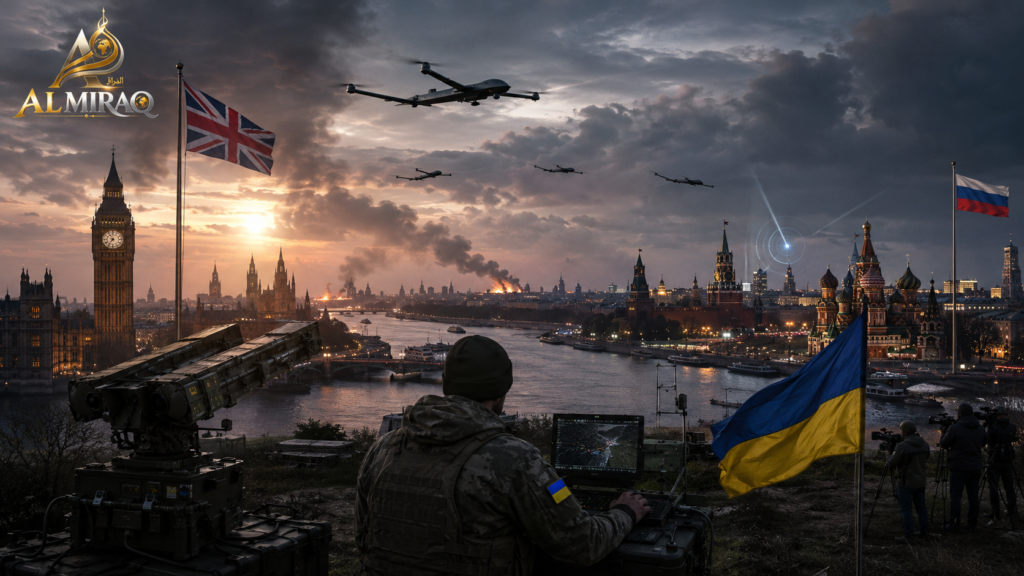
Britain has reaffirmed its unwavering support for Ukraine after Russia warned that London could face consequences over reports that British-made drones have been used in long-range attacks against targets inside Russian territory.
The latest development has increased tensions between Moscow and London at a time when Ukraine has significantly expanded its ability to conduct deep strikes against Russian military and economic targets.
British Prime Minister Andy Burnham said the United Kingdom would continue to stand behind Ukraine, describing Britain’s position as consistent throughout the war. His comments came after Russian Foreign Minister Sergey Lavrov said Moscow had grounds to regard Britain’s involvement as direct participation in the conflict.
The dispute highlights the increasingly complicated role of Western weapons in the Russia-Ukraine war, particularly as Kyiv develops longer-range capabilities to strike targets far beyond the front line.
Russia Warns Britain Over Alleged Use of British-Made Drones
Moscow has reacted strongly to reports that British-made drones were involved in long-range Ukrainian strikes against Russian territory.
Lavrov said Russia had the right to consider British involvement in such attacks as participation in the war, raising concerns about further escalation between Russia and a major NATO member.
The Russian government has repeatedly warned Western countries that supplying weapons and military assistance to Ukraine could make them increasingly involved in the conflict. The latest warning, however, comes as Ukraine’s ability to conduct attacks deep inside Russia continues to expand.
Russia’s embassy in London also warned that Britain’s actions could have consequences, accusing the UK of becoming more deeply involved in supporting Kyiv.
Britain has rejected the idea that its military assistance represents participation in Russia’s war. Instead, London maintains that Ukraine has the right to defend itself against Russia’s invasion.
UK Says Support for Ukraine Will Not Change
Prime Minister Andy Burnham has made clear that Britain intends to continue supporting Ukraine despite Moscow’s latest warning.
The UK government says its military assistance is intended to help Ukraine defend itself against Russia’s invasion rather than directly enter the war.
Burnham emphasized that Britain’s support has remained consistent under successive governments and that London would continue standing with Kyiv.
The UK’s position reflects its broader strategy since Russia launched its full-scale invasion of Ukraine in February 2022. Britain has been among Ukraine’s most prominent European military supporters, providing weapons, training, intelligence assistance and financial backing.
The latest comments suggest that London does not intend to reduce that support because of Russian threats.
Ukraine Expands Its Long-Range Drone Campaign
Ukraine has increasingly relied on long-range drones as an important part of its strategy against Russian targets.
Unlike traditional artillery and short-range weapons, long-range drones can travel hundreds of miles and allow Ukraine to strike infrastructure located far behind the battlefield.
Ukrainian forces have used domestically produced drones to target facilities linked to Russia’s military campaign, including logistics infrastructure, industrial sites and energy-related targets.
The growing scale of Ukraine’s drone production has also reduced its dependence on foreign-supplied systems for some long-range missions.
Recent attacks demonstrate how quickly drone warfare has developed during the conflict. Large numbers of Ukrainian drones have been launched toward Russian territory, including the Moscow region.
Russia has responded by deploying air-defence systems and reporting the interception of large numbers of drones.
Moscow Region Comes Under Heavy Drone Attack
The latest escalation follows a series of significant Ukrainian drone attacks against the Moscow region.
Russian authorities have reported large-scale drone interceptions during recent attacks, while local officials have reported casualties and damage to infrastructure.
In one major attack, Russian authorities said hundreds of Ukrainian drones were intercepted across the country. The Moscow region was among the areas affected, with damage reported at several locations.
Reuters reported that an earlier large-scale attack on the Moscow region killed an elderly man and caused damage to a warehouse near Moscow. Russian authorities said hundreds of drones had been shot down across the country.
The attacks demonstrate Ukraine’s growing ability to bring the war closer to Russia’s political and economic centre.
For Moscow, the increased frequency of these attacks presents both a military and political challenge.
Britain’s Role Goes Beyond Drones
Although the controversy currently centres on British-made drones, Britain’s role in supporting Ukraine is much broader.
Since the beginning of the full-scale war, the UK has supplied Ukraine with a range of military equipment, including artillery systems, armoured vehicles, anti-tank weapons and longer-range strike capabilities.
Britain has also provided training and intelligence support.
Long-range weapons have become particularly important because they give Ukraine the ability to target military infrastructure and supply networks far behind the front line.
British intelligence and satellite information have also been valuable to Ukrainian forces, helping them identify potential targets and monitor Russian military activity.
The UK has additionally committed substantial funding for Ukrainian drones. Britain announced a package worth hundreds of millions of pounds that includes support for the supply of large numbers of drones to Ukraine. Reuters reported that the UK has committed to providing 150,000 drones by the end of 2026.
British Drones and the Question of Direct Involvement
One of the most sensitive issues surrounding the latest dispute is whether supplying a weapon means the supplying country becomes a direct participant in a conflict.
Russia argues that Western countries are becoming increasingly involved because their weapons are being used against Russian territory.
Britain, however, maintains that providing weapons to Ukraine does not mean British forces are participating directly in attacks.
The distinction is important because direct military involvement between Britain and Russia could dramatically increase the risks of a wider confrontation involving NATO.
For now, there is no indication that Britain intends to deploy combat forces against Russia. London’s stated policy remains focused on helping Ukraine defend itself.
The British government has also not publicly confirmed reports that particular British-made drones were used in specific strikes inside Russia.
Russia Has Threatened Western Support Before
Moscow’s latest warning is not the first time Russia has threatened countries supporting Ukraine.
Since the beginning of the full-scale invasion, Russian officials have repeatedly warned Western governments that supplying increasingly advanced weapons could lead to retaliation.
The rhetoric has intensified whenever Ukraine has received weapons capable of striking targets at greater distances.
Britain has nevertheless continued supplying military equipment to Ukraine.
The UK has also been one of the European countries pushing allies to provide Kyiv with stronger military capabilities.
This has included support for artillery, armoured vehicles, air defence and longer-range strike systems.
NATO Faces a Delicate Balance
The latest confrontation comes as European countries attempt to maintain support for Ukraine while avoiding a direct war with Russia.
NATO members have repeatedly stated that they are not seeking a direct military confrontation with Moscow.
At the same time, European governments argue that Ukraine must have the ability to defend itself and resist Russian attacks.
This creates a difficult strategic balance.
If Western countries provide Ukraine with increasingly advanced weapons, Russia may respond with stronger threats or covert measures. If support is reduced, Ukraine could face greater military pressure.
Britain appears to have chosen the first approach, arguing that continued military assistance is necessary to help Ukraine withstand Russia’s invasion.
Russia Could Increase Pressure Through Covert Operations
British officials and security experts have previously warned that Russia could use methods short of conventional military attacks to pressure European countries.
These could include cyber operations, espionage, sabotage and other forms of covert disruption.
The UK and other European governments have already increased attention on critical infrastructure and national security as tensions with Moscow have grown.
Any increase in Russian covert activity would add another layer to the confrontation between Britain and Russia.
Rather than a direct battlefield conflict, the confrontation could increasingly involve cyberattacks, intelligence operations, infrastructure disruption and military signalling.
Ukraine Still Faces Heavy Russian Attacks
While Ukraine is increasingly capable of striking deep inside Russia, Kyiv remains under severe pressure from Russian missile and drone attacks.
The country’s air-defence systems remain a crucial part of its ability to protect civilians and critical infrastructure.
Ukraine has repeatedly appealed to Western allies for additional air-defence systems, particularly advanced missile interceptors.
The continuing attacks demonstrate that Ukraine’s military needs extend far beyond offensive drones.
Kyiv requires ammunition, air-defence missiles, intelligence, financial assistance and other forms of military support to maintain its defence.
This is one reason British and European assistance remains strategically important.
Why the Latest UK-Russia Dispute Matters
The dispute over British-made drones is significant because it highlights how the nature of the Ukraine war has changed.
In the early stages of the conflict, Ukraine depended heavily on short-range Western weapons and conventional battlefield equipment.
Today, Ukraine has developed a much larger domestic drone industry and is capable of conducting attacks hundreds of miles from the front line.
At the same time, Western countries are providing increasingly sophisticated equipment and intelligence.
That combination has made the boundary between domestic Ukrainian capabilities and foreign military assistance increasingly difficult to separate.
Russia’s reaction shows that Moscow is closely watching the source and capabilities of weapons being used against targets inside its territory.
Could the Situation Lead to Direct UK-Russia Conflict?
Despite the increasingly strong language coming from Moscow, a direct military confrontation between Britain and Russia remains unlikely.
Both countries understand the potentially catastrophic consequences of a direct conflict involving a NATO member and Russia.
Britain’s stated policy is to support Ukraine while avoiding direct participation in combat operations against Russia.
Russia, meanwhile, has continued to focus the overwhelming majority of its military operations on Ukraine.
However, the possibility of escalation cannot be completely dismissed.
A serious incident involving British personnel, Russian forces or NATO territory could create a much more dangerous situation.
For that reason, governments on both sides are likely to continue carefully calibrating their actions and public statements.
Britain’s Ukraine Policy Remains Firm
The latest comments from London indicate that Britain’s fundamental policy toward Ukraine has not changed.
Despite Moscow’s warning, the UK continues to argue that Ukraine has the right to defend itself and that Western assistance is necessary to help Kyiv resist Russia’s invasion.
The British government has also signalled that it will continue providing military equipment and other forms of assistance.
For Ukraine, that support remains important as the conflict enters another increasingly technology-driven phase.
Long-range drones are now a central component of the war, while air defence, intelligence and precision weapons remain critical to Ukraine’s ability to operate effectively.
What Happens Next?
The immediate question is whether Russia will take any concrete action against Britain following its latest warnings.
Moscow has not announced a direct military response, and Britain has shown no sign of changing its policy because of the threats.
The more likely scenario is continued diplomatic pressure combined with possible cyber, intelligence or other covert activity.
Meanwhile, Ukraine is expected to continue developing and using long-range drones as it seeks to disrupt Russian military infrastructure and supply networks.
The situation will also be closely watched by other European governments, many of which are increasing their own military support for Kyiv.
For now, Britain’s message is clear: London intends to continue supporting Ukraine despite Russia’s warnings.
The latest confrontation therefore represents another test of the fragile balance between Western military assistance to Ukraine and the risk of a wider confrontation with Russia.
As the war increasingly extends beyond traditional front-line battles, drones, intelligence and long-range weapons are reshaping the conflict—and Britain’s role in supporting Ukraine is likely to remain a major point of tension between London and Moscow.
Al Miraq will continue to monitor developments in the Russia-Ukraine war and Britain’s response to Moscow’s latest warnings.