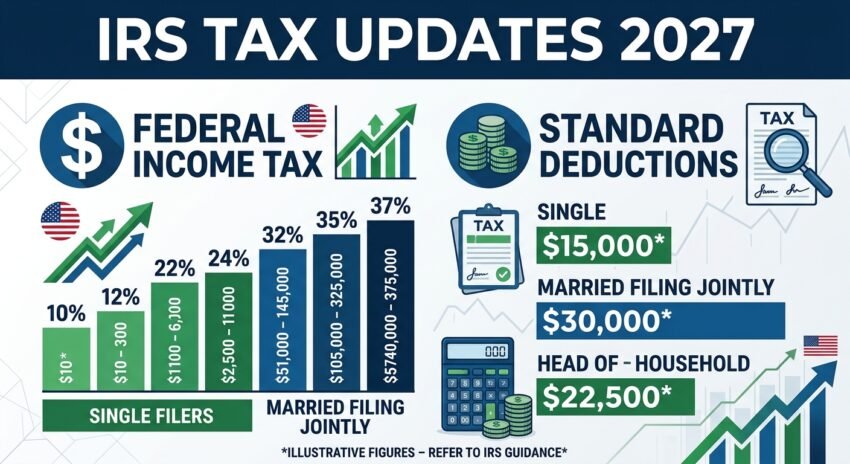
Millions of Americans could receive some additional tax relief in 2027 as the Internal Revenue Service (IRS) increases the federal standard deduction by $500 for individual taxpayers. The adjustment is part of the agency’s annual inflation-related tax changes and is expected to help workers, families, and households keep a slightly larger portion of their income away from federal income taxation.
According to the IRS announcement released on November 5, 2026, the standard deduction for single taxpayers will increase from $16,100 in 2026 to $16,600 in 2027. Married couples filing jointly will see their standard deduction rise from $32,200 to $33,200, representing a $1,000 increase for the household.
These changes are important because the standard deduction reduces the amount of income subject to federal income tax. As a result, eligible taxpayers may have a lower taxable income when filing their 2027 tax returns.
The updated deduction is part of a broader set of federal tax adjustments covering income tax brackets, child tax credits, estate tax exemptions, and other provisions. While the additional $500 does not mean every American will receive a $500 tax refund, it could provide meaningful savings depending on individual income and tax circumstances.
Here is what taxpayers should know about the new standard deduction, how it works, and what the changes could mean for personal finances in 2027.
What Does the Extra $500 Tax Deduction Mean?
The additional $500 refers to the increase in the standard deduction available to single taxpayers for the 2027 tax year.
A standard deduction is an amount that eligible taxpayers can subtract from their income before calculating their federal income tax. Instead of listing individual deductible expenses, taxpayers can choose this simplified deduction when filing their annual tax returns.
For example, a single taxpayer earning $60,000 in 2027 could generally subtract the new $16,600 standard deduction from their adjusted gross income, assuming they qualify and have no other relevant adjustments.
This would leave $43,400 in taxable income before considering any additional deductions or adjustments.
In comparison, the 2026 standard deduction is $16,100. Therefore, the new amount allows eligible single taxpayers to exclude an additional $500 from taxable income.
For married couples filing jointly, the increase is even larger at the household level. Their standard deduction will rise by $1,000, from $32,200 to $33,200.
It is important to understand that this is an increase in the amount of income that can be deducted, not a direct $500 payment from the federal government.
New Standard Deduction Amounts for 2027
The IRS has announced updated standard deduction amounts for different filing categories. These changes will generally apply to income earned during the 2027 tax year.
Here is a comparison of the 2026 and 2027 standard deductions:
| Filing Status | 2026 Standard Deduction | 2027 Standard Deduction | Increase |
|---|---|---|---|
| Single taxpayers | $16,100 | $16,600 | $500 |
| Married filing jointly | $32,200 | $33,200 | $1,000 |
| Head of household | $24,150 | $24,925 | $775 |
| Married filing separately | $16,100 | $16,600 | $500 |
The increases are intended to reflect inflation and help taxpayers maintain some purchasing power as living costs and wages change.
The adjustment is especially relevant for workers who rely on regular salaries and do not have significant itemized deductions.
Why Is the IRS Increasing the Standard Deduction?
Inflation is one of the primary reasons the IRS updates standard deductions and federal income tax brackets every year.
When prices increase, employees may receive higher salaries to manage expenses such as rent, groceries, transportation, healthcare, and utilities. However, higher nominal earnings can also increase taxable income.
Without adjustments to the tax system, taxpayers could gradually move into higher tax brackets or lose some of their purchasing power because of inflation.
This situation is commonly called bracket creep.
Annual inflation adjustments help reduce this problem by increasing income thresholds and deductions. The IRS uses legally established inflation-related calculations to update several tax provisions.
For 2027, the standard deduction increase is one of the most noticeable changes for ordinary taxpayers because it directly affects how much income can be excluded from federal income taxation.
Who Will Benefit From the Additional $500 Deduction?
The new standard deduction may benefit a wide range of American taxpayers, although the exact financial impact will depend on income, filing status, and individual tax circumstances.
1. Single Workers
Single employees will see their standard deduction increase to $16,600 in 2027.
This means they can generally deduct an additional $500 compared with the previous tax year. Workers earning salaries from full-time or part-time employment may benefit from the higher deduction when calculating their federal taxable income.
2. Married Couples
Married couples filing joint tax returns will receive a larger standard deduction of $33,200.
The $1,000 increase compared with 2026 gives eligible households additional room to reduce taxable income.
For couples managing mortgage payments, childcare costs, transportation expenses, and everyday household bills, even modest tax savings may help their annual budgets.
3. Heads of Households
Individuals who qualify for head-of-household filing status will receive a standard deduction of $24,925 in 2027.
This is an increase of $775 from the previous year’s amount.
The higher deduction could be particularly helpful for eligible taxpayers who support qualifying dependents and manage household expenses on a single income.
4. Retirees and Older Taxpayers
Retirees who qualify for the standard deduction may also benefit from the updated amount.
Their overall federal tax liability will depend on the types of income they receive, including wages, pensions, retirement account withdrawals, and taxable Social Security benefits.
Older taxpayers should also review other applicable deductions and tax provisions when preparing their 2027 financial plans.
How Much Money Could Taxpayers Actually Save?
One common misunderstanding about the additional $500 deduction is that taxpayers will automatically receive $500 in cash.
That is not how the standard deduction works.
The $500 represents additional income that can be deducted before federal income tax is calculated. The actual tax savings depend on the taxpayer’s marginal tax rate.
For example, consider a single taxpayer whose marginal federal income tax rate is 12%.
An additional $500 deduction could reduce federal income tax by approximately $60, assuming the entire additional deduction reduces income that would otherwise be taxed at that rate.
A taxpayer in the 22% marginal tax bracket could potentially save around $110 from the same additional deduction.
Here are simplified examples:
| Marginal Tax Rate | Additional Deduction | Potential Tax Savings |
|---|---|---|
| 10% | $500 | $50 |
| 12% | $500 | $60 |
| 22% | $500 | $110 |
| 24% | $500 | $120 |
| 32% | $500 | $160 |
| 35% | $500 | $175 |
| 37% | $500 | $185 |
These are illustrative calculations, not guaranteed savings. Actual results can vary depending on taxable income, other deductions, credits, and applicable tax rules.
For married couples filing jointly, the standard deduction increase is $1,000, so the potential savings may be higher depending on their marginal tax rate.
How the New Standard Deduction Fits Into the 2027 Tax Brackets
The higher standard deduction is only one part of the IRS’s 2027 tax adjustment announcement.
The agency has also increased federal income tax bracket thresholds while keeping the seven marginal tax rates unchanged.
The federal income tax rates for 2027 will remain:
- 10%
- 12%
- 22%
- 24%
- 32%
- 35%
- 37%
However, taxpayers will generally need higher taxable incomes to enter the next tax bracket.
For example, the 10% tax rate will apply to taxable income up to $12,800 for single taxpayers and $25,600 for married couples filing jointly.
The 12% bracket will apply to income above those amounts, with the next thresholds adjusted accordingly.
These changes are designed to help prevent inflation-related wage increases from automatically pushing taxpayers into higher marginal tax brackets.
When combined with the higher standard deduction, the updated income thresholds could help eligible Americans reduce their overall federal tax burden.
When Will the New Tax Deduction Take Effect?
The new standard deduction amounts apply to the 2027 tax year.
This means they will generally apply to income earned between January 1 and December 31, 2027.
Taxpayers will use the updated deduction when preparing their 2027 federal income tax returns, which will generally be filed in 2028.
The changes should not be confused with the 2026 tax deductions that apply to income earned during the current year.
Anyone preparing a 2026 tax return in early 2027 should continue using the applicable 2026 tax rules rather than the newly announced 2027 amounts.
Understanding the difference between the tax year and the filing year is important for avoiding mistakes during tax preparation.
Standard Deduction vs. Itemized Deductions: Which Is Better?
American taxpayers generally have two main options when claiming deductions on their federal income tax returns: taking the standard deduction or itemizing eligible deductions.
The standard deduction is a fixed amount based on filing status. It allows taxpayers to reduce taxable income without calculating and documenting every eligible expense.
Itemized deductions, on the other hand, allow eligible taxpayers to deduct certain qualifying expenses according to IRS rules.
These may include qualifying mortgage interest, eligible charitable contributions, certain state and local taxes, and qualifying medical expenses.
For many taxpayers, the standard deduction is the simpler and more beneficial option.
However, people with substantial deductible expenses may find that itemizing provides a greater tax benefit.
Taxpayers should compare both options before filing their returns to determine which method is more advantageous.
Other Important IRS Tax Changes for 2027
Along with the additional standard deduction, the IRS has announced several other inflation adjustments that could affect American households.
Higher Child Tax Credit
The maximum Child Tax Credit will increase to $2,300 per qualifying child in 2027, up from $2,200 in 2026.
The maximum refundable portion will also increase to $1,800.
This adjustment could provide additional support to eligible families with children, although income limits and qualifying-child requirements will continue to apply.
Higher Estate Tax Exemption
The federal estate tax exclusion will increase to $15.48 million for individuals who die during 2027.
This is an increase from the $15 million exclusion applicable to 2026.
The adjustment may be important for families with substantial assets and people planning long-term wealth transfers.
Increased Annual Gift Tax Exclusion
The annual gift tax exclusion will rise to $20,000 per recipient in 2027, compared with $19,000 in 2026.
This allows eligible individuals to give more money to each recipient without including those gifts in their total taxable gifts, subject to applicable IRS requirements.
Higher Earned Income Tax Credit
The maximum Earned Income Tax Credit for eligible taxpayers with three or more qualifying children will increase to $8,496 in 2027.
This is an increase from $8,231 in 2026.
The credit is designed to support qualifying workers and families with low to moderate incomes.
What Should Taxpayers Do to Prepare for 2027?
Although the new standard deduction will not apply to 2026 income, taxpayers can begin preparing for the upcoming tax year.
Here are several useful steps:
Review Your Expected Income: Estimate your total earnings for 2027, including salaries, bonuses, freelance income, and other taxable sources.
Check Your Tax Withholding: Employees may want to review their withholding if their income, filing status, or household circumstances change.
Compare Deduction Options: Consider whether the standard deduction or itemized deductions will provide the greater tax benefit.
Understand Tax Credits: Review eligibility for the Child Tax Credit, Earned Income Tax Credit, and other available tax benefits.
Maintain Financial Records: Keep important income statements, receipts, charitable contribution records, and other tax documents organized.
Seek Professional Guidance: Taxpayers with investments, businesses, multiple income sources, or complicated financial circumstances may benefit from speaking with a qualified tax professional.
Taking these steps can make tax planning easier and help reduce unexpected tax liabilities.
Conclusion
The IRS decision to increase the standard deduction for 2027 offers additional tax relief to eligible American taxpayers. Single filers will be able to deduct $16,600, which is $500 more than in 2026, while married couples filing jointly will receive a $33,200 deduction, an increase of $1,000.
Although the additional deduction does not represent a direct $500 government payment, it can reduce taxable income and potentially lower federal income tax bills.
The higher standard deduction is also accompanied by updated income tax brackets, an increased Child Tax Credit, and other inflation-related adjustments.
For American workers, families, and retirees, understanding these changes can help with budgeting, withholding decisions, and future tax preparation.
The key takeaway is that eligible taxpayers may be able to protect a larger portion of their income from federal taxation in 2027. Reviewing the updated IRS rules and planning ahead can help households make better financial decisions and take advantage of the deductions available to them.