Understanding the 2027 tax brackets and federal income tax rates is important for millions of Americans preparing for the next tax year. The Internal Revenue Service (IRS) has announced updated income thresholds, standard deductions, and several other tax provisions that will affect how individuals and families calculate their federal income taxes in 2027.
The new adjustments are designed to account for inflation and help taxpayers avoid paying higher taxes simply because their earnings have increased over time. Although the seven federal income tax rates will remain unchanged, the income limits for each tax bracket will increase.
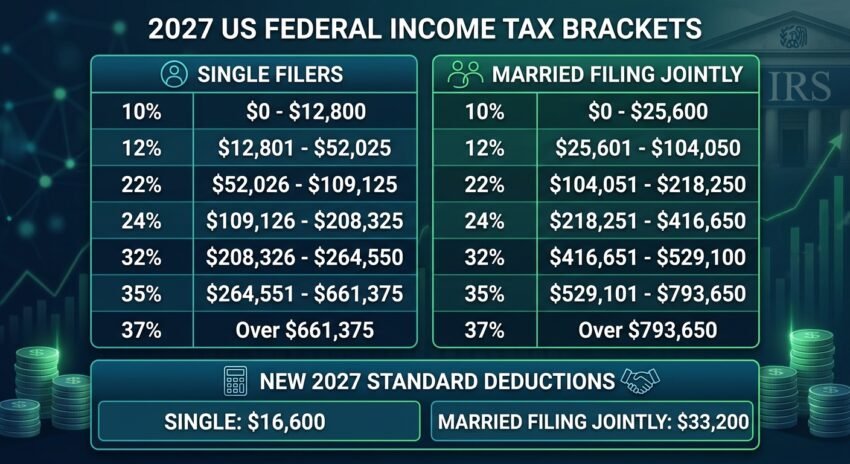
According to the Tax Foundation’s latest analysis, the top federal income tax rate of 37% will apply to single taxpayers with taxable income above $661,375 and married couples filing jointly with taxable income above $793,650.
The IRS has also increased the standard deduction, adjusted the Alternative Minimum Tax (AMT), and updated several tax credits and exemptions. These changes could influence financial planning decisions for employees, business owners, retirees, and families across the United States.
The updated tax provisions generally apply to income earned during the 2027 tax year, with taxpayers filing their corresponding federal income tax returns in 2028.
In this guide, we explain the 2027 federal income tax brackets, how the new rates work, who may benefit, and what American taxpayers should know before preparing their taxes.
What Are the Federal Income Tax Brackets for 2027?
The United States uses a progressive federal income tax system. This means that different portions of a taxpayer’s taxable income are taxed at different rates.
For 2027, the federal government will continue using seven individual income tax rates:
- 10%
- 12%
- 22%
- 24%
- 32%
- 35%
- 37%
The IRS has increased the income thresholds associated with these rates to reflect inflation.
This adjustment is important because it allows taxpayers to earn more taxable income before entering higher tax brackets.
The following tables show the updated federal income tax brackets for the 2027 tax year.
2027 Federal Income Tax Brackets for Single Filers
Single taxpayers will face the following federal income tax thresholds in 2027:
| Tax Rate | Taxable Income |
|---|---|
| 10% | $0 – $12,800 |
| 12% | $12,801 – $52,025 |
| 22% | $52,026 – $109,125 |
| 24% | $109,126 – $208,325 |
| 32% | $208,326 – $264,550 |
| 35% | $264,551 – $661,375 |
| 37% | $661,376 or more |
These income limits apply to taxable income rather than total annual earnings.
For example, a single employee earning $70,000 annually may have a lower taxable income after subtracting the standard deduction and any other eligible adjustments.
The employee’s taxable income, rather than the full $70,000 salary, determines which portions of income fall into each tax bracket.
2027 Federal Income Tax Brackets for Married Couples Filing Jointly
Married couples filing joint federal income tax returns will have higher income thresholds than single taxpayers.
The 2027 tax brackets for married couples filing jointly are:
| Tax Rate | Taxable Income |
|---|---|
| 10% | $0 – $25,600 |
| 12% | $25,601 – $104,050 |
| 22% | $104,051 – $218,250 |
| 24% | $218,251 – $416,650 |
| 32% | $416,651 – $529,100 |
| 35% | $529,101 – $793,650 |
| 37% | $793,651 or more |
These wider income ranges reflect the different filing status used by married couples.
The updated thresholds may provide additional flexibility for households with two earners or families managing multiple sources of income.
However, couples should consider their combined taxable income, deductions, and applicable credits when estimating their total federal tax liability.
2027 Tax Brackets for Heads of Households
Taxpayers who qualify for head-of-household filing status will also receive updated income thresholds.
The 2027 federal income tax brackets for heads of households are:
| Tax Rate | Taxable Income |
|---|---|
| 10% | $0 – $18,250 |
| 12% | $18,251 – $69,650 |
| 22% | $69,651 – $109,100 |
| 24% | $109,101 – $208,300 |
| 32% | $208,301 – $264,550 |
| 35% | $264,551 – $661,350 |
| 37% | $661,351 or more |
Head-of-household status generally applies to eligible unmarried taxpayers who meet specific household maintenance and qualifying-person requirements.
This filing category can offer more favorable income thresholds and a higher standard deduction than the single filing category.
Taxpayers should review IRS eligibility rules carefully before selecting their filing status.
Why Are the 2027 Federal Tax Brackets Changing?
Inflation is one of the main reasons behind the annual adjustments to federal income tax brackets.
As the cost of living increases, employees may receive higher wages to manage expenses such as housing, groceries, transportation, insurance, and healthcare.
However, without adjustments to tax thresholds, these salary increases could push taxpayers into higher tax brackets even when their purchasing power has not increased.
This problem is commonly known as bracket creep.
To address this issue, the IRS adjusts various tax provisions annually using inflation-related calculations.
The Tax Foundation explains that the IRS uses the Chained Consumer Price Index for All Urban Consumers (C-CPI-U) for many inflation adjustments.
For the 2027 tax year, the average increase across inflation-adjusted tax parameters is approximately 3.2%.
These adjustments help maintain the relationship between income growth and federal taxation.
What Is the Standard Deduction for 2027?
The standard deduction is one of the most important parts of the federal income tax system.
It allows eligible taxpayers to subtract a fixed amount from their income before calculating federal income taxes.
For 2027, the IRS has increased standard deduction amounts for different filing categories.
| Filing Status | 2027 Standard Deduction |
|---|---|
| Single | $16,600 |
| Married Filing Jointly | $33,200 |
| Head of Household | $24,925 |
Compared with 2026, the standard deduction will increase by $500 for single taxpayers and $1,000 for married couples filing jointly.
Heads of households will receive an increase of $775.
For example, a single taxpayer with $60,000 in adjusted gross income who qualifies for the $16,600 standard deduction would generally have $43,400 in taxable income before considering other applicable adjustments.
This deduction can reduce the amount of income subject to federal income tax.
Taxpayers generally choose between the standard deduction and itemizing eligible deductions. They cannot claim both for the same return.
Understanding Marginal Tax Rates in 2027
One common misunderstanding about federal income tax brackets is that people believe their entire income is taxed at the highest bracket they reach.
However, the United States uses a progressive tax system, meaning different portions of taxable income are taxed at different rates.
For example, a single taxpayer with $100,000 in taxable income does not pay 22% on the entire amount.
Instead, the taxpayer pays:
- 10% on the first $12,800.
- 12% on income between $12,800 and $52,025.
- 22% on income above $52,025 up to $100,000.
This system ensures that higher tax rates apply only to the portions of income within the relevant brackets.
The highest marginal tax rate is therefore not the same as the taxpayer’s effective tax rate.
The effective tax rate represents the percentage of total taxable income actually paid in federal income taxes after applying the relevant brackets and accounting for applicable tax provisions.
2027 Alternative Minimum Tax (AMT) Changes
The Alternative Minimum Tax is another important part of the federal tax system.
It was designed to ensure that certain higher-income taxpayers pay a minimum amount of federal income tax, even when they qualify for deductions and other tax benefits under the regular tax system.
For 2027, the AMT exemption amounts will increase.
The updated exemption amounts are:
| Filing Status | AMT Exemption |
|---|---|
| Unmarried Individuals | $93,000 |
| Married Filing Jointly | $144,700 |
The exemption phaseout will begin at $515,950 for unmarried individuals and $1,031,900 for married couples filing jointly.
The AMT uses separate calculations and two tax rates: 26% and 28%.
Taxpayers with higher incomes, certain deductions, or complicated financial arrangements may need to consider both the regular federal income tax system and the AMT when estimating their tax obligations.
2027 Earned Income Tax Credit Changes
The Earned Income Tax Credit (EITC) is an important federal tax benefit for eligible workers and families with low to moderate incomes.
The credit is designed to provide financial assistance to qualifying individuals based on their earned income, filing status, and number of qualifying children.
For 2027, the maximum EITC amounts will be:
| Number of Qualifying Children | Maximum EITC |
|---|---|
| No Children | $685 |
| One Child | $4,573 |
| Two Children | $7,552 |
| Three or More Children | $8,496 |
The actual credit depends on income, filing status, and other eligibility requirements.
The updated amounts could provide additional financial support to qualifying working households.
Eligible taxpayers should use the IRS eligibility guidelines to determine whether they qualify for the credit.
2027 Child Tax Credit
Families with qualifying children may also benefit from an increased Child Tax Credit.
The maximum Child Tax Credit will rise to $2,300 per qualifying child in 2027, representing an increase of $100 compared with the previous year.
The maximum refundable portion will increase to $1,800.
The credit can help eligible families manage household expenses, childcare costs, education-related expenses, and other financial responsibilities.
However, the amount a family receives depends on applicable income limits, qualifying-child requirements, and other tax rules.
Parents should review the latest IRS guidance before calculating their expected tax benefits.
2027 Long-Term Capital Gains Tax Rates
Federal taxes on long-term capital gains are different from ordinary income tax rates.
Long-term capital gains generally apply to profits from selling qualifying investments and assets held for more than one year.
For 2027, the federal long-term capital gains tax rates will remain 0%, 15%, and 20%.
The taxable income thresholds are:
| Tax Rate | Single Filers | Married Filing Jointly | Head of Household |
|---|---|---|---|
| 0% | Up to $51,050 | Up to $102,100 | Up to $68,350 |
| 15% | $51,051–$563,200 | $102,101–$633,600 | $68,351–$598,400 |
| 20% | Above $563,200 | Above $633,600 | Above $598,400 |
These rates generally apply to qualifying long-term capital gains rather than ordinary wages or salary income.
Investors should understand the difference between short-term and long-term capital gains because the holding period can significantly affect federal tax treatment.
How Will the 2027 Tax Changes Affect American Taxpayers?
The updated federal tax brackets and deductions could affect households differently depending on their income and financial circumstances.
For lower-income workers, the higher standard deduction and available tax credits may help reduce their overall tax burden.
Middle-income households could benefit from increased income thresholds, particularly if their wages rise because of inflation.
Higher-income taxpayers may also benefit from wider tax brackets, although some may need to consider additional provisions such as the Alternative Minimum Tax and investment-related taxes.
Families with qualifying children may receive additional support through the increased Child Tax Credit.
Retirees and older Americans should also review the special deductions available under the updated tax rules.
Overall, the changes are intended to adjust the federal tax system for inflation while maintaining the existing seven-rate structure.
Important Tips for Preparing Your 2027 Federal Tax Return
Taxpayers can take several practical steps to prepare for the updated tax rules.
1. Review Your Income: Calculate your expected annual earnings, including salaries, bonuses, business income, and investment returns.
2. Understand Your Filing Status: Single, married filing jointly, married filing separately, and head-of-household taxpayers have different tax thresholds.
3. Check Your Standard Deduction: Compare the standard deduction with eligible itemized deductions to determine which option provides a greater benefit.
4. Review Available Tax Credits: Check eligibility for the Child Tax Credit, Earned Income Tax Credit, and other applicable federal tax benefits.
5. Adjust Tax Withholding: Employees should review their withholding if their income or family circumstances change.
6. Keep Financial Records: Organize income statements, investment records, charitable contributions, and other relevant tax documents.
7. Seek Professional Advice: Individuals with multiple income sources, investments, or business activities may benefit from consulting a qualified tax professional.
Planning ahead can make tax preparation easier and help taxpayers avoid unexpected financial obligations.
When Will the 2027 Tax Brackets Take Effect?
The updated federal income tax brackets apply to the 2027 tax year.
This means they generally cover income earned between January 1 and December 31, 2027.
Taxpayers will use these updated figures when filing their 2027 federal income tax returns in early 2028.
The changes should not be confused with the tax rules for 2026 income, which will generally be used when preparing returns in 2027.
Understanding this distinction is important for employees, business owners, and families planning their finances.
Conclusion
The 2027 tax brackets and federal income tax rates introduce important changes for American taxpayers. Although the seven federal income tax rates will remain unchanged, the IRS has increased income thresholds to account for inflation and reduce the impact of bracket creep.
Single taxpayers will enter the top 37% tax bracket when their taxable income exceeds $661,375, while married couples filing jointly will reach that threshold above $793,650.
The higher standard deduction, updated Alternative Minimum Tax exemptions, increased Earned Income Tax Credit, and larger Child Tax Credit are also important developments for the 2027 tax year.
For individuals and families, understanding these changes can make financial planning and tax preparation more manageable.
Taxpayers should review their filing status, expected income, deductions, and available credits to understand how the updated rules may affect their personal tax situations.
By staying informed about the latest IRS requirements, Americans can make better financial decisions and prepare more effectively for the 2027 tax season.