By Al Miraq News Desk
Published: August 29, 2026
Iran has condemned the latest round of US sanctions against Iran, describing Washington’s expanding economic campaign as an act of “state terrorism” and a violation of international law. Tehran’s response came after the Trump administration intensified financial pressure on Iran and targeted institutions and individuals accused of helping the Iranian economy bypass existing sanctions.
The latest measures form part of a broader US strategy known as Operation Economic Outcast, which Washington says is designed to cut off the financial channels sustaining the Iranian government and its international networks. The campaign has increasingly extended beyond Iran itself, putting pressure on foreign banks, companies and other entities that maintain financial or commercial links with Tehran.
Iran, however, argues that the measures go beyond legitimate economic restrictions and threaten ordinary citizens by affecting access to employment, trade, financial services and essential goods.
The dispute comes at a particularly sensitive moment. The United States and Iran remain locked in a prolonged confrontation, while uncertainty surrounding shipping through the Strait of Hormuz continues to create risks for regional stability and global energy markets.
Iran Condemns New US Sanctions
Iran’s Foreign Ministry strongly rejected the latest US measures on Friday, August 28, calling the American economic campaign “tantamount to state terrorism” and accusing Washington of using the dollar and its control over the international financial system to pressure other countries.
Iranian officials also urged governments around the world not to cooperate with the new sanctions.
The Iranian Foreign Ministry argued that forcing other countries to comply with unilateral American restrictions violates national sovereignty and international law. Tehran has repeatedly rejected the legitimacy of US sanctions and has accused Washington of using economic pressure as an extension of its broader campaign against the Iranian government.
The characterization of the sanctions as “state terrorism” represents Tehran’s political response to the growing scope of the US campaign. It should not be treated as an independent legal finding.
Washington has presented a fundamentally different interpretation.
US officials say the sanctions are intended to disrupt financial networks connected to the Iranian government, prevent sanctions evasion and restrict sources of revenue that Washington says support Iran’s military capabilities and regional activities.
Treasury Secretary Scott Bessent announced Operation Economic Outcast on August 24, describing it as a major campaign aimed at severing Iran’s remaining financial connections around the world.
What the New US Sanctions Target
The latest measures are notable because they do not focus exclusively on Iranian institutions.
On August 28, the US Treasury Department announced action targeting Banque Misr’s UAE operations, proposing restrictions that would prevent the bank’s UAE branches from maintaining correspondent banking access to US financial institutions.
US authorities alleged that the UAE branches had processed approximately $1.8 billion involving companies linked to Iranian shadow-banking networks.
The Treasury also sanctioned Reza Mohammad Taeedi, identified as the manager of Bank Melli Iran’s Dubai branch, as well as a Hong Kong-based company that US authorities say was involved in financial activity connected to Iran.
Egypt’s central bank has clarified that the action concerns Banque Misr’s UAE branches rather than the bank’s operations in Egypt.
The move illustrates how the American strategy is increasingly focused on the international financial infrastructure through which Iranian businesses and institutions conduct transactions.
Pressure Beyond Iran’s Borders
The US campaign is designed to make financial institutions in third countries consider the consequences of continuing business with Iranian entities.
Washington has warned that companies and financial institutions that facilitate sanctioned Iranian activity could face restrictions on their own access to the US financial system.
Reuters reported that the Trump administration has expanded the potential scope of its secondary-sanctions strategy to areas including digital assets, gold, technology, aviation and shipping.
This creates a difficult choice for international banks.
Even institutions that are not based in the United States can have substantial exposure to the US financial system because of the importance of the dollar and American correspondent banking networks.
That gives Washington considerable leverage over international transactions.
Why the Economic Campaign Matters for Iran
The sanctions arrive as Iran faces severe economic pressures.
Reuters reported that Iranian inflation has climbed sharply and that foreign trade has contracted significantly amid the wider conflict and sanctions regime.
For Tehran, the challenge is not simply finding buyers for Iranian goods or oil. The larger problem is receiving payments, accessing foreign currency and moving money through international financial channels.
Iran has spent years developing alternative mechanisms to reduce the impact of sanctions. These include relationships with neighboring countries, informal financial networks, alternative currencies and complex commercial structures.
US sanctions increasingly attempt to identify and disrupt those channels.
The Treasury Department has already targeted Iranian currency networks and exchange houses in previous rounds of sanctions. Earlier in August, Washington announced measures against networks that it said helped Iran move hundreds of millions of dollars through international financial channels.
The latest measures therefore represent an escalation of an existing policy rather than an entirely new approach.
Iran’s Economic Problems Add to the Pressure
The economic consequences are particularly significant because Iranian households are already dealing with higher prices and uncertainty.
Iranian officials have emphasized the need to address inflation, unemployment and the cost of goods and services.
Iran’s Supreme Leader, Mojtaba Khamenei, has also called for social cohesion and warned against statements that could weaken public morale, according to reporting on the latest developments.
This is an important correction to the supplied material, which referred to Iran’s supreme leader as “Mustafa Khamenei.” Current reporting identifies Mojtaba Khamenei as Iran’s supreme leader.
The economic situation presents a political challenge for Tehran. Maintaining domestic confidence becomes harder when sanctions reduce foreign-exchange availability and increase the cost of imports.
At the same time, Iran’s leadership has an incentive to demonstrate that it can withstand external pressure.
Pezeshkian Signals Regional Cooperation
Iranian President Masoud Pezeshkian has continued to emphasize cooperation with neighboring states.
His position is significant because Iran’s economic survival increasingly depends on maintaining regional commercial relationships despite American pressure.
The Gulf states occupy an especially important position in this equation.
Iran has long maintained extensive economic and social links with countries across the Gulf, while the UAE in particular has historically served as an important commercial hub for Iranian businesses.
However, Washington’s expanding sanctions strategy is placing those relationships under increasing pressure.
The United States wants countries and companies that conduct business with Iran to understand that access to the American financial system may be at risk.
Iran, meanwhile, is seeking to preserve alternative economic channels and regional partnerships.
The Strait of Hormuz Remains a Major Security Concern
The sanctions dispute cannot be separated from the continuing crisis around the Strait of Hormuz.
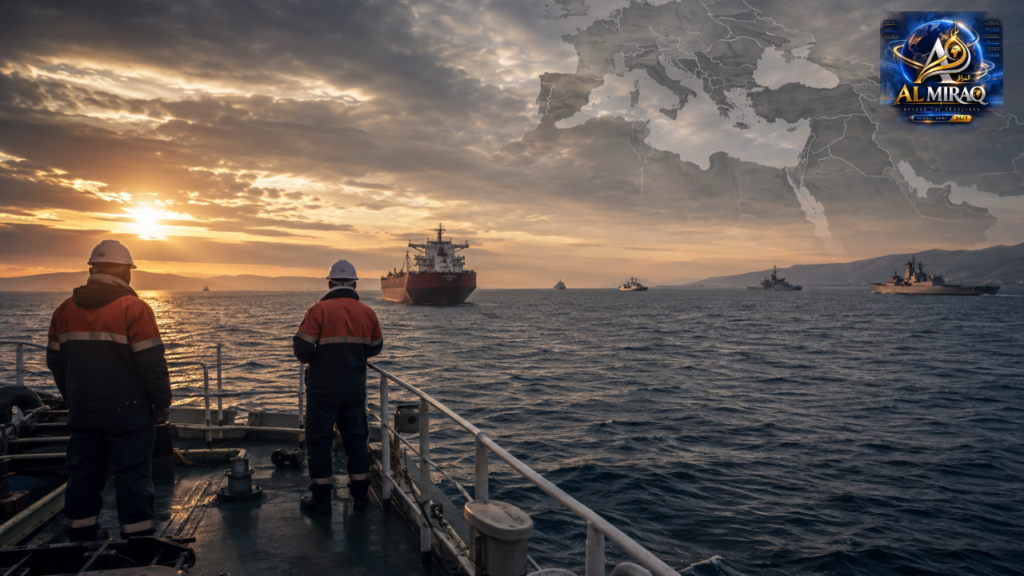
The waterway is one of the world’s most important energy corridors. Disruption to shipping through the strait can affect oil supplies, insurance costs, freight rates and energy prices far beyond the Middle East.
European governments are particularly sensitive to developments in the region because disruption to energy markets can contribute to inflation and increase pressure on already vulnerable economies.
Reuters reported that shipping through the strait has remained severely restricted despite conflicting claims over its operational status.
Only a limited number of vessels have recently been able to transit safely, highlighting the continuing uncertainty surrounding commercial shipping.
Europe’s Exposure
European countries face a difficult balancing act.
On one side, European governments have an interest in preventing Iran from disrupting international navigation and threatening regional security.
On the other, European economies have a direct interest in keeping energy supplies stable and avoiding a wider military confrontation.
The European Union has already taken measures against Iranian actors connected with restrictions on navigation in the Strait of Hormuz.
In June, the EU sanctioned individuals and an Iranian Revolutionary Guard naval command over actions it said threatened freedom of navigation.
This demonstrates that European policy is not simply an extension of the US sanctions strategy. The EU has its own legal and foreign-policy framework, although its concerns over navigation and regional security can overlap with those of Washington.
Bulgaria and Cyprus Face a Different Security Question
The broader confrontation also has implications for southeastern Europe.
Reports cited by the Financial Times have raised concerns about possible Iranian consideration of US-linked military assets in countries such as Bulgaria and Cyprus if the confrontation expands. These reports describe potential planning and assessments rather than confirmed Iranian decisions to attack those countries.
That distinction is important.
Bulgaria’s defence minister said in August that there was no direct national-security threat to Bulgarian territory following reports about possible Iranian threats to US targets in Europe.
Cyprus also occupies a strategically sensitive position because of its location in the eastern Mediterranean and its proximity to the Middle East.
Any significant expansion of the Iran conflict toward European territory would therefore represent a major escalation.
At present, however, reported possibilities should not be presented as evidence that Iran has decided to launch attacks against Bulgaria or Cyprus.
NATO and European Security Implications
The confrontation also raises questions for NATO and European defence planning.
If the conflict remains concentrated in the Middle East, European governments are primarily concerned with energy security, maritime trade, migration and regional instability.
A direct attack on NATO territory or on assets located in NATO member states would create a substantially different security environment.
Bulgaria is a NATO member, meaning any attack affecting Bulgarian territory would carry implications beyond the immediate US-Iran confrontation.
Cyprus is not a NATO member, although its geographical position makes developments there important to European security.
The possibility of Iranian threats reaching farther into Europe is therefore being watched closely, even as officials seek to avoid exaggerating the immediate danger.
US Military Pressure Is Also Affecting Europe
The Iran confrontation is placing pressure on American military resources.
Recent reporting has highlighted concerns about US ammunition stocks after months of military operations in and around the region. Some US missile-defence systems and other assets have been heavily used, raising questions about America’s ability to simultaneously address security challenges in Europe and Asia.
For NATO allies, this creates a strategic issue.
The United States is expected to maintain its commitments to European security, but Washington must also manage demands in the Middle East and the Indo-Pacific.
A prolonged Iran conflict could therefore affect defence planning well beyond the Middle East.
Can Sanctions Force Iran to Change Course?
The central question is whether the latest US economic pressure will produce a political change in Tehran.
Washington believes that cutting off Iran’s financial lifelines can weaken the government’s ability to fund military and other strategic activities.
Iran argues that sanctions primarily hurt ordinary people and will not force the country to surrender its core interests.
History provides arguments for both positions.
Sanctions can significantly restrict access to international finance, technology and investment. But heavily sanctioned states can also develop alternative networks over time.
Iran has spent decades adapting to economic restrictions.
The effectiveness of the latest campaign will therefore depend not only on the severity of US measures but also on how consistently other countries enforce them.
China, Russia and Other Trading Partners Matter
The United States faces a significant challenge in securing universal cooperation.
China remains an important economic partner for Iran, while Russia also maintains close strategic ties with Tehran.
Washington has so far demonstrated caution about imposing the harshest possible measures on major Chinese financial institutions, partly because of the broader diplomatic and economic consequences.
This creates a potential gap in the sanctions strategy.
If Iran can continue selling commodities, accessing foreign currency and maintaining trade relationships through major non-Western economies, the effects of American restrictions may be reduced.
At the same time, even partial sanctions enforcement can raise transaction costs and make international business with Iran considerably more difficult.
What Remains Unclear
Several major questions remain unresolved.
First, it is unclear how far the United States will extend secondary sanctions against countries that continue trading with Iran.
Second, the long-term effect of the restrictions on Iran’s oil exports remains uncertain.
Third, it remains unclear whether diplomatic efforts can produce a sustainable arrangement for shipping through the Strait of Hormuz.
And fourth, there is uncertainty over whether the confrontation will remain primarily economic or eventually return to a wider military escalation.
The situation is particularly fluid because Washington and Tehran continue to send sharply different messages about negotiations and future policy.
The White House said this week that no negotiations with Iran were currently underway and that all options remained on the table.
Meanwhile, regional mediators have continued diplomatic efforts aimed at reducing tensions and restoring shipping.
A Wider Test for International Security
The latest confrontation is about much more than sanctions.
It involves the future of Iran’s economy, the credibility of US economic power, the security of Gulf shipping routes and the ability of European and regional governments to manage the consequences of a prolonged conflict.
Conclusion
Iran condemns new US sanctions as “state terrorism” as Washington intensifies its campaign to isolate Tehran from international financial networks. The latest measures targeting Banque Misr’s UAE branches, a Bank Melli official and a Hong Kong-based entity demonstrate that the American strategy increasingly reaches beyond Iranian territory.
The economic pressure comes as Iran faces severe inflation, trade disruption and uncertainty surrounding the Strait of Hormuz. Tehran has rejected Washington’s approach and called on other countries not to cooperate with the sanctions.
The consequences extend well beyond the US-Iran relationship. Europe remains exposed to energy-market disruption and maritime instability, while countries such as Bulgaria and Cyprus are being watched because of their strategic positions and links to Western military infrastructure. Reports of possible threats against European targets remain assessments rather than confirmed Iranian plans, and officials in Bulgaria have said there is currently no direct national-security threat.
The immediate trajectory will depend on whether economic pressure produces renewed diplomacy or contributes to another escalation. With the Strait of Hormuz still a major point of uncertainty, the US-Iran confrontation remains a significant risk to regional stability, European security and the wider international economy.
Al Miraq — Beyond the Headlines.