The Internal Revenue Service (IRS) has announced new federal income tax brackets for 2027, bringing important changes for millions of American taxpayers. The updated tax brackets include higher income thresholds designed to account for inflation, helping taxpayers avoid moving into higher tax brackets simply because their wages have increased.
Announced on November 5, 2026, the new adjustments cover federal income tax rates, standard deductions, child tax credits, estate tax exemptions, and several other tax-related provisions. These changes are part of the IRS’s annual inflation adjustments and will generally apply to income earned during the 2027 tax year, with tax returns filed in 2028.
Although the seven federal income tax rates will remain unchanged, the income limits associated with each bracket will increase. This could provide some financial relief to individuals, families, and married couples as they plan their budgets for the coming year.
Understanding these changes is important for anyone who wants to manage their finances, estimate their tax liability, and prepare for the 2027 tax season.
What Are the New Federal Income Tax Brackets for 2027?
The IRS has confirmed that the federal income tax rates for 2027 will remain at 10%, 12%, 22%, 24%, 32%, 35%, and 37%.
However, the income thresholds for these rates have increased. This means taxpayers can earn more taxable income before reaching the next tax bracket.
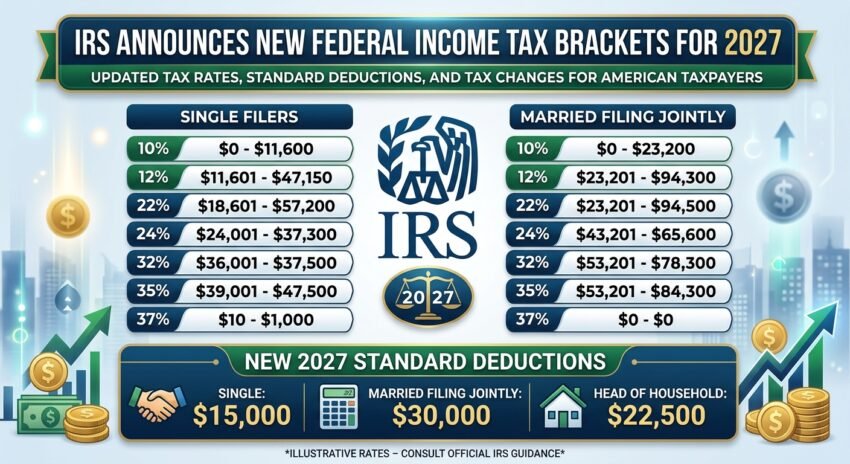
Here are the announced federal income tax brackets for single taxpayers and married couples filing jointly.
2027 Federal Income Tax Brackets for Single Filers
| Tax Rate | Taxable Income |
|---|---|
| 10% | $12,800 or less |
| 12% | More than $12,800 |
| 22% | More than $52,025 |
| 24% | More than $109,125 |
| 32% | More than $208,325 |
| 35% | More than $264,550 |
| 37% | More than $661,375 |
2027 Federal Income Tax Brackets for Married Couples Filing Jointly
| Tax Rate | Taxable Income |
|---|---|
| 10% | $25,600 or less |
| 12% | More than $25,600 |
| 22% | More than $104,050 |
| 24% | More than $218,250 |
| 32% | More than $416,650 |
| 35% | More than $529,100 |
| 37% | More than $793,650 |
These figures represent taxable income thresholds, not total annual earnings. Taxable income is generally calculated after subtracting eligible deductions from adjusted gross income.
The updated thresholds are intended to reflect inflation and help prevent taxpayers from facing higher marginal tax rates simply because their earnings have increased.
Why Is the IRS Increasing Tax Brackets for 2027?
Inflation is one of the main reasons behind the annual changes to federal income tax brackets.
Over time, the cost of everyday necessities such as groceries, housing, transportation, healthcare, and utilities can increase. Employees may receive higher salaries to keep up with these rising expenses, but higher earnings can also push them into higher tax brackets if tax thresholds remain unchanged.
This situation is commonly known as bracket creep.
For example, an employee who receives a salary increase to compensate for inflation might end up paying a higher marginal tax rate even though their purchasing power has not improved significantly.
To address this issue, the IRS adjusts income tax brackets annually using inflation-related calculations.
The 2027 adjustments are part of this process and are intended to maintain a more balanced relationship between income growth and federal taxation.
Standard Deduction Amounts Will Also Increase in 2027
Along with the new federal income tax brackets, the IRS has announced higher standard deduction amounts for 2027.
The standard deduction reduces the portion of income subject to federal income tax. Taxpayers who qualify can claim this deduction instead of itemizing eligible expenses on their federal tax returns.
For the 2027 tax year, the standard deduction amounts will be:
- Single taxpayers: $16,600, increasing from $16,100 in 2026.
- Married couples filing jointly: $33,200, increasing from $32,200.
- Heads of household: $24,925, increasing from $24,150.
These increases could help eligible taxpayers reduce their taxable income and potentially lower their overall federal income tax bills.
For example, a single taxpayer with $60,000 in adjusted gross income who qualifies for the $16,600 standard deduction would generally have $43,400 in taxable income before considering other applicable adjustments or deductions.
The final tax liability will depend on the taxpayer’s filing status, income sources, credits, and other eligible tax benefits.
Child Tax Credit Increases to $2,300 in 2027
Families with qualifying children may also benefit from the IRS’s latest inflation adjustments.
The maximum Child Tax Credit will increase to $2,300 per qualifying child for the 2027 tax year, representing a $100 increase compared with the 2026 amount.
The maximum refundable portion of the credit will also rise to $1,800, up from $1,700 in 2026.
This adjustment could provide additional financial support to eligible families dealing with childcare expenses, education costs, housing payments, and other household necessities.
However, not every family will automatically receive the maximum credit. Eligibility and the amount available depend on applicable income limits, qualifying-child requirements, and other IRS rules.
Parents should review the latest IRS guidance before estimating how much they may receive when filing their 2027 tax returns.
Higher Estate and Gift Tax Exemptions for 2027
The IRS has also increased the federal estate tax exclusion and annual gift tax exclusion for 2027.
The basic estate tax exclusion will increase to $15.48 million for individuals who die during 2027. This is higher than the $15 million exclusion applicable to individuals who died in 2026.
The annual gift tax exclusion will also increase from $19,000 to $20,000 per recipient.
These adjustments are particularly relevant to individuals with substantial assets, families planning wealth transfers, and people considering long-term estate planning strategies.
The higher annual gift exclusion means eligible individuals can generally give up to $20,000 to each recipient during 2027 without including those gifts in their total taxable gifts, subject to applicable rules.
Married couples may have additional planning opportunities, but they should understand the relevant reporting requirements and consult qualified tax professionals when necessary.
Alternative Minimum Tax Exemption Amounts for 2027
Another important part of the IRS announcement involves the Alternative Minimum Tax (AMT).
The AMT is a separate tax calculation designed to ensure that certain higher-income taxpayers pay at least a minimum amount of federal income tax after considering applicable deductions and exemptions.
For tax year 2027, the AMT exemption amounts will increase to:
- Unmarried individuals: $93,000.
- Married couples filing jointly: $144,700.
The exemption begins to phase out at $515,950 for unmarried individuals and $1,031,900 for married couples filing jointly.
These updated amounts may affect taxpayers with higher incomes and those who have particular deductions or financial circumstances.
Individuals who may be subject to the AMT should review their tax situations carefully rather than relying only on the regular federal income tax brackets.
Earned Income Tax Credit Changes for 2027
The Earned Income Tax Credit (EITC) is another important tax benefit included in the IRS inflation adjustment announcement.
This credit is designed to support eligible workers and families with low to moderate incomes. The amount a taxpayer can receive depends on factors such as earned income, filing status, and the number of qualifying children.
For the 2027 tax year, the maximum EITC will increase to $8,496 for qualifying taxpayers with three or more children.
This is an increase from the $8,231 maximum available for the 2026 tax year.
The IRS has also adjusted income thresholds and phase-out amounts for different categories of eligible taxpayers.
Workers who believe they may qualify should check the official IRS eligibility requirements because the credit is subject to specific income and family-related rules.
When Will the New 2027 Tax Brackets Take Effect?
One of the most important details in the IRS announcement is the effective tax year.
The newly announced federal income tax brackets apply to the 2027 tax year, not the 2026 tax year.
This means income earned between January 1 and December 31, 2027, will generally be subject to the updated tax brackets.
Taxpayers will typically report that income when filing their federal income tax returns in 2028.
The announcement does not mean Americans should immediately use the 2027 tax brackets when preparing their 2026 tax returns in early 2027.
Understanding this difference can help prevent confusion during tax preparation and financial planning.
How Will the New Tax Brackets Affect American Taxpayers?
The higher income thresholds could provide benefits to taxpayers across different income levels.
For workers receiving annual salary increases, the updated brackets may reduce the possibility of moving into a higher marginal tax rate solely because of inflation-related wage growth.
Middle-income households may also benefit from higher standard deductions, which can reduce the amount of income subject to federal taxation.
Families with qualifying children could receive a larger Child Tax Credit, while eligible lower-income workers may benefit from increased Earned Income Tax Credit amounts.
However, the actual financial impact will vary from person to person.
A taxpayer’s total tax bill depends on several factors, including:
- Annual taxable income.
- Filing status.
- Standard or itemized deductions.
- Tax credits and eligibility requirements.
- Investment income and other earnings.
- Additional federal tax provisions.
For this reason, taxpayers should consider their complete financial situation instead of focusing only on their marginal tax bracket.
Practical Tips to Prepare for the 2027 Tax Year
Although the new tax brackets will not generally affect returns until 2028, taxpayers can start preparing in advance.
Here are several practical steps to consider:
1. Review Your Annual Income
Estimate your expected income for 2027, including wages, bonuses, freelance earnings, and other taxable income. This can help you understand which tax brackets may apply.
2. Check Your Tax Withholding
Employees should review their federal income tax withholding, particularly if they expect significant changes in salary, employment, or household circumstances.
3. Understand Available Deductions
Compare the standard deduction with any itemized deductions you may be eligible to claim. Choosing the appropriate option can help reduce taxable income.
4. Review Available Tax Credits
Families, working individuals, and eligible taxpayers should check whether they qualify for credits such as the Child Tax Credit and Earned Income Tax Credit.
5. Keep Financial Records Organized
Maintain records of income, eligible expenses, charitable contributions, and other tax-related documents. Organized records can make future tax preparation easier.
6. Consult a Qualified Tax Professional
People with multiple income sources, investments, business earnings, or complicated financial situations may benefit from professional tax advice.
What Taxpayers Should Remember About the IRS Announcement
The IRS announcement is part of its annual inflation adjustment process and covers almost 70 federal tax provisions for 2027.
While the federal income tax rates remain unchanged, higher income thresholds and deductions could provide additional flexibility for taxpayers.
The changes to the standard deduction, Child Tax Credit, estate tax exclusion, gift tax exclusion, and Earned Income Tax Credit are also important considerations for individuals and families.
Taxpayers should remember that the announced amounts generally apply to the 2027 tax year and will affect returns filed in 2028.
They should also monitor official IRS updates because tax rules and eligibility requirements can change.
Conclusion
The IRS announcement of new federal income tax brackets for 2027 brings several important updates for American taxpayers. Although the seven federal tax rates remain the same, higher income thresholds mean individuals and families can earn more taxable income before entering the next marginal tax bracket.
The increased standard deduction, higher Child Tax Credit, and updated estate and gift tax exemptions may also offer financial benefits to eligible taxpayers.
For Americans planning their budgets and financial decisions, understanding these changes early can make tax preparation easier and help them make informed choices throughout 2027.
The most important takeaway is that the new tax brackets are designed to account for inflation, and they generally apply to income earned in 2027, with tax returns filed in 2028. Taxpayers should review the official IRS guidance, understand their eligibility for available deductions and credits, and plan ahead to make the most of the updated federal tax provisions.