
By Al Miraq News Desk
Published: August 28, 2026
The Khyber Pakhtunkhwa government has decided to review fire safety arrangements at hospitals across the province following concerns about inadequate emergency equipment, outdated infrastructure and the ability of medical facilities to protect patients and staff in the event of a fire.
The move comes amid reports highlighting serious shortcomings at some government hospitals in Peshawar, including the Nasirullah Babar Hospital, where fire safety arrangements have reportedly been found to be extremely limited.
The concerns are particularly significant because hospitals contain large numbers of patients, including people who may be unable to evacuate independently during an emergency. Any fire inside an occupied medical facility can therefore create risks that are considerably greater than those faced by ordinary buildings.
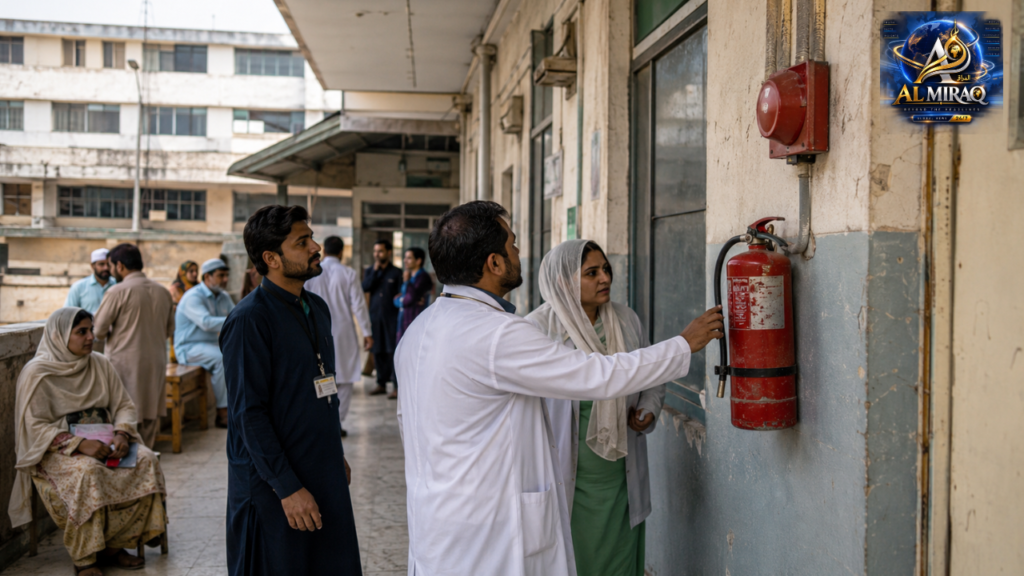
Reports from Peshawar have drawn attention to the condition of firefighting equipment at older hospitals, with concerns that some existing systems are either inadequate or not functioning properly.
The provincial government has subsequently taken notice of the issue and directed hospital administrations to develop strategies for improving fire prevention and emergency response arrangements.
Khyber Pakhtunkhwa Hospital Fire Safety Measures to Be Reviewed
The supplied report indicates that many hospitals across Khyber Pakhtunkhwa operate from older buildings. In such facilities, the age and design of the structure can create additional challenges for emergency evacuation and firefighting.
The concern is not limited to the availability of fire extinguishers.
Where such systems are missing or poorly maintained, even a relatively small fire can become difficult to control.
The provincial government’s reported instructions indicate an intention to ensure that hospitals develop appropriate strategies and install necessary firefighting arrangements.
Why Hospital Fire Safety Is Particularly Important
Hospitals present unique challenges during a fire because not every person inside the building can evacuate without assistance.
Some may also be connected to medical equipment or require continuous supervision.
A hospital evacuation therefore requires considerably more planning than the evacuation of an ordinary commercial or residential building.
Concerns at Nasirullah Babar Hospital in Peshawar
One of the facilities highlighted in the reporting is the government-run Nasirullah Babar Hospital in Peshawar.
The report describes fire safety arrangements at the hospital as extremely limited. It also raises concerns about the absence of an adequate fire alarm system.
If confirmed, such deficiencies could make it difficult for hospital staff to quickly alert patients and colleagues during an emergency.
The hospital receives patients on a daily basis and contains wards where some people undergoing treatment may not be able to leave the building on their own.
This makes the condition of emergency systems particularly important.
A fire alarm serves a basic but critical purpose: providing an early warning that allows people inside a building to respond before conditions deteriorate.
In a hospital, the warning must reach not only mobile visitors but also medical staff responsible for patients who need assistance.
The absence or inadequate functioning of such a system could therefore complicate an emergency response.
Vulnerable Patients Face Greater Evacuation Risks
Patients who are mobile may be able to respond quickly to an alarm and follow evacuation instructions. Others may require nurses, doctors or support staff to physically assist them.
Patients receiving treatment in wards may also have limited mobility because of illness, injury, age or medical procedures.
This creates a need for hospitals to maintain clearly defined emergency procedures that account for different categories of patients.
Without adequate planning and functioning equipment, those decisions become considerably more difficult.
Concerns Extend Beyond a Single Hospital
The broader concern involves older hospitals across Khyber Pakhtunkhwa, many of which operate from buildings constructed several years ago.
Older infrastructure does not automatically mean that a hospital is unsafe. However, ageing buildings may require additional investment to bring fire detection, suppression and evacuation systems in line with modern safety requirements.
The report also raises concerns about hospitals operating under different administrative structures, including medical teaching institutions.
Such an assessment could help authorities establish which hospitals have functioning alarms, firefighting equipment, emergency exits and evacuation plans and which facilities require immediate intervention.
Government Directs Hospital Administrations to Act
The Khyber Pakhtunkhwa government has reportedly directed hospital administrations to formulate strategies for improving fire safety arrangements.
The reported instructions followed a notice taken by the provincial chief minister after a fire-related incident in Islamabad, although the supplied material does not establish that the incident occurred inside a Khyber Pakhtunkhwa hospital or provide sufficient details to link it directly to the provincial facilities under review.
The government response indicates that hospital fire preparedness has become a matter requiring administrative attention.
For hospital authorities, the challenge now is to translate broad instructions into practical improvements.
Regular inspections would also be important because simply installing equipment does not guarantee that it will work when needed.
Fire Alarms Can Be Critical During an Emergency
A fire alarm system is one of the most basic components of a modern building’s emergency infrastructure.
Its purpose is to detect a potential fire or smoke condition and alert people inside the building.
In a hospital environment, early warning can be particularly valuable because staff may need additional time to move patients.
A fire involving one section of a hospital can also create smoke that spreads beyond the immediate location of the flames. In many emergencies, smoke itself can become a serious threat to people inside a building.
Detection, warning, suppression, evacuation and staff preparedness all form part of an effective safety system.
Older Hospital Buildings Create Additional Challenges
Hospitals are complex facilities that may contain multiple wards, corridors, treatment rooms, electrical systems, oxygen supplies, laboratories, kitchens and other infrastructure.
As buildings age, their original safety systems may become outdated or require replacement.
Changes made over time can also affect evacuation routes.
A fire safety review can therefore provide an opportunity to examine whether the current configuration of a hospital remains suitable for emergency evacuation.
What Effective Hospital Fire Preparedness Requires
Although the precise measures required at each facility would depend on its structure and risk assessment, a modern hospital fire safety strategy generally involves several interconnected elements.
Fire Detection and Alarm Systems
Hospitals need reliable mechanisms for detecting fires and alerting people inside the building.
Firefighting Equipment
Fire extinguishers and other firefighting equipment need to be available in appropriate locations and maintained in working condition.
Emergency Evacuation Procedures
Hospitals should have clear evacuation plans that account for patients who cannot move independently.
Staff Training
Fire safety procedures are only effective if employees understand how to respond.
Regular training and drills can help staff become familiar with alarm procedures, evacuation routes and emergency responsibilities.
Routine Inspections
Fire safety equipment requires regular inspection and maintenance.
A system that worked when installed may not remain reliable if it is not tested and serviced.
Potential Risks for Peshawar’s Public Hospitals
Peshawar is home to a large number of healthcare facilities serving residents of the city as well as patients arriving from other parts of Khyber Pakhtunkhwa.
Government hospitals can experience significant patient and visitor traffic, placing additional importance on emergency preparedness.
If fire safety systems are inadequate in a busy hospital, evacuation could become more complicated because of the number of people present at any given time.
The presence of patients requiring medical assistance can further increase the complexity of an emergency.
This is why fire safety assessments should ideally consider not only equipment but also patient numbers, building layouts, staffing levels and evacuation capacity.
What Remains Unclear
While the reported concerns have prompted government attention, several details remain unclear from the available material.
It is not yet established how many hospitals across Khyber Pakhtunkhwa have been identified as having inadequate fire safety arrangements.
The supplied report also does not provide a province-wide inventory of functioning fire alarms, extinguishers or other firefighting systems.
Similarly, no comprehensive timeline has been provided for the installation or replacement of equipment at the hospitals where deficiencies have reportedly been identified.
There are also no verified figures in the supplied material regarding casualties from hospital fires in the province, and such figures should not be inferred from the current safety concerns.
These distinctions are important. The existence of fire safety deficiencies does not mean that a fire has occurred or that casualties have resulted.
Why the Review Matters
The decision to review fire safety arrangements could provide an opportunity for Khyber Pakhtunkhwa authorities to address longstanding infrastructure weaknesses before an emergency occurs.
Preventive action is generally more effective than responding after a disaster.
For hospitals, prevention involves identifying hazards, maintaining equipment, training employees and ensuring that evacuation plans are practical.
The review could also help authorities prioritize funding. Facilities with the most serious deficiencies may require urgent investment, while hospitals with functioning systems may need routine maintenance and periodic upgrades.
A province-wide approach could provide authorities with a clearer picture of the overall condition of hospital fire preparedness.
A Broader Public Safety Issue
The concerns highlighted in Peshawar also reflect a wider challenge faced by public institutions operating in ageing buildings.
Healthcare facilities are particularly sensitive because their occupants include people who may have limited mobility and depend on staff for protection during emergencies.
Improving fire safety is therefore not simply an infrastructure issue. It is also connected to patient protection, workplace safety and emergency preparedness.
The government’s reported decision to examine hospital arrangements represents an important first step, but the practical impact will depend on implementation.
Regular inspections, transparent assessments and timely repairs will be essential if the review is to produce lasting improvements.
Conclusion
The Khyber Pakhtunkhwa hospital fire safety review comes amid serious concerns about the preparedness of some older medical facilities, particularly in Peshawar.
Reports have highlighted inadequate firefighting arrangements and the reported absence of an effective fire alarm system at Nasirullah Babar Hospital, while broader concerns have been raised about ageing hospital buildings across the province.
The provincial government’s decision to take notice and direct hospital administrations to develop fire safety strategies signals recognition of the potential risks.
However, the immediate priority will be turning those directives into measurable improvements. Hospitals need functioning detection and alarm systems, properly maintained firefighting equipment, clear evacuation procedures and trained staff capable of assisting vulnerable patients.
The available material does not establish that a major hospital fire has occurred as a result of these deficiencies, nor does it provide verified casualty figures. The significance of the issue lies in the potential consequences if inadequate safety systems remain unaddressed.
For Khyber Pakhtunkhwa, a comprehensive and properly implemented review could help identify weaknesses before they result in a serious emergency. For patients, medical workers and visitors, reliable fire safety systems are not an optional facility upgrade—they are a fundamental part of a safe healthcare environment.
Al Miraq — Beyond the Headlines.