
By Al Miraq News Desk
Published: August 18, 2026
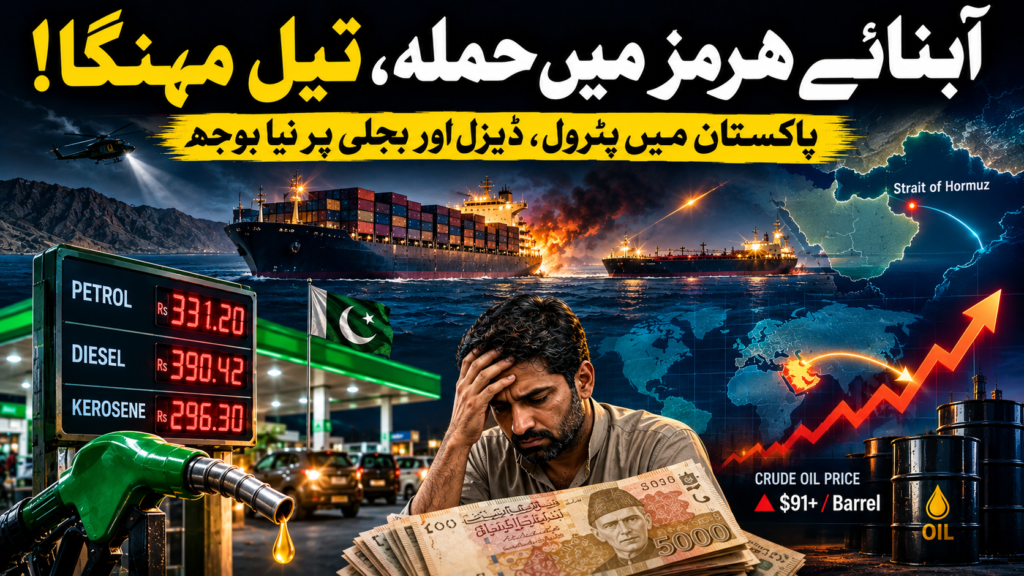
Global energy markets are facing renewed uncertainty after a commercial vessel reportedly came under a missile attack while leaving the Strait of Hormuz, according to the shipping information cited in the supplied news transcript.
The reported incident has raised fresh concerns about the safety of one of the world’s most important energy routes at a time when tensions surrounding the Iran conflict are already putting pressure on global oil supplies.
The vessel was reportedly hit by an unidentified projectile, with its engine and crew said to have been affected. Omani coast guard authorities were reportedly providing assistance.
The development came alongside a sharp increase in international crude prices and a new increase in petroleum prices in Pakistan, creating an immediate concern for consumers already facing high transportation and energy costs.
Ship Reportedly Hit Near Strait of Hormuz
According to maritime information cited in the transcript, a ship travelling out of the Strait of Hormuz was struck by an unidentified projectile.
The reported attack caused damage to the vessel’s engine and affected members of its crew.
The Omani coast guard was said to be assisting the vessel.
The incident has renewed concerns about commercial shipping through the Strait of Hormuz, a strategically important maritime passage connecting the Persian Gulf with the Gulf of Oman and the wider Arabian Sea.
Any prolonged disruption to commercial shipping through the area could have consequences for international energy markets because the route is crucial to global oil and gas transportation.
Shipping Activity Continues Despite Risks
Shipping data cited in the broadcast indicated that commercial shipping through the Strait continued despite the reported attack.
The transcript said that six commercial cargo vessels passed through the waterway the previous day.
However, no LNG tanker was reported to have passed through the Strait during that period.
The difference is significant because disruptions to energy shipments can have a much larger impact on international markets than disruptions affecting ordinary commercial cargo.
Global Oil Market Comes Under Pressure
The reported maritime incident comes as the global oil market is already facing significant uncertainty.
According to the supplied transcript, crude oil prices were showing an upward trend.
Brent crude moved above $91 per barrel, while West Texas Intermediate approached $85 per barrel.
The transcript also cited another crude benchmark at approximately $98 per barrel.
Rising crude prices can quickly translate into higher costs for countries that rely heavily on imported petroleum.
For Pakistan, where a substantial portion of domestic energy demand is linked to imported fuel, international oil prices are particularly important.
US Strategic Oil Reserves Fall to Lowest Level in Decades
Another major development highlighted in the transcript is the decline in US strategic petroleum reserves.
According to US energy data cited in the broadcast, approximately 5.3 million barrels of oil were released from American strategic reserves during the previous week.
The transcript said that US crude reserves had fallen to approximately 293.4 million barrels, described in the broadcast as the lowest level since 1982.
The strategic reserve exists to provide an emergency buffer during major disruptions to energy supplies.
Its use during a period of geopolitical instability demonstrates the pressure that governments can face when global oil markets become unstable.
Iran Conflict Adds to Energy Market Uncertainty
The oil-market pressure is closely connected to the broader conflict involving Iran and the uncertainty surrounding the Strait of Hormuz.
The transcript said that the United States and other member countries of the International Energy Agency had previously agreed to use oil reserves in an effort to stabilise global energy markets.
Strategic reserves can provide temporary relief when supply is disrupted.
However, they cannot permanently replace normal commercial production and transportation.
If shipping through major energy routes remains threatened for an extended period, markets could continue to price in a geopolitical risk premium.
Pakistan Raises Petrol and Diesel Prices
The international energy-market pressure has coincided with a major increase in petroleum prices in Pakistan.
According to the figures in the supplied transcript:
| Petroleum Product | Increase | New Price |
|---|---|---|
| Petrol | Rs5.77/litre | Rs331.20/litre |
| Diesel | Rs6.47/litre | Rs390.42/litre |
| Kerosene | Rs6.88/litre | Rs296.30/litre |
These figures represent a significant additional burden for Pakistani consumers.
Petrol directly affects private transportation, motorcycles, cars and other vehicles, while diesel has an even broader economic role because it is widely used by commercial transport, agriculture and heavy machinery.
Why Diesel Prices Matter to the Economy
A diesel-price increase can have consequences far beyond fuel stations.
Trucks use diesel to transport goods across Pakistan.
Buses and other commercial vehicles also depend heavily on diesel.
Agricultural machinery and generators can also be affected.
When transportation becomes more expensive, businesses may increase their operating costs.
Those costs can eventually be passed on to consumers through higher prices for food, manufactured products and other goods.
This means that an increase in diesel prices can contribute to broader inflationary pressure.
Electricity Could Become More Expensive Too
Petroleum was not the only energy-related concern highlighted in the transcript.
The National Electric Power Regulatory Authority, or NEPRA, is set to hear a request seeking an increase in electricity prices.
The request was reportedly submitted by the Central Power Purchasing Agency under the July fuel price adjustment mechanism.
According to the transcript, the proposed increase is Rs2.52 per unit.
The hearing is scheduled for August 27, according to the supplied information.
If approved, the increase could reportedly create an additional burden of approximately Rs41 billion including GST for consumers.
This means Pakistani households could face pressure from both transportation fuel and electricity costs at the same time.
Jamaat-e-Islami Protests Against Fuel Levy and Inflation
The increase in petroleum prices has also become a political issue.
According to the transcript, Jamaat-e-Islami protests against the petroleum levy and inflation have entered their third day in Lahore, Karachi and Peshawar.
The party is demanding a reduction in petrol prices and a forensic audit of independent power producers.
The protests reflect wider public concerns about the relationship between fuel prices, government taxation and the cost of living.
For ordinary households, the issue is not limited to what they pay at a petrol station.
Higher fuel prices can affect transportation, food distribution, electricity generation and business costs.
Pakistan’s Energy Challenge
The latest price increase illustrates Pakistan’s vulnerability to international energy shocks.
When global oil prices rise, countries that import petroleum products can face higher import bills.
That can put pressure on foreign-exchange reserves and the country’s external account.
Higher import costs can also place pressure on the Pakistani rupee and contribute to inflation.
The result can become a cycle in which higher international energy prices create pressure across several areas of the economy simultaneously.
Balochistan Security Operations
While energy markets dominated the international economic picture, Pakistan also reported continuing security operations.
According to the supplied transcript, security forces conducted intelligence-based operations in Ziarat, Harnai and Sorab under Operation Radd-ul-Fitna 3.
Security sources claimed that more than nine alleged militants were killed.
The transcript said the operations targeted militant hideouts in mountainous areas between Ziarat and Harnai.
Another operation in Sorab reportedly detected the movement of suspected militants.
Security sources said ammunition, magazines, hand grenades, walkie-talkies, motorcycles and other equipment were recovered.
As with other claims attributed to security sources, these battlefield details have not been independently established in the supplied material.
Political Opposition Meeting Postponed
On the political front, a planned meeting between opposition leadership and the Pakistan Peoples Party parliamentary leadership was reportedly postponed.
According to the transcript, the opposition leader was scheduled to meet PPP leadership from the National Assembly and Senate.
The meeting was reportedly planned in the National Assembly chamber.
No detailed explanation for the postponement was provided in the supplied transcript.
Supreme Court Hears Petitions Concerning PTI Founder
The Supreme Court also continued hearings concerning petitions related to meetings and medical treatment involving the founder of Pakistan Tehreek-e-Insaf.
According to the transcript, a three-member bench headed by Justice Shahid Waheed was hearing the petitions.
The superintendent of Adiala Jail reportedly requested that the court dispose of the case.
A four-member medical board was also reported to have recommended additional meetings with the PTI founder.
Khyber Pakhtunkhwa Chief Minister Sohail Afridi expressed hope that the courts would eventually facilitate his release through legal proceedings.
Pakistan Rejects Indian Allegations
Pakistan’s Foreign Office rejected allegations made by India’s Home Minister Amit Shah concerning terrorism.
According to the transcript, Pakistan accused India of attempting to divert domestic public attention toward Pakistan and gain limited political advantage.
Islamabad also called on the international community to hold India accountable for what it described as state-sponsored terrorism.
The Indian government has previously made its own allegations against Pakistan.
The competing claims underline the continuing tensions between the two neighbouring countries.
Pakistan Criticises Indian Documentary
Pakistan also rejected an Indian documentary related to Operation Sindoor, with the Inter-Services Public Relations describing it as an emotional and cinematic presentation rather than an accurate representation of events.
According to the transcript, Pakistan’s military media wing argued that the documentary could not change what it described as the realities of the 2025 conflict.
The ISPR repeated claims concerning Indian military losses during the confrontation.
These claims remain part of competing official narratives from India and Pakistan and should be treated as such.
Trump Says Iran Cannot Have Nuclear Weapons
US President Donald Trump was also quoted in the transcript regarding negotiations with Iran.
Trump reportedly said Washington was not seeking an expansion of its objectives in negotiations with Tehran.
He said the central goal was to prevent Iran from obtaining nuclear weapons.
The comments come amid wider uncertainty surrounding the Iran conflict and the future of diplomatic efforts.
Any development involving Iran has the potential to affect oil markets because of the country’s geographical position near the Strait of Hormuz.
Yemen Reports Operations Against Houthis
Yemen’s government forces reportedly said that 133 operations had been conducted against Houthi positions over a 24-hour period.
According to the transcript, weapons storage sites, command-and-control centres and vehicles were targeted using rockets, artillery and drones.
The development adds to the wider regional security picture surrounding the Red Sea, Gulf of Aden and Persian Gulf.
Russia Warns Britain Over Ukraine Drone Support
Russia also warned Britain over its continued military assistance to Ukraine.
According to the transcript, Moscow claimed that British-supplied drones had been used in attacks against Russian military and industrial targets.
The British Defence Ministry, meanwhile, said support for Ukraine would continue.
The competing positions reflect the continuing escalation of the Russia-Ukraine conflict and the involvement of Western countries in supporting Kyiv.
Heavy Rain Hits Islamabad and Rawalpindi
Back in Pakistan, heavy monsoon rainfall affected Islamabad and Rawalpindi.
Low-lying areas were reportedly inundated.
The transcript said 116 millimetres of rain was recorded in Shamsabad, Rawalpindi.
Emergency arrangements were activated, while heavy machinery was deployed in vulnerable areas.
Authorities also cancelled staff leave in preparation for possible emergencies.
The meteorological department warned of further heavy rainfall in parts of upper Khyber Pakhtunkhwa and Gilgit-Baltistan.
Zardari Announces Tree-Planting Target
President Asif Ali Zardari also issued a message at the beginning of the 2026 monsoon tree-planting campaign.
According to the transcript, the government has set a target of planting 20 million trees across Pakistan.
Zardari emphasised the importance of forests and local tree species in responding to climate change.
Pakistan has increasingly focused on climate resilience following repeated floods, heatwaves and other extreme weather events.
Pakistan Approves Wheat Imports
The Economic Coordination Committee reportedly approved the import of one million tonnes of wheat through the Trading Corporation of Pakistan.
The transcript cited a report stating that a steering committee would oversee the necessary conditions before imports begin.
These conditions reportedly include free-shipment inspection and ensuring that provinces provide the required funds for their needs.
The development comes as strategic wheat reserves held by PASSCO were reportedly close to being depleted.
Wheat availability remains an important issue because it directly affects the price and supply of flour and other staple food products.
Constitutional Court Rules on Super Tax Credits
Pakistan’s Federal Constitutional Court delivered an important ruling concerning corporate taxation.
According to the transcript, the court ruled that previously obtained tax credits could legally be adjusted against super tax liabilities.
The court reportedly clarified that tax credits received through filing and deductions could be used to adjust the amount of super tax payable.
The decision came in appeals involving a private mobile company and overturned the Islamabad High Court’s earlier ruling.
The case could have implications for how corporate tax credits are treated in similar disputes.
Lahore Shooting Leaves Four Relatives Dead
A serious domestic crime was also reported in Lahore.
According to police information cited in the transcript, a man opened fire in the Chung area, killing four members of his in-laws’ family.
Police said the suspect reportedly died by suicide after the incident.
The case remains a matter for police investigation and legal proceedings.
Sports: Pakistan Faces Multiple Major Fixtures
The sports section of the news cycle is also packed with important events.
In the Champions Cup final in Multan, Pakistan Gold, led by Shaheen Afridi, is scheduled to face Pakistan Green, led by Shadab Khan.
The match is scheduled for 3:00 PM according to the supplied transcript.
Pakistan is also preparing for its three-Test series against England.
The first Test is scheduled to begin in Leeds, with Pakistan completing preparations through training sessions ahead of the opening match.
Pakistan’s hockey team is also scheduled to face India in the FIH Hockey Pro League.
The match is scheduled for 6:00 PM according to the transcript.
The Bigger Picture
The day’s developments show how closely Pakistan’s domestic economy is connected to international geopolitics.
A reported incident near the Strait of Hormuz has the potential to affect global oil prices.
Higher international crude prices can then influence Pakistan’s import costs.
Those costs can eventually affect petrol and diesel prices, transportation, food prices and inflation.
At the same time, Pakistan is dealing with electricity-price pressures, protests over petroleum levies, security operations, political disputes and extreme weather.
The international environment is equally uncertain.
The Iran conflict, tensions around the Strait of Hormuz, the Russia-Ukraine war and instability across the Middle East all have implications for global energy and security markets.
For Pakistan, the immediate challenge will be managing the impact of these external shocks while protecting consumers from further increases in the cost of living.
Conclusion
The reported attack on a commercial vessel near the Strait of Hormuz has once again placed global energy security under the spotlight.
With Brent crude moving above $91 a barrel and uncertainty surrounding energy shipments, oil-importing countries could face increased pressure.
Pakistan has already raised petrol, diesel and kerosene prices, while another electricity-price increase is under consideration.
For ordinary Pakistanis, the consequences could extend well beyond the petrol station.
Higher fuel costs can translate into more expensive transportation, food, electricity and everyday goods.
At a time when households are already facing inflationary pressure, the biggest question is whether global energy instability will trigger another wave of economic pressure inside Pakistan.
Al Miraq — Beyond the Headlines.