
By Al Miraq News Desk
Published: August 18, 2026
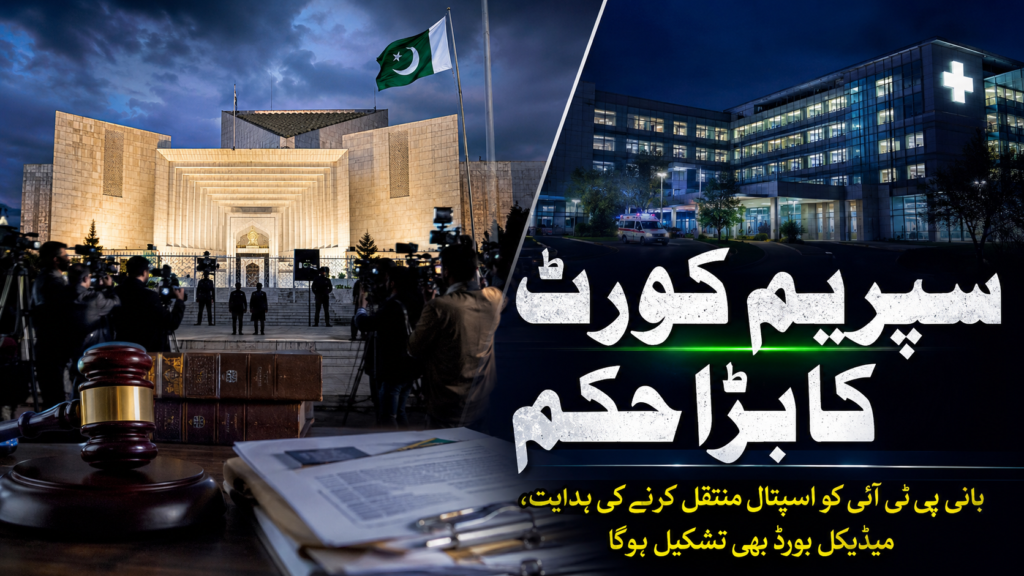
The Supreme Court has issued an interim order regarding the medical treatment of the PTI founder, directing his transfer to Shifa International Hospital and ordering the formation of a specialist medical board. The court also directed that he be allowed a weekly meeting with family members and warned against using medical reports for political purposes.
Pakistan’s political and legal landscape witnessed another significant development after the Supreme Court issued directions concerning the medical treatment and family access of the founder of the Pakistan Tehreek-e-Insaf (PTI).
According to the details contained in the news report, the Supreme Court ordered that the PTI founder be temporarily shifted to Shifa International Hospital for medical treatment. The court also directed the relevant authorities to establish a medical board comprising specialist doctors to examine and monitor his condition.
The decision comes amid continuing political debate surrounding the PTI founder’s imprisonment, medical care, access to family members and ongoing legal proceedings.
The court’s directions have been welcomed by PTI leaders, while government representatives have also indicated that the judicial order will be implemented.
Supreme Court Issues Interim Order on Medical Treatment
The Supreme Court issued an interim order on an application seeking the transfer of the PTI founder to a hospital for medical treatment.
According to the report, the court directed that the PTI founder be transferred to Shifa International Hospital for treatment rather than continuing to rely solely on arrangements within the prison system.
The order also focused on ensuring that qualified medical professionals are involved in assessing his health.
The court directed that a medical board be constituted and that specialist doctors be included in the process. The names of Dr Faisal Sultan and Dr Uzma Khan were specifically mentioned in connection with the medical arrangements.
The development is significant because medical treatment of senior political figures can quickly become intertwined with wider political debates. In this case, the Supreme Court specifically emphasized that medical information should not be used as a political tool.
Medical Board to Assess the PTI Founder
One of the central elements of the Supreme Court’s order is the formation of a medical board.
The purpose of the board, according to the reported court directions, is to provide a professional medical assessment and oversee the treatment process.
The involvement of multiple doctors is intended to provide a broader medical evaluation rather than relying on a single opinion.
The report states that Dr Faisal Sultan and Dr Uzma Khan are expected to be associated with the medical arrangements.
A medical board can also provide a structured mechanism through which the court and relevant authorities can receive information about the patient’s condition without turning individual medical reports into political statements.
The court reportedly directed that the medical information remain focused on medical considerations.
Court Warns Against Politicising Medical Reports
Another important aspect of the ruling is the Supreme Court’s direction concerning medical records.
The court reportedly made it clear that medical reports should not be used for political purposes.
This direction comes against the backdrop of intense political disagreement surrounding the PTI founder. Supporters of the former prime minister have repeatedly raised questions concerning his health and treatment, while government officials have also responded to claims made by the opposition.
By directing that medical information should not become a political instrument, the court has placed emphasis on maintaining a distinction between medical treatment and political debate.
The approach could also help ensure that doctors can perform their responsibilities without being drawn into political controversies.
PTI Founder to Receive Weekly Family Meetings
The Supreme Court also directed that the PTI founder be allowed to meet members of his family once a week.
Family access has remained an important issue in the wider dispute surrounding his imprisonment.
According to the report, the court sought information regarding previous meetings between the PTI founder and his family. It also requested details relating to communication with his children.
The court reportedly directed authorities to provide records covering the previous three years, including details of family meetings and relevant case information.
The direction regarding weekly meetings represents another significant component of the interim order.
For the PTI leadership and the founder’s family, regular access is viewed as an important issue, particularly while he remains in custody.
Family to Bear Hospital Treatment Expenses
The reported court order also addresses the financial arrangements associated with the hospital transfer.
According to the report, the expenses of treatment at Shifa International Hospital will be borne by the family.
This arrangement separates the cost of private hospital treatment from the government’s responsibility for maintaining the prison system and its medical facilities.
The hospital transfer will therefore involve coordination between the relevant authorities, the medical team and the family.
The exact scope and duration of the hospital stay will depend on the medical assessment and subsequent developments.
PTI Welcomes Supreme Court Decision
The Pakistan Tehreek-e-Insaf welcomed the Supreme Court’s decision.
In a statement, the party described the order as an important development concerning the medical treatment of its founder.
PTI said that the court had directed his transfer to Shifa International Hospital and ordered the creation of a specialist medical board.
The party also emphasized the importance of ensuring family meetings in accordance with the Supreme Court’s directions.
For PTI supporters, the order represents a significant judicial development after a prolonged period of political and legal uncertainty surrounding the party’s founder.
Party leaders have also called for the government and relevant authorities to implement the court’s directions without unnecessary delay.
Government Says Court Order Will Be Implemented
The government has also responded to the Supreme Court’s decision.
Federal Parliamentary Affairs Minister Tariq Fazal Chaudhry reportedly assured that the court order would be implemented.
He described the judicial process as an important avenue for resolving legal matters surrounding the PTI founder.
Government representatives have also continued to emphasize political dialogue as a possible way forward in resolving broader political differences.
The government’s response suggests that, at least on the issue of the hospital transfer, attention will now shift toward practical implementation of the Supreme Court’s directions.
PTI Leadership Calls for Dialogue
The Supreme Court’s decision has also renewed discussion about political dialogue between the government and opposition.
PTI Secretary General Salman Akram Raja described the decision as a sign of hope.
PTI Chairman Barrister Gohar Khan also called for political disagreements to be addressed through dialogue rather than confrontation.
Speaking to the media, Gohar emphasized that the political process should move toward negotiations and democratic mechanisms.
The PTI leadership has repeatedly argued that political issues should be resolved through parliamentary and constitutional channels.
Meanwhile, government representatives have said that the Prime Minister’s offer of dialogue remains available.
Opposition and Government Face Continuing Political Challenges
The hospital transfer decision comes at a time when Pakistan’s political environment remains highly contentious.
Government and opposition parties continue to disagree over a number of political and legal issues.
The PTI has demanded greater political space and access to its leadership, while government officials have repeatedly called for political disagreements to remain within constitutional and parliamentary boundaries.
The possibility of dialogue has therefore emerged as another important element of the broader political situation.
According to the report, government representatives have continued to invite the opposition to negotiations.
Whether those negotiations can produce meaningful progress remains uncertain.
Pakistan Rejects Indian Allegations
Beyond domestic politics, the news bulletin also reported another escalation in Pakistan-India diplomatic tensions.
Pakistan rejected allegations made by Indian Home Minister Amit Shah concerning individuals arrested in India and alleged links to Pakistan.
Pakistan’s Foreign Office described the allegations as an attempt to divert attention from India’s internal security challenges.
The Pakistani side called on the international community to examine what it described as state-sponsored terrorism and to hold those responsible accountable.
Indian authorities have previously accused individuals allegedly linked to Pakistan of involvement in terrorism-related activities.
Islamabad has repeatedly rejected such accusations and has called for evidence-based investigations.
Pakistan Calls for International Accountability
The Pakistani Foreign Office spokesperson reportedly said that allegations against Pakistan should not be used to divert global attention from terrorism-related concerns.
Pakistan also referred to the case of Indian national Kulbhushan Jadhav as what it considers evidence of Indian involvement in activities inside Pakistan.
India has rejected Pakistan’s allegations regarding Jadhav.
The issue remains one of the longstanding points of disagreement between Islamabad and New Delhi.
The latest exchange demonstrates that political and security tensions between the two nuclear-armed neighbours continue to influence their diplomatic relations.
Government Focuses on Youth Employment
The news report also covered the government’s plans concerning youth employment.
Prime Minister Shehbaz Sharif reportedly said that providing respectable employment opportunities to skilled and capable young people remains a priority.
During a review meeting on the National Youth Employment Policy, the prime minister emphasized the importance of creating employment opportunities for young people and women.
Special attention was reportedly directed toward young people in Balochistan and Khyber Pakhtunkhwa.
The government intends to expand opportunities for skills development and employment under its youth-focused initiatives.
Youth unemployment remains a major economic and social challenge, particularly in regions where access to quality education, vocational training and formal employment opportunities is limited.
Saudi Refinery Drone Attack Claim Emerges
The report also mentioned a claim concerning a drone attack on a Saudi Aramco refinery in Jazan.
According to the report, Houthi sources claimed that their forces had targeted the facility with drones.
However, the report specifically noted that the claim had not been independently confirmed by Saudi authorities at the time.
The distinction is important because claims made during periods of military tension can change rapidly and may require independent verification.
Any confirmed disruption to major energy infrastructure in the Gulf region could have wider consequences for international oil markets.
What the Supreme Court Order Means for the PTI Founder
The Supreme Court’s interim order represents an important development in the ongoing legal and political situation surrounding the PTI founder.
Three elements stand out from the reported decision:
- Transfer to Shifa International Hospital for medical treatment
- Formation of a specialist medical board
- Weekly meetings with family members
The court has also sought historical records concerning medical treatment, family meetings and related matters.
A Major Development in Pakistan’s Political Landscape
The Supreme Court’s decision arrives at a sensitive moment for Pakistan.
The country is simultaneously dealing with political disagreements, security challenges, economic pressures and diplomatic tensions.
The decision concerning the PTI founder has therefore attracted significant political attention.
While PTI leaders see the order as an important step toward improved medical care and family access, government officials have emphasized compliance with the court while continuing to advocate dialogue.
The coming weeks will show whether the Supreme Court’s directions can help reduce tensions or whether the issue will remain part of the wider political confrontation.
For now, the immediate focus remains on the implementation of the hospital transfer, the formation of the medical board and the court-ordered weekly family meetings.
The next major development is expected when the case returns to the Supreme Court on September 16.
Al Miraq — Beyond the Headlines.