
By Al Miraq News Desk
Published: August 29, 2026
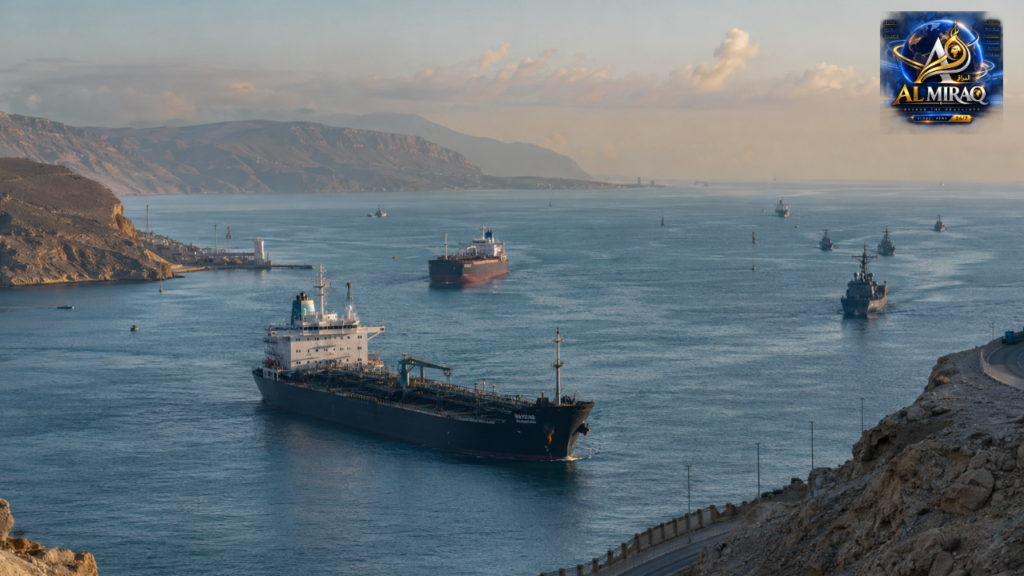
Iran has rejected U.S. claims that the Strait of Hormuz remains open and said its forces have full control over the strategic waterway, escalating an already serious confrontation between Tehran and Washington.
Iran’s Revolutionary Guards naval forces said on August 28 that the strait was under Iranian control and dismissed American statements about the waterway as an attempt to influence oil markets and conceal what Tehran described as U.S. failures.
The Iranian position represents a direct challenge to Washington’s efforts to maintain pressure on Tehran and restore the flow of commercial shipping through one of the world’s most important energy corridors.
The dispute has become increasingly significant because the Strait of Hormuz is a critical route for global oil and liquefied natural gas shipments. Disruptions to traffic through the waterway can quickly affect energy prices, shipping insurance, refinery costs and the broader global economy.
The latest Iranian declaration also comes as the United States expands its economic campaign against Tehran. U.S. Treasury Secretary Scott Bessent announced a new initiative on August 24 aimed at cutting Iran’s remaining financial links with the international economy.
Iran Strait of Hormuz Restrictions Remain a Major Dispute
Tehran has made clear that restrictions on the Strait of Hormuz will remain until the United States ends its military actions against Iran and meets Iranian demands.
That position follows weeks of conflicting statements from Washington and Tehran over who controls the waterway and under what conditions commercial vessels can pass through it.
The situation is more complicated than a simple declaration that the strait is either “open” or “closed.” Shipping traffic has fluctuated substantially during the conflict, while military activity, inspections, threats and restrictions have created uncertainty for commercial operators.
Reuters reported earlier in August that traffic through the strait had fallen sharply after attacks on ships, while the United States said it had the capability to maintain a naval blockade of Iran indefinitely.
Iran, meanwhile, has sought to establish conditions under which shipping could resume. Iranian security officials have said that reopening the waterway would depend on broader political and economic arrangements, including an end to the regional conflict and changes to U.S. measures against Tehran.
The result is an unstable maritime environment in which commercial vessels, energy companies and governments must assess both military and political risks before determining whether and how to use the route.
Why the Strait of Hormuz Matters to the Global Economy
The strategic importance of Hormuz extends far beyond Iran and the United States.
The narrow waterway connects the Persian Gulf with the Gulf of Oman and the wider Arabian Sea. Major energy producers in the Gulf depend on maritime routes through the region to reach international markets.
Any sustained disruption can therefore have consequences for countries that have no direct involvement in the conflict.
Oil markets respond particularly quickly to uncertainty surrounding Hormuz. Even when alternative supply routes or additional production are available, replacing the scale and efficiency of established maritime flows can be difficult.
The European economy is particularly sensitive to energy disruptions because higher oil and gas costs can feed into transportation, electricity generation, manufacturing and consumer prices.
For Asian economies, the consequences can also be substantial because several major energy-importing countries depend heavily on Gulf supplies.
The strategic significance of the waterway is therefore not simply military. It is also financial and economic.
U.S. Economic Pressure on Iran Is Intensifying
The latest dispute over Hormuz is unfolding alongside a significant expansion of U.S. economic pressure on Iran.
On August 24, Treasury Secretary Scott Bessent announced what Washington called Operation Economic Outcast, a campaign designed to sever financial connections supporting the Iranian economy and increase pressure on Tehran. The U.S. Treasury said the initiative was intended to target Iran’s financial lifelines and entities helping the country maintain international economic relationships.
The administration’s strategy combines financial restrictions with pressure surrounding Iran’s oil exports and maritime access.
Washington’s broader objective is to increase the economic cost of the conflict and pressure Tehran toward an outcome favorable to the United States.
Iran has strongly rejected the American campaign.
Iranian officials have described U.S. sanctions as unlawful and harmful to civilians, arguing that countries cooperating with Washington’s restrictions could themselves become involved in measures Tehran considers illegitimate.
The dispute has consequently expanded beyond military confrontation into banking, energy, shipping and international trade.
New U.S. Financial Restrictions Target Iran-Linked Transactions
The economic campaign is already affecting financial institutions with connections to Iranian trade.
The United States has moved against the United Arab Emirates branches of Banque Misr, restricting their access to the U.S. financial system over alleged links to transactions involving Iran.
The measures also involve an individual associated with Iran’s Bank Melli and a Hong Kong-based entity accused by Washington of supporting Iranian financial activity. The U.S. action reflects an attempt to make international institutions choose between maintaining certain relationships with Iran and retaining access to the U.S.-dominated financial system.
Such measures could increase pressure on Iranian businesses and financial intermediaries even if they do not immediately stop all Iranian oil exports.
They also raise the possibility of wider economic consequences for companies and banks in countries that maintain commercial ties with Tehran.
Iran’s Oil Exports Remain Central to the Dispute
Oil is at the center of the confrontation because it represents both a major source of Iranian revenue and a critical component of global energy security.
The supplied claims include an assertion from U.S. Treasury Secretary Scott Bessent that around 130 million barrels of oil had moved through the Strait of Hormuz over a two-week period.
That figure should be treated as a reported U.S. assessment rather than an independently established measurement unless supported by detailed shipping and cargo data.
The wider picture, however, is clear: the amount of oil moving through Hormuz has become a key indicator of the effectiveness of the restrictions and the degree of disruption in global energy markets.
Recent market reporting indicates that oil flows have recovered significantly from the most severe disruptions, although they remain below normal levels. That suggests the waterway is experiencing a state of restricted and uncertain movement rather than a straightforward return to normal commercial operations.
This distinction matters.
A partially functioning waterway can still impose substantial costs because shipping companies may face higher insurance premiums, longer journeys, additional inspections and greater risks to vessels and crews.
What Iran’s Position Means for Europe
Europe is watching the Hormuz confrontation closely because any prolonged disruption could affect energy security and economic stability.
Higher energy prices would increase costs for European manufacturers and transport companies while potentially making inflation more difficult to control.
European governments must also consider the security implications of a conflict that could expand beyond the Middle East.
The European Union has already taken measures connected with freedom of navigation in the Strait of Hormuz. In June, the EU listed the Hormozgan Provincial Command of the Islamic Revolutionary Guard Corps Navy, citing Iranian actions that it said threatened freedom of navigation.
This demonstrates that the dispute is not viewed solely as a bilateral confrontation between Washington and Tehran.
For European governments, the security of commercial shipping and access to energy supplies are directly connected to national economic interests.
Bulgaria and Cyprus Face Wider Security Questions
The potential European dimension becomes even more sensitive when considering U.S. military infrastructure in southeastern Europe.
A recent Financial Times report said Iranian officials and insiders were considering possible military responses against U.S. interests in Europe, including potential targets in Bulgaria and Cyprus, if the confrontation with Washington escalated. The report referred to possible threats involving military infrastructure and other strategic assets.
These reports should not be interpreted as confirmation that Iran has decided to attack Bulgaria or Cyprus.
They instead highlight a broader security concern: if the conflict expands geographically, U.S. facilities and allied infrastructure outside the Middle East could become more important to military planning and deterrence calculations.
Cyprus is particularly sensitive because of its location in the eastern Mediterranean and its proximity to the Middle East. The island also hosts British sovereign base areas that have historically played an important role in regional military operations.
Bulgaria, meanwhile, occupies a strategically important position on NATO’s southeastern flank and the Black Sea region.
Any confirmed attack on NATO territory would carry consequences far beyond the immediate Iran-U.S. confrontation.
At present, however, the reported European risks should be treated as potential scenarios rather than established events.
NATO’s Strategic Challenge
The Hormuz crisis creates a complicated problem for NATO.
The alliance’s core security obligations are focused on its members, meaning that developments involving U.S. forces or facilities outside NATO territory can have different legal and political implications depending on where an incident occurs.
At the same time, several NATO members have major economic and security interests in the Middle East.
A serious escalation involving American forces could therefore place European governments under pressure to support Washington while attempting to prevent the conflict from spreading.
NATO countries also have to consider the possibility that instability in the Middle East could interact with other security challenges, including the war in Ukraine, Russian activity and threats to critical infrastructure.
The risk is not necessarily that a Middle Eastern conflict automatically becomes a NATO war.
The more immediate concern is that multiple security crises could begin competing for the same military resources, intelligence capabilities, diplomatic attention and economic resources.
Iran’s Economic Problems Add Pressure at Home
The confrontation is also creating pressure inside Iran.
Iranian leadership has urged the government to focus on domestic economic challenges, including inflation, unemployment, prices and the availability of goods and services.
Iran’s leadership has also emphasized the need to maintain public confidence while confronting external economic pressure.
The economic dimension is critical because sanctions and restrictions can affect ordinary households through currency instability, higher prices, reduced investment and pressure on employment.
At the same time, the Iranian government argues that external pressure is itself responsible for much of the country’s economic hardship.
The competing narratives are likely to remain an important part of the political struggle between Tehran and Washington.
A Dispute Over More Than Shipping
The Strait of Hormuz has become a symbol of the wider confrontation.
For Iran, maintaining leverage over the waterway provides a powerful strategic tool against U.S. pressure.
For Washington, restoring reliable maritime access is essential to limiting Iran’s ability to use the strait as economic leverage.
That makes the waterway central to both sides’ calculations.
The United States can use naval power and economic sanctions to increase pressure on Iran. Iran can use its geographic position, military capabilities and influence over maritime traffic to raise the costs of that pressure.
Neither approach offers an easy solution.
A prolonged confrontation could increase energy prices, disrupt international trade and create incentives for additional military escalation.
What Remains Unclear
Several critical questions remain unresolved.
First, the exact level of commercial shipping currently moving through the Strait of Hormuz needs to be distinguished from political claims made by either side.
Second, it remains uncertain how long the current restrictions will continue.
Third, the effectiveness of the expanding U.S. sanctions campaign will depend partly on whether major international trading partners cooperate with Washington.
Fourth, there is uncertainty over whether diplomatic negotiations can produce an agreement acceptable to both sides.
Finally, reports about potential Iranian military action against U.S. interests in Europe require careful scrutiny. Claims involving Bulgaria, Cyprus or other European locations should not be treated as confirmed military plans without direct evidence or official confirmation.
These uncertainties are particularly important because inaccurate assumptions about military intentions can themselves contribute to escalation.
What Comes Next for Hormuz and Global Security?
The immediate future of the Strait of Hormuz will depend heavily on the wider U.S.-Iran confrontation.
If negotiations produce a sustainable agreement, commercial traffic could gradually normalize and some pressure could come out of global energy markets.
If negotiations fail and military or economic pressure increases, shipping disruptions could become more severe.
The most significant danger is an escalation cycle in which restrictions on shipping trigger military responses, which then lead to additional sanctions and further restrictions.
Such a cycle could extend the economic consequences well beyond the Persian Gulf.
Conclusion
Iran’s declaration that it has full control over the Strait of Hormuz marks another significant development in the continuing confrontation with the United States.
Tehran says restrictions on the waterway will remain until U.S. military actions and economic pressure against Iran end, while Washington is pursuing an increasingly aggressive sanctions strategy designed to isolate the Iranian economy.
The consequences extend far beyond the two countries.
Hormuz remains vital to global energy markets, making every disruption a concern for oil-importing economies in Europe and Asia. At the same time, reports about potential risks to U.S. interests in Bulgaria and Cyprus demonstrate why governments are increasingly considering the possibility that the conflict could acquire a wider geographical dimension.
For now, claims about future military action in Europe remain unconfirmed, while the status of commercial traffic through Hormuz continues to evolve.
What is clear is that the waterway has become one of the most important pressure points in the U.S.-Iran confrontation. Whether it becomes a pathway toward negotiations or another trigger for escalation will depend on decisions made in Tehran, Washington and other regional capitals in the weeks ahead.
Al Miraq — Beyond the Headlines.