
By Al Miraq News Desk
Published: August 29, 2026
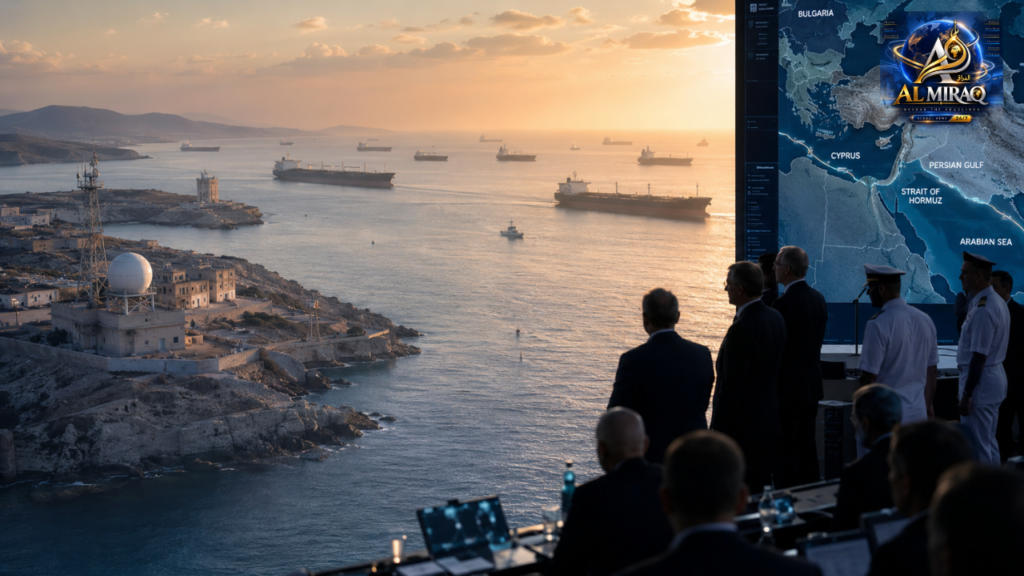
Iran has renewed its claim of having full control over the Strait of Hormuz, sharply escalating an already tense confrontation with the United States over one of the world’s most important maritime energy routes. Iran’s Revolutionary Guard Corps Navy said vessels seeking to pass through the strategic waterway must coordinate with Tehran, while rejecting U.S. assertions about the status of shipping through the strait.
The dispute comes as Washington expands economic pressure on Tehran. The Trump administration has launched a broader campaign aimed at isolating Iran financially, while the U.S. Treasury has moved against foreign institutions accused of helping maintain Iran’s access to international markets.
The latest developments have implications far beyond the Middle East. The Strait of Hormuz is a critical route for global energy shipments, and prolonged restrictions or disruption could affect oil prices, shipping costs, inflation and energy security in Europe and Asia.
At the same time, the competing claims over the waterway underline how difficult it has become to establish a clear picture of maritime activity in the region.
Iran and the United States Offer Conflicting Accounts
Iran’s Revolutionary Guard Corps Navy has publicly claimed that it exercises full control over the Strait of Hormuz and that ships cannot safely transit without Iranian coordination.
Iranian authorities have repeatedly rejected U.S. claims that Washington has established effective control over significant portions of the waterway. Tehran has characterized such statements as attempts to portray Iran as militarily weakened.
The United States and Iran therefore present fundamentally different accounts of the maritime situation.
Reports cited by international media indicate that commercial shipping through the strait has fallen dramatically compared with normal traffic levels. The Financial Times reported that Iran had threatened dozens of vessels with penalties, detention or confiscation for allegedly violating Iranian transit procedures, while daily ship crossings had fallen substantially.
That does not necessarily mean that Iran has physically closed the entire waterway. Rather, the situation reflects a highly contested maritime environment in which commercial operators face increased uncertainty and security risks.
For shipping companies, even uncertainty can have major economic consequences.
Why the Strait of Hormuz Matters
The Strait of Hormuz connects the Persian Gulf with the Gulf of Oman and the wider Arabian Sea. It is one of the world’s most strategically important maritime chokepoints.
Large quantities of crude oil, petroleum products and liquefied natural gas normally pass through the waterway. Any sustained reduction in traffic can therefore have consequences for international energy markets.
The importance of Hormuz also extends beyond oil.
Asian economies depend heavily on energy shipments originating from the Gulf, while European countries remain exposed to changes in global oil and gas prices. A prolonged crisis could increase transportation costs and place additional pressure on economies already dealing with inflation and uncertain energy markets.
The waterway is also strategically important because of its proximity to Iran and several Gulf Arab states. Any military escalation could therefore rapidly affect multiple countries.
U.S. Expands Economic Pressure on Tehran
The dispute over Hormuz is unfolding alongside an intensified American sanctions campaign.
Treasury Secretary Scott Bessent announced a new initiative designed to pressure governments and companies that continue to conduct business with Iran. The campaign targets financial networks, oil-related intermediaries, shipping interests and other entities that Washington says support Tehran’s economic infrastructure.
The United States has also taken steps against an Egyptian bank’s operations in the United Arab Emirates.
Under a proposed Treasury rule, the UAE branches of Banque Misr could lose access to the U.S. financial system. Washington has accused those operations of helping provide an economic lifeline to Iran. The proposed measure is subject to a public-comment period before it can take effect.
The Egyptian central bank has emphasized that the measure is limited to Banque Misr’s UAE branches and dollar-related transactions and does not affect the bank’s operations inside Egypt.
The U.S. Treasury has separately imposed sanctions on the manager of the Dubai branch of Iran’s Bank Melli and a Hong Kong-based company that Washington accuses of helping move funds for Iran.
Washington’s Broader Strategy
The latest measures indicate that Washington is attempting to increase economic pressure without relying exclusively on additional military action.
By targeting banks, shipping companies, oil networks and financial intermediaries, U.S. officials hope to make it increasingly difficult for Iran to generate foreign currency and maintain international commercial relationships.
For Tehran, however, the measures represent another layer of economic pressure at a time when the country’s economy is already under significant strain.
Iran has condemned the sanctions and urged other countries not to cooperate with Washington’s campaign.
Oil Markets Face Another Layer of Uncertainty
The Strait of Hormuz dispute has naturally raised concerns about oil supplies.
Any major interruption to the waterway could create a sharp shock in international energy markets. Even without a complete closure, reduced shipping activity can increase insurance premiums, freight costs and risk assessments for energy companies.
Recent market movements have shown that investors are closely watching developments around the conflict. Oil prices have reacted not only to physical supply concerns but also to expectations about whether the confrontation will escalate or move toward negotiations.
Iran’s own oil exports have also been affected by the broader conflict and U.S. restrictions.
Reuters reported that Washington’s latest strategy is designed to disrupt Iranian oil exports and the networks that facilitate them, including intermediaries operating through countries such as the UAE, Singapore and Hong Kong.
The result is a complicated economic contest: the United States is attempting to restrict Iran’s ability to sell oil and access global finance, while Iran retains strategic leverage through its geographical position around the Strait of Hormuz.
The Regional Security Dimension
The confrontation is not limited to Washington and Tehran.
Gulf states have a direct interest in maintaining freedom of navigation because their economies depend heavily on energy exports and maritime trade.
Saudi Arabia, the United Arab Emirates and other regional governments have generally sought to avoid being drawn deeper into a direct military confrontation. At the same time, continued instability around Hormuz presents a major security and economic challenge.
The crisis has also encouraged regional governments to reassess their security relationships.
Pakistan, meanwhile, continues to maintain close ties with Gulf countries. On Friday, Saudi Minister for Environment, Water and Agriculture Abdulrahman Abdulmohsen Al-Fadley met Pakistan’s Field Marshal Syed Asim Munir in Rawalpindi. The discussions included bilateral cooperation, agriculture, environmental sustainability and regional peace and stability.
Such diplomatic and security relationships could become increasingly important if instability in the Gulf persists.
Europe Watches the Crisis Closely
European governments have another reason to monitor the situation carefully: energy security.
Europe has spent years attempting to diversify its energy supplies and reduce dependence on individual sources. Nevertheless, global oil and gas markets remain interconnected.
A major disruption in the Gulf would not necessarily affect Europe only through direct physical shortages. Global prices could rise as buyers compete for alternative supplies.
Higher energy costs could then affect transportation, manufacturing, electricity generation and household expenses.
The European security implications are also broader.
The current confrontation is taking place alongside the continuing war in Ukraine and growing tensions between Russia and Western governments. The United States’ attention and military resources are therefore being divided across multiple strategic theaters.
That creates concerns among European allies about the wider security environment.
Russia and the Wider European Security Picture
A separate development adding to these concerns was the secretive visit by CIA Director John Ratcliffe to Moscow.
The Kremlin confirmed that Ratcliffe held talks with Russian intelligence counterparts, although Russian President Vladimir Putin did not meet with him. The unusual visit came amid continuing tensions over Ukraine and broader U.S.-Russia relations.
The exact substance of the discussions has not been fully disclosed.
Some reports have linked the talks to concerns about Russia’s behavior toward Ukraine and European security, while other reporting has pointed to the broader Middle Eastern crisis as another possible subject.
It is important, however, to distinguish reported intelligence assessments from publicly confirmed policy decisions.
There is no established evidence from the available reporting that Russia has decided to launch an attack on NATO countries. Such claims should therefore be treated cautiously.
Nevertheless, the possibility of miscalculation remains a concern as the United States manages simultaneous challenges involving Iran, Russia and other international actors.
U.S. Pressure Could Have Unintended Consequences
Washington’s strategy is intended to weaken Iran’s ability to finance its government and military capabilities.
But economic pressure can also produce unintended consequences.
If Iran believes that its economic survival is being directly threatened, it may seek alternative trade routes, increase cooperation with non-Western powers or use its geographical position to increase pressure on international shipping.
The Strait of Hormuz is particularly important in this regard because Iran does not need to completely shut the waterway to affect global markets.
A reduction in shipping confidence can itself be economically significant.
Higher insurance premiums, rerouted vessels and delays can increase the cost of transporting energy even when some ships continue to pass.
What Remains Unclear
Several important questions remain unresolved.
First, the competing claims about who effectively controls the Strait of Hormuz cannot be treated as independently established simply because either Tehran or Washington makes the assertion.
Iran says it has full control over the waterway, while reports citing U.S. officials have described a very different military picture.
Second, it remains uncertain how far the U.S. sanctions campaign will expand.
The proposed action against Banque Misr’s UAE branches demonstrates that Washington is willing to pressure financial institutions outside Iran, but the administration has also shown awareness of the risks involved in disrupting major international banking relationships.
Third, the impact on global energy markets will depend heavily on the duration and intensity of the crisis.
A temporary reduction in shipping may be absorbed by global markets. A prolonged disruption would be much more difficult to manage.
Pakistan Faces Its Own Security and Economic Challenges
The wider regional situation comes as Pakistan deals with several domestic developments.
One of the country’s most serious recent tragedies occurred at the Pakistan Institute of Medical Sciences in Islamabad, where a fire in the Mother and Child Health Centre killed 14 newborn babies. The government ordered an investigation, while officials and families raised questions about safety arrangements and the emergency response.
An official report reviewed by Arab News also identified concerns involving emergency exits and fire-safety arrangements.
The tragedy has intensified calls for accountability and stronger safety standards in major hospitals.
Pakistan is simultaneously facing pressure from international economic and regional developments, including energy prices and its relationships with Gulf states.
Pakistan’s Cricket Team Suffers Heavy Defeat at Lord’s
In sport, Pakistan suffered another difficult day against England in the second Test at Lord’s.
Pakistan was bowled out for just 110 in its first innings. Azan Awais top-scored with 46, while England’s Ollie Robinson took four wickets for 11 runs and Jofra Archer claimed three for 26.
England reached 81 for three in its second innings, giving the hosts an overall lead of 261 runs at the close of play.
The result left England in a dominant position in the Test, continuing a difficult series for Pakistan’s batting lineup.
Why the Hormuz Crisis Matters Beyond Iran
The latest confrontation demonstrates how a regional conflict can rapidly become a global economic and security issue.
The Strait of Hormuz is not simply a geographical feature. It is a central artery of the international energy system.
Any prolonged reduction in traffic could affect oil prices, shipping costs, inflation and industrial production across multiple continents.
For Europe, the crisis adds another layer of uncertainty to an already difficult security environment shaped by the war in Ukraine.
For Gulf countries, it raises questions about maritime security and the reliability of existing security arrangement.
And for Iran, the central issue is whether its strategic position around Hormuz can offset the growing economic pressure created by U.S. sanctions.
Conclusion
The latest Iran Strait of Hormuz control claim marks another significant escalation in the confrontation between Tehran and Washington. Iran’s Revolutionary Guard says the country maintains full control over the strategic waterway, while U.S.-linked assessments have presented a contrasting picture of maritime control. The competing claims remain difficult to independently verify in full.
At the same time, Washington is intensifying its economic campaign against Iran, including proposed restrictions affecting Banque Misr’s UAE branches and additional sanctions targeting individuals and entities linked to Iranian financial networks.
The consequences could extend well beyond the Middle East. Any sustained disruption to shipping through Hormuz could affect global energy prices and supply chains, while the simultaneous crises involving Iran, Russia and Ukraine could place additional pressure on European and NATO security planning.
For now, the most important question is whether the confrontation moves toward negotiations or further escalation. Until that becomes clearer, the Iran Strait of Hormuz control dispute will remain one of the most consequential geopolitical and energy-security issues facing the international community.
Al Miraq — Beyond the Headlines.