
By Al Miraq News Desk
Published: August 28, 2026
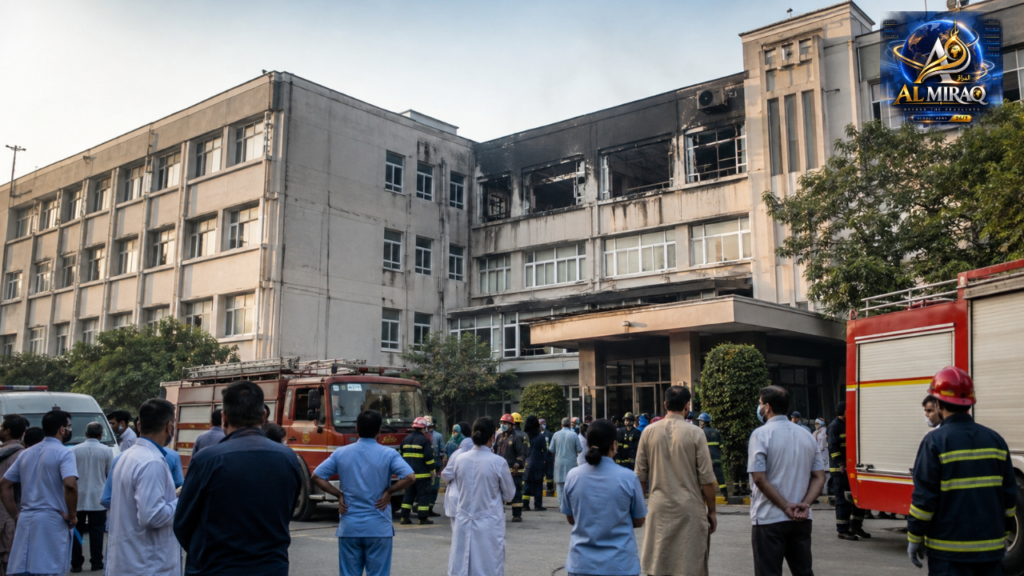
The PIMS hospital fire in Islamabad has triggered a national outcry after 14 newborn babies died in a blaze at the Pakistan Institute of Medical Sciences, with serious questions now being raised about the cause of the fire, emergency preparedness and possible failures in hospital safety procedures.
The tragedy has also created growing pressure for accountability as conflicting accounts emerge over how the fire started. An initial explanation pointed toward an air-conditioning unit, but members of a parliamentary health committee have questioned whether an electrical fault in the air conditioner was responsible.
As investigators examine the evidence, grieving families are seeking answers about how a fire could claim so many newborn lives inside one of Pakistan’s major public hospitals.
What Happened at PIMS?
The fire broke out in the Mother and Child Hospital area of PIMS in Islamabad, where newborn babies were receiving treatment.
Fourteen infants died in the incident, according to multiple reports.
The tragedy has raised particular concern because newborns in intensive-care and nursery facilities are among the most vulnerable patients in any hospital. Many cannot move without assistance and depend entirely on medical staff and functioning emergency systems during a crisis.
Reports from the scene and subsequent investigations have raised questions about evacuation arrangements, access to the ward and the availability of effective fire-safety measures.
The deaths have prompted mourning across Pakistan and intensified scrutiny of safety standards in public healthcare facilities.
PIMS Hospital Fire Cause Under Investigation
One of the biggest unanswered questions is what actually caused the fire.
Initial accounts attributed the blaze to a problem involving an air-conditioning system. Health authorities had indicated that an electrical issue or explosion associated with an air conditioner may have triggered the fire.
A parliamentary health committee examining the incident said there was no clear evidence that the old air-conditioning unit caused the blaze. Committee members questioned the original explanation and demanded a more thorough investigation.
The disagreement is significant because establishing the source of the fire is essential for determining whether the incident resulted from equipment failure, an electrical problem, human negligence, inadequate maintenance or another factor.
Conflicting Accounts Increase Pressure
The emergence of differing accounts from officials and medical personnel has increased public concern.
Reports have highlighted contradictions between statements about the condition of the air-conditioning equipment and the circumstances surrounding the fire.
That makes the formal investigation particularly important. Investigators will need to examine the physical evidence, maintenance records, electrical systems, surveillance footage, staff accounts and emergency-response procedures before reaching a definitive conclusion.
The investigation must also establish whether any safety violations contributed to the deaths.
Parliamentary Committee Questions Hospital Safety
Pakistan’s parliamentary health authorities have taken a critical view of the circumstances surrounding the tragedy.
The committee has also called for accountability and questioned the performance of senior officials.
Such demands reflect the wider concern that the tragedy may not simply have been an unavoidable accident. If investigators establish that safety systems were absent, defective or improperly maintained, responsibility could extend beyond the immediate cause of the fire.
This distinction will be central to the final findings.
A malfunctioning piece of equipment, for example, would raise one set of questions. A malfunctioning system combined with inadequate fire detection, evacuation procedures, staff training or emergency infrastructure would raise much broader concerns about institutional responsibility.
Government Orders High-Level Inquiry
Prime Minister Shehbaz Sharif ordered a high-level investigation following the deaths.
The government formed a committee headed by retired federal secretary Shahid Khan to examine the circumstances of the incident and determine what went wrong.
Officials have indicated that negligence, if established, should lead to action.
The investigation therefore has two important responsibilities: identifying the immediate cause of the fire and determining whether institutional failures contributed to the loss of life.
Calls for a Judicial Commission
The controversy has also prompted calls for a judicial commission.
Some lawmakers and legal experts have argued that an independent judicial investigation may ultimately be necessary, particularly if the government-led inquiry fails to answer the major questions surrounding the tragedy.
A judicial inquiry would potentially provide a broader mechanism for examining evidence and questioning officials, hospital administrators and other relevant personnel.
For families who have lost newborn children, however, the immediate priority remains obtaining a credible explanation of what happened.
Why the Nursery Environment Matters
Hospital fires are particularly dangerous in neonatal and maternity facilities because patients cannot evacuate independently.
A healthy adult may be able to respond immediately to smoke, flames or an alarm. Newborns, premature babies and critically ill infants cannot.
That means hospitals treating vulnerable patients require highly reliable fire detection, emergency power systems, evacuation plans, staff training, functioning firefighting equipment and clearly accessible escape routes.
Any weakness in one part of that system can become catastrophic when a fire develops rapidly.
The PIMS tragedy has therefore raised questions that go beyond one hospital.
Families Demand Answers and DNA Identification
The emotional impact of the tragedy has been compounded by the difficulties faced by families seeking certainty about the identities of the victims.
Relatives have demanded DNA testing where necessary to ensure that remains are correctly identified and returned to the appropriate families.
For parents who had newborn children receiving treatment in the hospital, the incident has created an unimaginable situation: instead of leaving with their babies after medical care, they were confronted with a disaster involving fire, uncertainty and loss.
The demand for transparent identification is therefore not merely administrative. It is an essential part of the government’s responsibility toward affected families.
Hospital Administration Under Pressure
The incident has placed the PIMS administration under intense scrutiny.
Questions are being asked about the hospital’s maintenance systems, emergency preparedness, staff training and the condition of equipment in the affected ward.
The PIMS executive director has reportedly resisted calls to resign, while demands for resignations have emerged from parliamentary circles.
Whether individual officials should remain in their positions is ultimately a matter for the relevant authorities and the findings of the investigation.
However, accountability will likely remain a central public demand until investigators establish whether negligence played a role.
The Wider Hospital Fire-Safety Problem
The PIMS disaster has exposed a broader issue for Pakistan’s healthcare system: fire safety cannot be treated as a secondary concern.
Hospitals contain electrical equipment, oxygen supplies, medical gases, generators, air-conditioning systems and large numbers of patients. In intensive-care and neonatal units, the risks are even greater because patients often require continuous life-support equipment.
Fire prevention therefore requires regular inspections rather than action only after an accident.
Hospitals need functioning alarms, smoke detection systems, emergency lighting, fire extinguishers, accessible evacuation routes and trained staff capable of responding immediately.
Regular drills can also help staff understand how to evacuate patients when conventional procedures are impossible.
For neonatal wards, emergency planning must account for the special needs of infants in incubators and other medical equipment.
What Remains Unclear?
Several important questions remain unanswered in the aftermath of the PIMS hospital fire.
First, investigators must determine the exact source of the fire.
Second, they must establish whether the air-conditioning system was functioning and whether it played any role in starting or spreading the blaze.
Third, investigators need to establish whether smoke alarms, firefighting equipment and emergency systems were operational.
Fourth, the investigation must determine how quickly hospital staff responded and whether their training and emergency procedures were adequate.
Finally, authorities must establish whether previous inspections identified safety problems and, if so, whether those problems were addressed.
These questions cannot be resolved through speculation.
They require technical evidence, witness testimony, maintenance records and an independent examination of the physical scene.
A Test of Accountability
The PIMS tragedy is now becoming a test of Pakistan’s ability to investigate institutional failures transparently.
Public anger is understandable after the deaths of 14 newborns, but a credible response requires more than statements of sympathy.
Families need clear answers. Hospital workers need safe working environments. Patients need confidence that medical facilities are capable of protecting them during emergencies.
If investigators find evidence of negligence, those responsible should face appropriate action under the law.
At the same time, authorities should avoid prematurely assigning blame before the investigation is complete.
The distinction between accountability and speculation is particularly important in a tragedy of this scale.
Implications for Pakistan’s Healthcare System
The incident could lead to a wider review of fire-safety arrangements at government hospitals across Pakistan.
Such a review would be particularly important for neonatal intensive-care units, maternity wards, emergency departments and other areas where patients cannot easily evacuate.
A national assessment could examine electrical systems, generators, air-conditioning equipment, fire alarms, oxygen infrastructure, emergency exits, staff training and evacuation plans.
The cost of such measures would be significant, but the consequences of ignoring safety weaknesses can be far greater.
The PIMS tragedy demonstrates that healthcare quality is not limited to doctors, medicines and medical equipment. Patient safety also depends on the physical environment in which treatment takes place.
Political and Public Pressure Is Likely to Continue
The controversy is unlikely to end with the first investigation report.
If the inquiry produces a clear and evidence-based explanation, it could help restore public confidence. If major questions remain unanswered, pressure for an independent judicial investigation is likely to increase.
The government’s handling of the investigation will therefore be closely watched.
For opposition parties, lawmakers and civil society groups, the incident has already become a symbol of wider concerns about governance and public-sector accountability.
For families, however, the issue is more personal.
They want to know why their children died and whether the deaths could have been prevented.
Conclusion
The PIMS hospital fire has become one of Pakistan’s most painful recent healthcare tragedies, with 14 newborn babies losing their lives in a fire at the Islamabad hospital. While an air-conditioning fault was initially cited as a possible cause, parliamentary investigators have questioned that explanation, and the precise origin of the blaze remains under investigation.
The government’s inquiry will need to establish not only how the fire started but also whether failures in maintenance, fire protection, emergency response or staff training contributed to the deaths.
The tragedy has also highlighted the vulnerability of newborn patients and the importance of robust safety systems in hospitals. Any final findings should be based on evidence rather than speculation, with responsibility established through a transparent and credible process.
For Pakistan’s healthcare system, the consequences could extend well beyond PIMS. If meaningful lessons are drawn from the disaster, hospitals across the country could strengthen emergency preparedness and fire-safety standards. If serious questions remain unanswered, however, public pressure for deeper accountability is likely to continue.
Ultimately, the families who lost their newborn children deserve more than condolences. They deserve a clear account of what happened, an honest assessment of whether the tragedy could have been prevented and concrete measures to ensure that a similar disaster does not happen again.
Al Miraq — Beyond the Headlines.