
By Al Miraq News Desk
Published: August 26, 2026
Asim Munir Iran Visit Comes as Pakistan Intensifies Peace Efforts
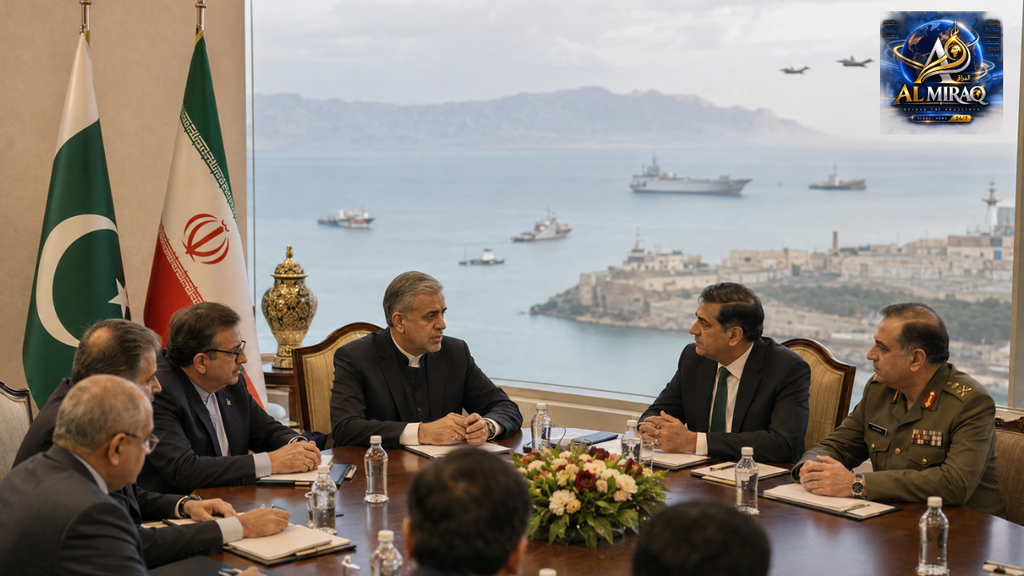
Pakistan has stepped up diplomatic efforts to help ease tensions between the United States and Iran, with Field Marshal Syed Asim Munir holding high-level talks in Tehran as Islamabad seeks a negotiated solution to the conflict. The Asim Munir Iran visit came at a particularly sensitive moment, with Washington preparing tougher economic measures against Tehran and Iran warning against further pressure.
Munir travelled to Tehran alongside Pakistan’s Interior Minister Mohsin Naqvi for a day-long diplomatic mission focused on regional stability. Pakistani officials later said the discussions made significant progress, although the details of any potential breakthrough were not publicly disclosed.
The visit highlights Pakistan’s increasingly important role as an intermediary between Washington and Tehran. It also comes as concerns grow that the conflict could affect energy markets, shipping routes and security beyond the Middle East.
Pakistan’s Diplomatic Push in Tehran
Iran’s Foreign Ministry had previously confirmed that Munir would travel to Tehran as part of Pakistan’s efforts to promote peace and security in the region.
According to Iran’s Foreign Ministry spokesman Esmaeil Baqaei, the visit was intended to strengthen bilateral cooperation while continuing Pakistan’s diplomatic efforts aimed at supporting regional peace. Munir was expected to meet senior Iranian officials during the trip.
The mission subsequently expanded into a series of high-level meetings.
Pakistan’s military said Munir met Iranian President Masoud Pezeshkian, Parliament Speaker Mohammad Bagher Ghalibaf, Foreign Minister Abbas Araghchi, Interior Minister Eskandar Momeni and Mohsen Rezaei, the Supreme Leader’s representative on the Supreme National Security Council.
The discussions reportedly focused on preventing further escalation, reopening the Strait of Hormuz and finding a path toward ending the conflict through negotiations.
Pakistan’s Interior Minister later described the talks as positive and productive, saying that “significant progress” had been made. However, neither side publicly provided detailed information about what agreements, if any, had been reached.
That distinction is important. The diplomatic language signals movement, but it does not yet establish that a comprehensive settlement has been achieved.
Why the Asim Munir Iran Visit Matters
The Asim Munir Iran visit carries significance beyond Pakistan-Iran relations because Islamabad has maintained communication with both Tehran and Washington.
Pakistan has previously attempted to facilitate dialogue between the United States and Iran. The latest initiative comes at a time when distrust between the two sides remains exceptionally high.
For Islamabad, preventing a wider regional conflict is also directly connected to its own national interests.
Pakistan shares a long border with Iran and has significant economic and security interests in the region. A prolonged confrontation could affect cross-border trade, energy supplies, maritime security and broader economic stability.
The possibility of disruption around the Strait of Hormuz adds another layer of concern.
The waterway is one of the world’s most important energy corridors. Any sustained disruption could have consequences well beyond the Gulf, potentially affecting oil prices, shipping costs and economies across Asia and Europe.
Talks Focus on the Strait of Hormuz
The Strait of Hormuz has emerged as one of the most sensitive issues in the wider crisis.
Pakistan’s military said discussions in Tehran included efforts to reopen the strategic waterway and accelerate the end of hostilities.
The importance of the strait means that any escalation involving commercial shipping could quickly become an international economic issue.
Even without a formal closure, threats against shipping can increase insurance premiums, force vessels to change routes and raise transportation costs.
For Pakistan, which relies heavily on imported energy, prolonged disruption could create additional economic pressure.
For Europe, the consequences could include higher energy and transportation costs and renewed concerns over the security of critical maritime routes.
US Economic Pressure on Iran Intensifies
The diplomatic effort from Pakistan is taking place alongside an expanding American economic pressure campaign against Tehran.
The United States has threatened severe sanctions targeting Iran and entities that support its economy. Reuters reported that new measures announced by Washington were aimed at further isolating Iran from the global economy.
Iran has strongly rejected the pressure campaign.
Iranian officials have described the new sanctions as unlawful and have warned that continued pressure could provoke retaliation. Tehran has also argued that Washington’s strategy represents a continuation of its longstanding policy of economic coercion.
The confrontation therefore has two interconnected dimensions: diplomacy and economic pressure.
While Pakistan is attempting to encourage dialogue, Washington is seeking to increase leverage over Tehran through sanctions and other economic measures.
The success of Islamabad’s mediation efforts could depend partly on whether the United States and Iran are willing to use diplomacy while maintaining their respective positions.
Iran Rejects Washington’s Pressure Campaign
Iranian leaders have responded forcefully to the latest American threats.
Parliament Speaker Mohammad Bagher Ghalibaf has dismissed Washington’s pressure strategy, while Iranian Foreign Minister Abbas Araghchi has also criticized the American approach.
Iranian officials have argued that sanctions and economic pressure will not force Tehran to abandon its strategic interests.
The Iranian government has also warned that threats against its infrastructure or wider national interests could trigger a response.
These positions illustrate the central challenge facing mediators such as Pakistan.
A successful diplomatic process would need to address fundamental disagreements rather than simply reduce tensions temporarily.
Economic Pressure Could Affect Third Countries
The dispute also has implications for countries that maintain commercial relationships with Iran.
Washington has warned that countries and entities helping Iran could face economic consequences. Reuters reported that the latest sanctions package targeted dozens of individuals, entities and vessels connected to Iran’s economic network.
That creates a difficult environment for neighboring states.
Countries seeking to preserve trade with Iran must increasingly balance economic interests against the possibility of secondary pressure from the United States.
Pakistan is particularly sensitive to this issue because of its geographic proximity to Iran and its interest in maintaining bilateral trade.
Iran Conflict Raises Concerns Beyond the Middle East
The latest crisis has increasingly raised concerns about the possibility of the conflict affecting European security.
A recent report by the Financial Times, cited by Bulgarian and regional media, said Iranian forces had assessed possible strikes against U.S. military assets in southeastern Europe if Washington were to resume a broader military offensive. Bulgaria and Cyprus were specifically mentioned in the report.
The claims remain reported assessments rather than confirmed evidence of an imminent Iranian attack.
That distinction is crucial.
The Financial Times report cited two people described as regime insiders. It did not establish that an attack had been ordered or that Iran had decided to strike European territory.
Bulgaria nevertheless reacted by strengthening security around the Bezmer air base, where the country had authorized the presence of U.S. aerial-refueling aircraft and personnel.
Why Bulgaria Has Become Part of the Security Discussion
Bulgaria is a NATO member, making any direct attack on its territory a potentially serious alliance issue.
The reported Iranian assessments were linked to the use of Bulgarian territory for U.S. military activities.
The Bulgarian government has sought to reassure the public while NATO officials have emphasized the alliance’s readiness to protect member states.
Bulgarian authorities have also treated the issue cautiously, with some officials warning that unverified information could potentially form part of a broader information or hybrid-warfare environment.
The situation demonstrates how a conflict centered in the Middle East can quickly become relevant to European defense planning.
Cyprus Adds Another Layer of Concern
Cyprus has also appeared in reports concerning possible Iranian retaliation.
The island hosts British sovereign military bases, including RAF Akrotiri, making it strategically important to Western military operations in the eastern Mediterranean.
The Financial Times report cited by regional media identified Cyprus as a possible target in a scenario involving renewed American military action against Iran.
However, Iranian diplomatic sources later indicated that Cyprus would not face a threat if British bases on the island were not used in operations against Iran.
That qualification is significant because it suggests that any potential threat assessment may be linked specifically to military use rather than Cyprus as a country.
Still, the situation has increased attention on the eastern Mediterranean and the potential consequences of the wider confrontation.
NATO and European Security Implications
The possibility of Iranian retaliation against military assets in Europe has prompted renewed discussion about NATO readiness.
Bulgaria’s security environment has received particular attention because of the reported use of its territory for American refueling operations.
NATO Secretary General Mark Rutte discussed the issue with Bulgaria’s prime minister, according to Bulgaria’s state news agency. The discussion reportedly focused on the broader European security environment and possible Iranian threats. NATO reiterated its commitment to defending member states.
For Europe, the issue extends beyond conventional military threats.
Critical infrastructure, energy supplies, undersea communications cables and maritime routes could all become part of a wider security calculation if tensions escalate.
This means European governments are increasingly watching developments in the Middle East not only through the lens of diplomacy but also through national security, energy security and infrastructure protection.
Pakistan’s Balancing Act Between Washington and Tehran
Pakistan’s mediation effort is particularly delicate because Islamabad needs working relationships with both Iran and the United States.
Pakistan has longstanding economic and geographic links with Iran, while Washington remains important to Pakistan’s international diplomacy, economy and security relationships.
Reuters reported that Munir had spoken with U.S. President Donald Trump before his Tehran trip, citing Pakistani sources. The reported conversation came as Washington prepared additional economic pressure on Iran.
The White House had not publicly confirmed the reported conversation at the time of the report.
If Pakistan can maintain communication with both sides, Islamabad could potentially help reduce misunderstandings and create space for negotiations.
But mediation also carries risks.
Pakistan cannot independently dictate the terms of a U.S.-Iran settlement. Any durable agreement would ultimately depend on decisions made by Washington and Tehran.
What Pakistan Is Trying to Achieve
The central objective of Islamabad’s current diplomacy appears to be de-escalation.
Pakistan wants to prevent the conflict from expanding further, encourage negotiations and help restore stability to critical regional routes.
The government’s diplomatic efforts are also aimed at protecting Pakistan from the economic consequences of a prolonged regional crisis.
The reopening of the Strait of Hormuz would be particularly important.
A reduction in tensions around the waterway could help stabilize shipping and energy markets while reducing the risk of a wider confrontation.
Pakistan’s approach therefore combines diplomacy with practical economic and security concerns.
A Difficult Path to a Settlement
Despite positive statements following the Tehran meetings, major obstacles remain.
The United States continues to demand greater pressure on Iran, while Tehran has rejected what it describes as coercive economic measures.
Both sides have competing security concerns and limited trust.
The possibility of renewed military action also remains a major factor.
Pakistan’s diplomatic initiative could help create an environment for further discussions, but it cannot by itself resolve the fundamental disagreements between Washington and Tehran.
What Remains Unclear
Several important questions remain unanswered following the latest diplomatic activity.
It is not yet clear what specific commitments were discussed during Munir’s meetings in Tehran or whether the talks produced a concrete framework for renewed U.S.-Iran negotiations.
The meaning of the reported “significant progress” also remains undefined.
Similarly, reports about possible Iranian military targets in Bulgaria and Cyprus should not be interpreted as evidence that attacks are imminent.
The available reporting describes assessments and contingency planning rather than a confirmed decision to launch attacks.
This distinction will remain important as governments and media organizations monitor developments.
Wider Regional Consequences
The outcome of the current diplomatic efforts could have consequences across the Middle East and beyond.
A negotiated reduction in tensions could improve maritime security, reduce pressure on energy markets and lower the risk of a broader military confrontation.
Failure to reach an agreement, however, could produce the opposite effect.
Further sanctions, military escalation or disruption around the Strait of Hormuz could affect international trade and increase pressure on countries that depend heavily on imported energy.
European governments would also have to consider the possibility that the geographic boundaries of the crisis could expand.
For NATO, the central concern would be protecting member states and military infrastructure while avoiding unnecessary escalation.
For Pakistan, the priority is likely to remain preventing a conflict on its western doorstep and preserving diplomatic channels with all major parties.
Conclusion
The Asim Munir Iran visit represents one of Pakistan’s most significant recent attempts to help break the diplomatic deadlock surrounding the U.S.-Iran confrontation.
Munir’s meetings with Iran’s senior leadership, together with Pakistan’s broader mediation efforts, have produced positive statements and claims of meaningful progress. However, no comprehensive peace agreement has been announced, and major disagreements between Washington and Tehran remain unresolved.
At the same time, expanding U.S. economic pressure on Iran and reports of contingency planning involving military assets in Bulgaria and Cyprus show how the consequences of the conflict could extend beyond the Middle East.
For Pakistan, the stakes are especially high. Islamabad has an opportunity to use its relationships with both Iran and the United States to encourage dialogue, but the country’s diplomatic influence has clear limits.
The immediate focus will remain on whether the latest contacts can translate into renewed negotiations, reduced tensions and greater maritime security. Until that happens, the wider region — and increasingly Europe — will remain exposed to the risks created by a conflict whose consequences are no longer confined to the Middle East.
Al Miraq — Beyond the Headlines.