
By Al Miraq News Desk
Published: August 21, 2026
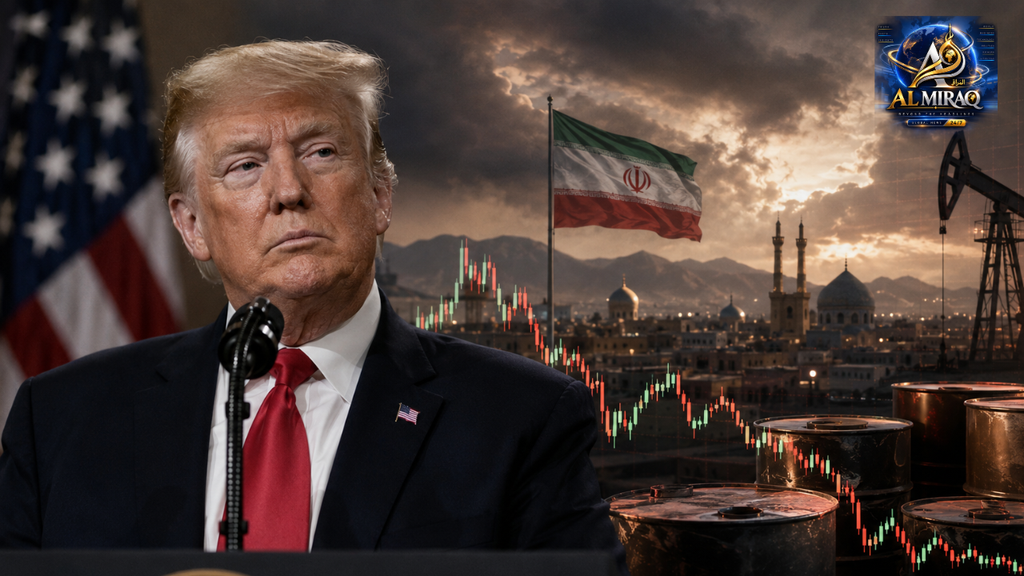
Trump Announces Major Economic Offensive Against Iran
US President Donald Trump has announced what he described as a large-scale economic offensive against Iran, escalating pressure on Tehran and warning countries and businesses that continue providing financial, commercial or logistical support to Iran.
In a statement shared on Truth Social, Trump said the United States was beginning a major economic campaign against Iran and warned that governments and entities helping Tehran could face serious consequences.
The announcement comes amid continued tensions between Washington and Tehran and growing international concern over the wider economic and security consequences of confrontation in the Middle East.
Trump specifically targeted Iranian oil smuggling networks, exchange houses and front companies, calling for them to be shut down. He also warned countries that provide Iran with economic facilities or use airports to maintain its lifeline that they could face consequences.
The US president also urged allied countries to stand with Washington in its efforts to put greater economic pressure on Iran.
According to Trump’s statement, Iran had previously been given an opportunity to reach an understanding, but the Iranian government failed to take advantage of that opportunity.
The latest announcement has therefore added another layer to the already tense relationship between the United States and Iran.
Washington Steps Up Pressure on Iranian Oil and Financial Networks
The economic measures outlined by Trump appear to focus particularly on the networks that allow Iran to continue international trade despite existing restrictions.
Iran’s oil sector has long remained a central target of US sanctions. Washington has repeatedly attempted to restrict Iranian oil revenues by targeting companies, intermediaries and trading networks involved in the movement and sale of Iranian crude.
Trump’s latest warning specifically mentioned oil smuggling, exchange houses and front companies.
The approach could create additional challenges for businesses operating in countries that maintain commercial relations with Iran.
The US administration’s warning also extends beyond Iranian companies themselves. Countries and businesses that facilitate Iran’s access to international financial and transportation networks could potentially face increased scrutiny and pressure.
This has raised concerns about the broader impact of the new US strategy on international trade and regional economies.
Iran Rejects Trump’s Economic Threat
Iranian Foreign Minister Abbas Araghchi responded to Trump’s announcement by criticizing the economic policies of the United States.
Araghchi argued that the United States itself is facing serious economic challenges, including high levels of debt and rising interest-related costs.
He suggested that continuing what he described as failed policies would ultimately result in further difficulties for Washington rather than forcing Iran to surrender.
The Iranian foreign minister also warned that continued economic pressure could increase hostility toward the United States among the Iranian population.
His response reflects Tehran’s long-standing position that sanctions and economic pressure cannot resolve political disputes between the two countries.
Iran has repeatedly called for diplomatic engagement instead of what it considers coercive economic measures.
China Rejects US Economic Pressure Campaign Against Iran
China has also rejected the idea that increasing economic pressure on Iran will resolve the dispute.
A Chinese Foreign Ministry spokesperson said sanctions and pressure would not solve the underlying problems and called for responsible measures aimed at reducing tensions.
Beijing emphasized diplomacy as the preferred mechanism for addressing disagreements.
China’s position is particularly significant because it maintains important economic and diplomatic relations with Iran while also being a major global trading power.
The Chinese response highlights the growing divide between Washington’s pressure-based approach and countries calling for diplomatic negotiations.
Pakistanis Injured in Houthi Attack Return Home
Amid the wider regional tensions, six Pakistani nationals injured in a Houthi attack have returned to Pakistan.
The bodies of two Pakistani nationals who were killed in the incident were also transported back to the country.
Deputy Prime Minister and Foreign Minister Ishaq Dar said Pakistani diplomatic officials in Jeddah and Riyadh took immediate steps because Pakistan does not maintain a diplomatic mission in Yemen.
Pakistan strongly condemned the attack on a Tanzanian commercial vessel by the Houthis and stressed that the safety and security of Pakistani citizens must be ensured under all circumstances.
The incident once again highlights the risks faced by international shipping routes in the region.
The security situation around the Red Sea and Yemen has remained a major concern for international shipping companies and governments because disruptions in the area can affect both trade and civilian lives.
Pakistan and Syria Discuss Stronger Bilateral Relations
Prime Minister Shehbaz Sharif held a meeting with Syrian Foreign Minister Asaad Hassan Al-Shaibani during his visit to Pakistan.
The Pakistani leadership reaffirmed support for Syria’s sovereignty, unity and regional stability.
Prime Minister Shehbaz Sharif expressed Pakistan’s intention to continue supporting Syria’s independence and territorial integrity.
The two sides also discussed the restoration of direct flights between Pakistan and Syria, a move that could make travel easier for visitors, pilgrims and business communities.
Prime Minister Shehbaz Sharif invited Syrian President Ahmad al-Sharaa to visit Pakistan.
Earlier, Syrian Foreign Minister Asaad Hassan Al-Shaibani met Deputy Prime Minister Ishaq Dar, where the two sides discussed regional developments and bilateral cooperation.
Pakistan also welcomed the Makkah Defence Agreement, while the Syrian foreign minister appreciated Pakistan’s constructive role in promoting regional peace and stability.
Pakistan and Syria Seek Greater Trade Cooperation
The Syrian delegation also held discussions with Pakistan’s commerce authorities.
Officials from both countries agreed on the need to strengthen bilateral trade and expand economic cooperation.
Pakistan and Syria have historically maintained diplomatic relations, but both sides see significant potential for greater commercial interaction.
Improved air connectivity, increased trade and stronger diplomatic engagement could help expand cooperation between the two countries.
The Syrian foreign minister also praised Pakistani efforts aimed at reducing tensions between the United States and Iran.
Pakistan’s diplomatic engagement with regional countries comes at a time when the Middle East remains under significant geopolitical pressure.
Malaysian Interior Minister Visits Pakistan Monument
Malaysia’s Interior Minister Saifuddin Nasution Ismail visited the Pakistan Monument in Islamabad along with Minister of State for Interior Talal Chaudhry.
The visiting minister was received with an official guard of honour by a contingent of the Federal Constabulary.
He also visited the Martyrs’ Memorial, laid a floral wreath and offered prayers.
The Malaysian delegation appreciated the historical importance of the Pakistan Monument and the memorial dedicated to those who sacrificed their lives for the country.
A special police parade was also organized at Islamabad Police Lines in honour of the Malaysian interior minister.
The visit reflects the close relationship between Pakistan and Malaysia and provides another opportunity for strengthening cooperation between the two countries.
Punjab Expands Digital Governance
Punjab Chief Minister Maryam Nawaz highlighted the province’s increasing reliance on technology and digital systems during an event related to the Punjab Information Technology Board and Software Technology Park.
She said Punjab was moving toward a governance model in which government departments and administrative systems could operate through an integrated digital ecosystem.
According to the chief minister, government operations across ministries, departments, districts and divisions are increasingly being connected through technology.
She emphasized that the province’s digital transformation was intended to improve administrative efficiency and make government services more accessible.
The chief minister also linked technology with disaster management.
She said government officials are expected to remain active during emergencies, including floods, heavy snowfall and other natural disasters.
Digital Technology Being Used for Disaster Management
Punjab has increasingly focused on using digital systems for governance and emergency response.
According to Maryam Nawaz, government departments can now coordinate through automated systems, allowing authorities to respond more quickly during emergencies.
She pointed to situations involving flooding and heavy snowfall as examples where rapid government coordination is necessary.
The comments come as several parts of Punjab and Khyber Pakhtunkhwa continue to experience heavy monsoon rainfall.
Weather-related emergencies have placed additional pressure on local administrations, rescue teams and municipal services.
Rawalpindi and Punjab Face Heavy Monsoon Rain
Several cities across Punjab and Khyber Pakhtunkhwa have experienced heavy rainfall during the ongoing monsoon spell.
Rawalpindi, Jhelum, Gujrat, Narowal and other areas have reported water accumulation on roads and in residential streets.
Rawalpindi has experienced several consecutive days of rainfall, with low-lying areas particularly affected.
According to reports, significant rainfall was recorded in different parts of the city, while the Water and Sanitation Agency deployed staff and heavy machinery to affected locations.
Authorities have been working to remove accumulated rainwater from roads and residential areas.
The heavy rains have also caused problems in other parts of Punjab, including Gujrat, Narowal, Wazirabad and Sarai Alamgir.
Roof Collapse Kills Father and Daughter in Swabi
Heavy rainfall has also caused a tragic incident in Swabi, Khyber Pakhtunkhwa.
A roof collapsed in the Azad Khel area following rainfall, resulting in the deaths of a father and daughter.
A woman and a child were reportedly injured in the incident.
The incident highlights the dangers posed by prolonged heavy rainfall, particularly in areas where buildings and roofs may not be able to withstand extreme weather conditions.
Authorities and emergency services continue to monitor vulnerable areas as the monsoon spell remains active.
Rainwater Damages Flour Mills
Rainwater also entered private flour mills in parts of the region, causing significant damage to stored flour.
Millions of rupees worth of flour were reportedly damaged after water entered the facilities.
Such incidents can create financial losses for businesses while also raising concerns about the protection and storage of food supplies during extreme weather.
Business owners in affected areas have called for better drainage systems and preventive measures to reduce losses during future rainfall.
Karachi Faces Drainage and Open Manhole Crisis
While Punjab and Khyber Pakhtunkhwa continue to deal with heavy rain, Karachi is facing another serious urban infrastructure problem.
Broken roads, overflowing sewage and open manholes have become persistent concerns in several areas of the city.
Residents of the Garden area have complained about sewage water, garbage and damaged roads.
They say the condition of the roads has made daily travel difficult and increased the risk of accidents.
Open manholes are particularly dangerous for pedestrians and motorists, especially during rainfall when water can hide dangerous openings.
Residents have called on municipal authorities to take immediate action and repair damaged sewerage lines.
Karachi Residents Demand Immediate Action
Residents in Garden have complained that repeated requests to municipal authorities have not resulted in satisfactory action.
They say damaged sewerage infrastructure has contributed to standing water, unpleasant smells and deteriorating road conditions.
Traffic congestion has further increased the difficulties faced by residents.
Citizens argue that they need practical solutions rather than repeated promises.
The situation has raised wider questions about Karachi’s urban infrastructure and the ability of municipal institutions to respond quickly to basic civic problems.
Power Outage Protest Causes Major Traffic Jam in Karachi
A protest against electricity outages in the Gharibabad area of Karachi caused severe traffic congestion across parts of the city.
Vehicles remained stuck on roads stretching from Karsaz and the SITE area toward Guru Mandir.
The disruption occurred during peak hours, when thousands of people were returning home from offices and businesses.
The traffic congestion created difficulties for commuters and emergency situations.
One particularly concerning case involved a child suffering from chest cancer who became trapped in the traffic jam while being taken to hospital for a medical check-up.
The family said the child was experiencing severe breathing difficulties while the road remained blocked.
The incident highlighted how protests and prolonged traffic blockages can create additional risks for patients requiring urgent medical attention.
Karachi Traffic Problems Add to Public Frustration
Residents complained that traffic congestion in several parts of Karachi has become increasingly difficult to manage.
Commuters reported spending significantly longer than normal on routes that would usually take a fraction of the time.
The combination of protests, poor road conditions, weak traffic management and ongoing infrastructure problems has created serious difficulties for citizens.
For patients traveling to hospitals, these delays can become particularly dangerous.
The latest developments have once again placed Karachi’s civic infrastructure and traffic management under public scrutiny.
Pakistan Faces Multiple Challenges Amid Regional Tensions
The latest developments show Pakistan dealing with several major challenges simultaneously.
Internationally, tensions between the United States and Iran are increasing as Washington announces stronger economic measures against Tehran.
At the regional level, attacks involving the Houthis continue to create security risks for commercial shipping and foreign nationals.
Pakistan is also strengthening diplomatic engagement with Syria and other regional countries while attempting to protect its citizens affected by regional instability.
Domestically, meanwhile, heavy monsoon rainfall is creating challenges for provincial administrations.
Punjab and Khyber Pakhtunkhwa are dealing with flooding, roof collapses and water accumulation, while Karachi continues to face long-running drainage, road and traffic problems.
Conclusion
The latest developments represent a combination of international geopolitical tensions and significant domestic challenges for Pakistan.
US President Donald Trump’s announcement of a major economic campaign against Iran could further increase pressure on Tehran and potentially affect regional trade and financial networks.
Iran has rejected the US approach, while China has called for diplomatic solutions instead of increased sanctions and economic pressure.
For Pakistan, the situation is particularly important because of its geographic position and close ties with countries across the Middle East.
At the same time, Pakistan continues to manage domestic challenges, including heavy monsoon rainfall, urban flooding, infrastructure problems and traffic disruptions.
The government’s response to these issues, along with its diplomatic efforts in the region, is likely to remain a major focus of national and international attention in the coming days.
Al Miraq — Beyond the Headlines.